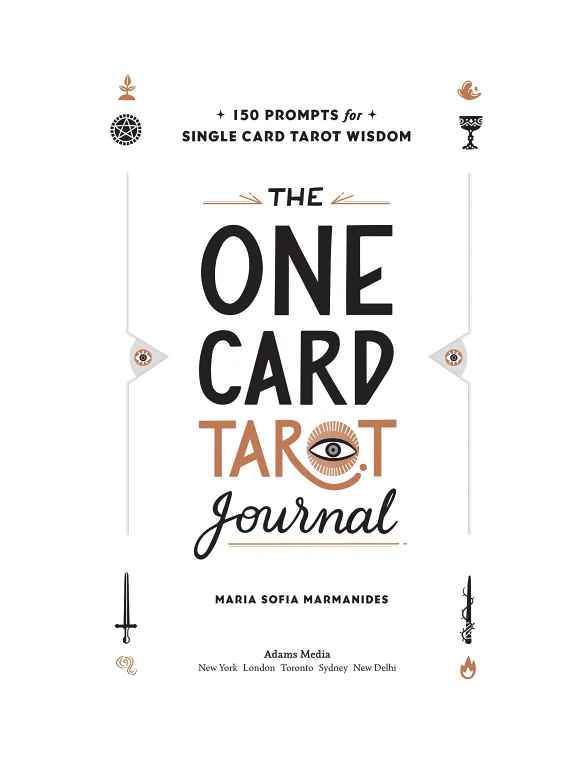
The One Card Tarot Journal
 76
76

The One Card Tarot Journal
Maria Sofia Marmanides’ The One Card Tarot Journal offers a refreshingly direct entry point into tarot for those who might feel intimidated by complex spreads. Its strength lies in its structured simplicity, providing clear guidance on conducting single-card readings and ample space for personal annotation. The inclusion of a reference for card meanings is a practical feature, though it necessarily offers condensed interpretations. I found the prompts to be generally effective, encouraging a reflective mindset. However, the journal's conciseness, while a benefit for accessibility, might leave advanced practitioners wanting more depth in the card meaning references or more varied interpretive frameworks. The layout is clean and functional, facilitating an easy ritualistic practice. It serves its purpose admirably as a tool for consistent, focused self-exploration through tarot.
📝 Description
76
Maria Sofia Marmanides' The One Card Tarot Journal, published in 2022, simplifies tarot practice to single card pulls.
This journal focuses on the practice of single tarot card readings, moving away from complex spreads. It provides a dedicated space for users to record their daily or situational divinations. The aim is to build a personal ritual that can foster spiritual awareness.
It is suited for those seeking a more direct way to engage with tarot. Beginners who might feel overwhelmed by multi-card layouts will find it accessible. Experienced practitioners can use it to sharpen their intuition through regular, concentrated use. Anyone wanting to establish a daily spiritual habit or employ tarot for self-examination will find it useful.
The One Card Tarot Journal is situated within a contemporary revival of divination practices, particularly tarot, for personal insight. While tarot originated in 15th-century Europe, its use for psychological and spiritual guidance expanded significantly in the late 20th century. This work draws on that tradition by emphasizing focused inquiry through single cards, encouraging a consistent practice that transforms card pulling into a moment of introspection.
💡 Why Read This Book?
• You will learn to establish a consistent spiritual ritual by dedicating space for daily one-card pulls, as Marmanides guides you to create a personal practice centered around the 2022 publication. • You will gain confidence in interpreting tarot by focusing on single card meanings, a method introduced by the author to simplify the learning curve from the 1909 Waite-Smith deck. • You will develop a deeper self-awareness through structured reflection, using the journal's specific prompts to explore the insights offered by each card pull.
⭐ Reader Reviews
Honest opinions from readers who have explored this book.
❓ Frequently Asked Questions
What is the primary purpose of The One Card Tarot Journal?
The journal's main goal is to facilitate a personal spiritual practice by simplifying tarot readings. It encourages users to record and reflect on single-card pulls, fostering introspection and a consistent ritual.
Who is Maria Sofia Marmanides, the author?
Maria Sofia Marmanides is the author of The One Card Tarot Journal, first published in 2022. She focuses on making esoteric practices accessible and actionable for personal growth.
How does this journal differ from other tarot resources?
It specifically focuses on the practice of one-card pulls, offering a streamlined approach. Unlike comprehensive tarot encyclopedias, it emphasizes personal journaling and ritual creation around simple readings.
What is a 'one card pull' in tarot?
A one-card pull is a tarot technique where only a single card is drawn from the deck to answer a question or provide a focus for the day. It's often used for quick insights or daily guidance.
When was The One Card Tarot Journal first published?
The One Card Tarot Journal was first published on April 5, 2022, making it a contemporary resource for modern spiritual practices.
Does the journal explain how to read tarot cards?
Yes, the journal includes an explanation of how to conduct a one-card pull and provides a reference for each card’s meaning, alongside space for personal reflections and interpretations.
🔮 Key Themes & Symbolism
Focused Divination
The journal champions the efficacy of single-card readings as a potent tool for divination and self-reflection. It posits that by concentrating on one card, practitioners can achieve deeper, more nuanced understanding than by attempting to interpret complex spreads prematurely. This approach encourages mindful engagement with each card's archetypal energies and symbolic language, transforming a simple draw into a profound personal dialogue.
Ritual Creation
A central theme is the establishment of a personal spiritual ritual. The journal provides the structure and space necessary to cultivate a consistent practice, turning the act of pulling and reflecting on a tarot card into a sacred, recurring event. This ritualistic approach aims to anchor spiritual inquiry within the user's daily life, fostering discipline and a deeper connection to their inner wisdom.
Intuitive Development
By focusing on one card at a time and providing guided prompts, the journal aims to enhance intuitive abilities. It encourages users to move beyond rote memorization of card meanings and instead develop a personal relationship with the imagery and symbolism of the tarot. This process of active reflection and annotation cultivates a more intuitive understanding of the cards and their messages.
Accessible Esotericism
Marmanides' work democratizes tarot practice by offering a simplified entry point. It explains the esoteric by breaking down the process into manageable steps, making the wisdom of the tarot accessible to a wider audience. The journal serves as a practical guide for those new to tarot or seeking a less intimidating way to engage with its insights.
💬 Memorable Quotes
Direct passages from the work, attributed to the author.
“Record and reflect on your tarot readings with The One Card Tarot Journal and create a wonderful ritual for your spiritual practice.”
— This statement captures the dual purpose of the journal: to serve as a repository for tarot insights and to actively foster the development of a meaningful spiritual ritual through consistent engagement.
“Looking for some answers? Let tarot be your guide.”
— This offers a direct invitation to the reader, positioning tarot not just as a divination tool but as a supportive guide for seeking clarity and answers to life's questions.
“The One Card Tarot Journal unlocks the power of the deck by opening up the practice with simplified yet insightful one cad pulls.”
— This suggests that the journal's strength lies in its ability to reveal the inherent power within the tarot deck by making its practice more accessible and understandable through focused, single-card readings.
“By first explaining how to conduct a one card pull and including a reference for each card’s meaning, this journal then provides prompts for your own single card pull and gives you space”
— This section of the blurb details the journal's pedagogical approach: it equips readers with foundational knowledge of one-card pulls and card meanings before guiding them through personal application with prompts and writing space.
💡 Key Ideas
Editorial paraphrase of the work's core concepts — not direct quotes.
By first explaining how to conduct a one card pull and including a reference for each card’s meaning, this journal then provides prompts for your own single card pull and gives you space
This passage highlights the journal's foundational structure: it educates on the technique of single-card pulls, offers interpretive guidance, and crucially, provides dedicated space for personal recording and reflection, emphasizing practical application.
🌙 Esoteric Significance
Tradition
This journal operates within the broad spectrum of modern Western esotericism, drawing implicitly from the divinatory lineage established by the Rider-Waite-Smith tradition originating around 1909. It departs from more complex Kabbalistic or Hermetic systems by offering a simplified, practical application focused on personal reflection rather than elaborate magical theory or ritual. Its lineage is more akin to popular occultism and New Age spirituality, emphasizing accessibility and individual guidance.
Symbolism
The primary symbols are the tarot cards themselves, each imbued with archetypal imagery. The 'One Card Pull' acts as a symbolic focus, representing a singular point of inquiry or a concentrated dose of wisdom. The journal's blank pages serve as a symbolic space for the user's subconscious to project meaning, acting as a mirror for internal states and external influences.
Modern Relevance
Contemporary practitioners of mindfulness, self-help, and beginner-level tarot enthusiasts often draw upon resources like Marmanides' journal. It appeals to modern spiritual seekers who prioritize personal experience and actionable guidance over dogmatic adherence to ancient traditions. Its focus on ritual and journaling aligns with current trends in digital wellness and personal development apps.
👥 Who Should Read This Book
• Novice tarot enthusiasts seeking a straightforward method to begin their practice without feeling overwhelmed by complex spreads or extensive memorization. • Individuals interested in establishing a daily spiritual or mindfulness ritual that incorporates self-reflection and intuitive guidance through simple, focused inquiry. • Experienced practitioners looking for a dedicated space to log and analyze single-card readings, fostering a deeper, more consistent connection with their tarot deck.
📜 Historical Context
Maria Sofia Marmanides' The One Card Tarot Journal (2022) enters a contemporary landscape shaped by a renewed interest in esoteric practices, particularly evident since the late 20th century. This resurgence builds upon foundations laid by figures like A.E. Waite and Pamela Colman Smith, whose iconic Rider-Waite-Smith deck, first published in 1909, became a standard for modern tarot interpretation. Marmanides' work aligns with a broader cultural movement towards personal spirituality and self-help, often diverging from earlier, more formal occult traditions. While academic occultism and ceremonial magic were prominent in the early 20th century, often debated by scholars like Aleister Crowley, the late 20th and early 21st centuries saw a democratization and personalization of these practices. This journal reflects that shift, focusing on accessible tools for individual introspection rather than adherence to specific magical orders or complex philosophical systems. Its publication in 2022 places it within a digital age where online communities and readily available resources further fuel engagement with divination.
📔 Journal Prompts
Your daily card’s core message for navigating today.
The central challenge presented by this card.
A practical action inspired by the card’s symbolism.
How the card’s energy manifests in your current situation.
The hidden opportunity revealed by this single pull.
🗂️ Glossary
One Card Pull
A tarot reading technique where only a single card is drawn from the deck to provide a focused answer, insight, or daily theme.
Tarot Deck
A collection of 78 cards, typically divided into the Major Arcana and Minor Arcana, used for divination, self-reflection, and spiritual guidance.
Major Arcana
The 22 trump cards of the tarot deck, representing significant life events, archetypal figures, and major spiritual lessons.
Minor Arcana
The 56 cards of the tarot deck, divided into four suits (Wands, Cups, Swords, Pentacles), representing everyday experiences, challenges, and situations.
Divination
The practice of seeking knowledge of the future or the unknown by supernatural means, often using tools like tarot cards, astrology, or runes.
Archetype
A universal, archaic symbol, image, or pattern of thought derived from the collective unconscious and appearing in art, literature, and mythology.
Spiritual Practice
A set of activities or disciplines undertaken to cultivate spiritual growth, inner peace, or a deeper connection to oneself or a higher power.
This book appears in 1 collection
🔮 Readers Also Liked
Browse all →









From the “Minor Arcana” Collection
View all →








More Free Occult Philosophy Books
View all →