The Tarot Wayfinder: Building clarity, compassion and awareness through the cards
 76
76

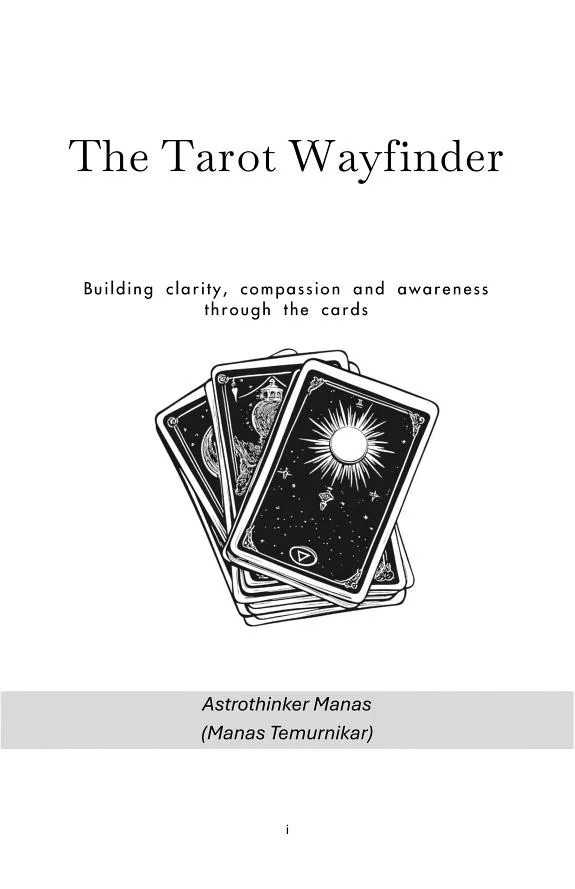
The Tarot Wayfinder: Building clarity, compassion and awareness through the cards
Astrothinker Manas’s *The Tarot Wayfinder* eschews the common sensationalism of tarot as a mere predictive device. Instead, it positions the cards as introspective tools, akin to mirrors reflecting the querent’s inner landscape. This approach prioritizes self-awareness and intuitive development over divination. The work’s strength lies in its consistent focus on the present moment, encouraging a dialogue between the reader and the archetypal imagery of the tarot. A minor limitation is the author’s occasional reliance on esoteric jargon without extensive foundational explanation, which might briefly challenge newcomers to the field. However, the section detailing the 'Shadow aspect of the Fool' offers a particularly compelling reinterpretation, moving beyond simplistic interpretations of this foundational card. Ultimately, *The Tarot Wayfinder* serves as a valuable guide for those seeking personal growth through symbolic understanding.
📝 Description
76
Manas Temurnikar's The Tarot Wayfinder was published in 2023.
This book presents a structured approach to using tarot cards for personal growth. It guides readers through understanding the symbolism and archetypes within the tarot deck. The author focuses on developing intuition and self-awareness by applying card meanings to everyday situations. Readers learn practical methods for gaining clarity on challenges and fostering compassion for themselves and others. The text encourages a consistent tarot practice as a tool for mindful living.
The Tarot Wayfinder engages with the Western esoteric tradition of tarot as a spiritual and psychological tool. It draws from the lineage that views the cards not merely as a divinatory device, but as a mirror for the soul and a map of consciousness. This perspective aligns with movements that integrate tarot into personal development and self-understanding, moving beyond simple fortune telling towards a more introspective application of the cards' wisdom.
💡 Why Read This Book?
• Understand your present moment with greater clarity by learning to interpret tarot cards not as fortune-telling tools, but as reflective mirrors, a concept explored extensively in the early chapters. • Cultivate your intuition and inner wisdom by engaging with the archetypal language of the tarot, as demonstrated through exercises related to the Major Arcana. • Develop self-compassion and awareness by viewing tarot readings as a dialogue with your subconscious, a core tenet emphasized throughout the book's practical applications.
⭐ Reader Reviews
Honest opinions from readers who have explored this book.
❓ Frequently Asked Questions
What is the primary aim of 'The Tarot Wayfinder'?
The book's primary aim is to shift the perception of tarot from a predictive tool to one that fosters clarity, compassion, and self-awareness by acting as a mirror to the present.
Is 'The Tarot Wayfinder' suitable for beginners?
Yes, the book is designed for those new to tarot or seeking a deeper, more introspective approach. It moves beyond basic card meanings to explore personal application.
When was 'The Tarot Wayfinder' first published?
The first publication date for 'The Tarot Wayfinder' is October 7, 2025.
What does the author mean by tarot cards as 'gentle mirrors'?
This metaphor suggests that tarot cards don't dictate the future but reflect the user's current inner state, thoughts, and feelings, aiding in self-discovery.
Does the book focus on predicting the future?
No, the book explicitly states it is not about predicting the future but about understanding the present and trusting one's intuition.
Who is the author of 'The Tarot Wayfinder'?
The author is Astrothinker Manas (Manas Temurnikar).
🔮 Key Themes & Symbolism
Tarot as Self-Reflection
This theme recontextualizes the tarot from a divinatory system to a sophisticated psychological and spiritual tool. The work emphasizes that each card, from the Fool to the World, can serve as a reflective surface, revealing aspects of the user's current emotional and mental state. It’s about engaging in a dialogue with the archetypal imagery, prompting introspection rather than seeking external predictions. This approach encourages users to trust their intuition and subjective responses to the cards, fostering a deeper connection with their inner world and guiding personal development.
Intuitive Development
A core tenet of 'The Tarot Wayfinder' is the cultivation of intuition. The book guides readers to move beyond memorized meanings and instead to listen to the subtle whispers and personal associations that arise when engaging with the cards. This process involves developing a more refined sensitivity to symbolic language and internal guidance. By consistently practicing this intuitive engagement, users are encouraged to build confidence in their inner knowing, seeing it as a reliable compass for navigating life's challenges and opportunities.
The Present Moment Focus
Rather than dwelling on past grievances or future anxieties, this work champions an intense focus on the present. The tarot is presented as a means to anchor oneself in the 'now,' understanding current circumstances and internal dynamics with greater precision. This present-moment awareness is framed as the foundation for genuine understanding and compassionate self-action. By clear the immediate range of the psyche, the book helps readers to respond more effectively to their current reality, fostering a sense of agency and presence.
Compassion and Awareness
The title itself highlights two crucial outcomes: compassion and awareness. The Tarot Wayfinder posits that by looking at oneself through the lens of the cards with an attitude of non-judgment, one can foster deep self-compassion. This empathetic understanding of one's own patterns and struggles is presented as a pathway to greater emotional intelligence and holistic awareness. The journey through the cards becomes a practice in self-acceptance, leading to a more balanced and integrated sense of self.
💬 Memorable Quotes
Direct passages from the work, attributed to the author.
“The cards stop being “fortune-telling tools” and start becoming gentle mirrors.”
— This statement expresses the book's central thesis: a radical reorientation of the tarot's purpose from external prediction to internal self-exploration and insight.
“It’s about understanding your present, trusting your intuition, and learning to listen to the quiet wisdom within.”
— This highlights the practical application of the tarot as a tool for self-awareness, emphasizing present-moment understanding and the development of inner guidance.
“Interpreting the cards becomes a dialogue with your own subconscious.”
— This suggests that the process of tarot reading is not passive receiving of information but an active, interactive engagement with one's own deeper psychological layers.
“Each card holds a potential lesson for your current path.”
— This frames the tarot as a pedagogical tool, where every card encountered can offer specific, relevant wisdom applicable to the individual's immediate life circumstances.
“The goal is not to know the future, but to know yourself more fully.”
— This directly contrasts the book's approach with traditional divination, prioritizing self-knowledge and personal growth over precognitive abilities.
🌙 Esoteric Significance
Tradition
The work draws from a modern esoteric tradition that synthesizes psychological archetypes, particularly influenced by Carl Jung's theories, with the symbolic language of the Rider-Waite-Smith tarot deck. While not strictly adhering to a single lineage like Hermeticism or Kabbalah, it engages with the archetypal currents that underpin many Western esoteric systems. It departs from traditional divination by prioritizing introspection and self-awareness, aligning more with esoteric psychology than predictive magic.
Symbolism
Central symbols include the 'Fool's Shadow,' reinterpreting the archetype of new beginnings as also containing elements of fear and unconscious potential. The concept of the tarot deck itself functions as a symbol of the human psyche's journey, with each card representing a stage or aspect of this process. The 'mirror' metaphor is crucial, symbolizing the tarot's function in reflecting the user's inner world, facilitating self-recognition and understanding.
Modern Relevance
This book speaks directly to contemporary practitioners of Jungian analysis, transpersonal psychology, and modern witchcraft who seek practical, non-dogmatic tools for self-exploration. It speaks to those interested in the intersection of spirituality and psychology, finding echoes in the work of contemporary authors who explore archetypes and consciousness. The emphasis on intuitive development is also relevant to current trends in mindfulness and embodied spiritual practices.
👥 Who Should Read This Book
• Aspiring tarot enthusiasts seeking to move beyond basic meanings and develop a more profound, personal relationship with the cards. • Individuals interested in Jungian psychology and archetypal studies looking for practical applications of symbolic interpretation in daily life. • Seekers of personal growth and self-awareness who are open to exploring introspective tools that foster compassion and intuitive understanding.
📜 Historical Context
Published in 2025, *The Tarot Wayfinder* emerges in an era where esoteric studies have seen a resurgence, often blending Jungian psychology with traditional occult frameworks. This period follows decades where tarot was largely relegated to the fringes or viewed through a purely predictive lens, a perception challenged by figures like Rachel Pollack in the late 20th century who advocated for its psychological depth. Manas Temurnikar's work aligns with a contemporary movement that seeks to clarify the tarot, making it accessible as a tool for personal development rather than arcane prophecy. The book's approach stands apart from the more rigid, dogmatic interpretations found in older grimoires or the popular, often superficial, online tarot culture of the 2010s. Its emphasis on self-awareness and compassion reflects a broader societal interest in mindfulness and emotional intelligence, integrating esoteric practices with secular wellness trends.
📔 Journal Prompts
Reflect on the 'mirror' quality of the Three of Swords in your current emotional landscape.
Explore the 'Shadow aspect of the Fool' within your own recent experiences.
How does the concept of 'listening to quiet wisdom' apply to your interpretation of the Hierophant?
Consider the present moment awareness highlighted by the Ace of Cups in your life.
What self-compassion is revealed by the imagery of the Ten of Pentacles?
🗂️ Glossary
Archetype
Universal, archaic patterns and images that derive from the collective unconscious and are the psychic counterpart of the instincts. In tarot, these are often represented by the Major Arcana figures.
Querent
The person for whom a tarot reading is performed. In this context, the querent is also the primary interpreter of the cards' reflections.
Intuition
The ability to understand something immediately, without the need for conscious reasoning. The book encourages developing this faculty through tarot engagement.
Divination
The practice of seeking knowledge of the future or the unknown by supernatural means. This book reorients tarot away from this traditional application.
Inner Wisdom
The inherent knowledge or guidance residing within an individual, often accessed through introspection and intuition, which the tarot is used to uncover.
Major Arcana
The set of 22 trump cards in a tarot deck, typically depicting significant life lessons, spiritual archetypes, and major life events or phases.
Rider-Waite-Smith Deck
A widely influential tarot deck first published in 1909, known for its allegorical illustrations with strong symbolism, often serving as a basis for modern interpretations.
This book appears in 1 collection
🔮 Readers Also Liked
Browse all →


From the “Minor Arcana” Collection
View all →

More Free Occult Philosophy Books
View all →