The Night Is Watching
 76
76

The Night Is Watching
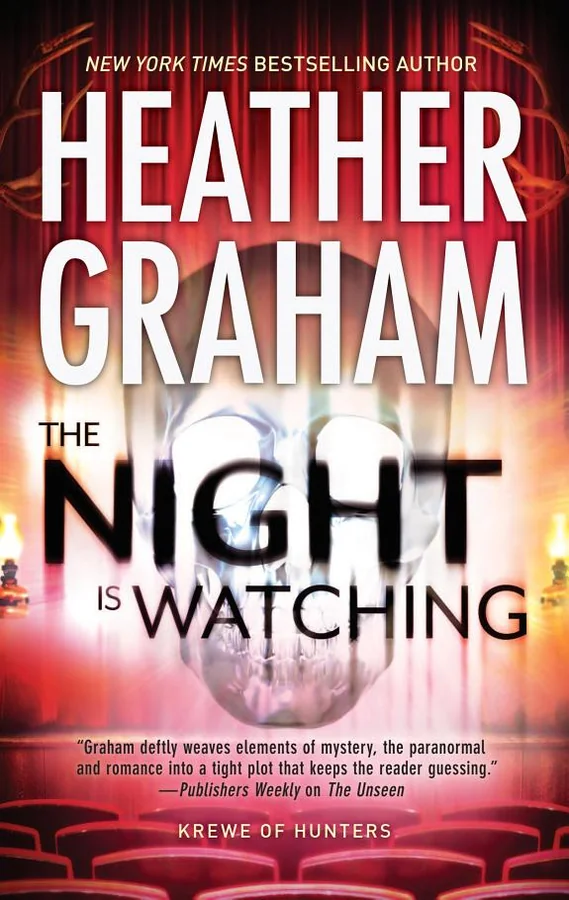
Heather Graham's The Night Is Watching attempts to blend classic ghost story tropes with a police procedural, centered on a grisly discovery at the Gilded Lily theater. The premise, involving Sheriff Sloan Trent and paranormal investigator Jane Everett, promises a compelling clash of skepticism and belief. Graham excels at creating atmospheric settings; the theater itself feels alive with spectral potential. However, the pacing occasionally falters, with the romantic subplot sometimes overshadowing the central mystery. A particularly intriguing element is the integration of historical records concerning the theater's past, which hints at the spectral manifestations. While the resolution provides closure on the criminal aspect, the paranormal threads feel somewhat underdeveloped by the conclusion. The work provides a serviceable entry into the paranormal mystery subgenre.
📝 Description
76
In 2013, Heather Graham published The Night Is Watching, centering on a Gilded Lily theater.
The Night Is Watching follows Sheriff Sloan Trent and paranormal investigator Jane Everett as they look into a disturbing discovery at the historic Gilded Lily theater. A human skull found on the premises leads them to investigate both a potential haunting and a crime from decades past.
The story contrasts the pragmatic approach of law enforcement with the beliefs of those who accept the supernatural. The Gilded Lily theater itself, with its history and grandeur, becomes a focal point for lingering spirits and unresolved events. Graham uses such locations to explore how past tragedies can manifest in the present.
The investigation probes whether spectral activity is the actual cause of disturbances or a cover for a more earthly crime. This blending of a criminal investigation with supernatural elements is a core aspect of the novel's suspense.
This novel situates itself within the tradition of ghost stories that connect spectral phenomena to specific historical locations and past traumas. It taps into the idea that places can retain psychic impressions of significant events, leading to hauntings. The narrative explores how these lingering energies might interact with or even influence ongoing criminal activities, blurring the lines between the physical and the spectral planes.
💡 Why Read This Book?
• Learn how historical trauma can manifest as present-day hauntings, as seen in the spectral activity surrounding the Gilded Lily theater's past. • Understand the challenges of investigating crimes when paranormal phenomena are involved, mirroring Sheriff Sloan Trent's dual investigation. • Experience the atmospheric tension of a classic haunted location, exploring how the theater's history fuels the mystery.
⭐ Reader Reviews
Honest opinions from readers who have explored this book.
❓ Frequently Asked Questions
What is the main setting for Heather Graham's 'The Night Is Watching'?
The primary setting is the historic Gilded Lily theater, a location steeped in history that becomes the focal point for a murder investigation and suspected paranormal activity.
Who are the main characters investigating the mystery in 'The Night Is Watching'?
The investigation is led by Sheriff Sloan Trent, a pragmatic law enforcement officer, and Jane Everett, a paranormal investigator from the Krewe of Hunters.
What initiates the investigation in 'The Night Is Watching'?
The discovery of a human skull on the grounds of the Gilded Lily theater serves as the catalyst for the investigation into both a potential crime and a haunting.
What genre does 'The Night Is Watching' fall into?
The novel is classified as paranormal mystery and romantic suspense, blending elements of crime investigation with supernatural occurrences.
When was 'The Night Is Watching' first published?
Heather Graham's 'The Night Is Watching' was first published on May 28, 2013.
Does 'The Night Is Watching' involve romance?
Yes, the book incorporates romantic suspense elements, developing a relationship between Sheriff Sloan Trent and paranormal investigator Jane Everett amidst the mystery.
🔮 Key Themes & Symbolism
Haunting and History
The narrative explores how past tragedies and unresolved events can leave energetic imprints on locations, leading to spectral manifestations. The Gilded Lily theater serves as a potent example, its history fueling the paranormal occurrences. This theme examines the concept of residual hauntings, where the environment itself seems to replay moments of intense emotion or violence, making the theater a character in its own right.
Skepticism vs. Belief
A central dynamic is the interplay between Sheriff Sloan Trent's grounded, logical approach to crime-solving and Jane Everett's acceptance of supernatural explanations. Their differing perspectives create tension but also lead to a more comprehensive investigation, forcing both characters to confront possibilities beyond their initial understanding. This theme examines how belief systems shape our perception of reality and evidence.
The Intersection of Crime and the Supernatural
The book posits that paranormal activity might be directly linked to criminal acts, either as a consequence or a clue. The investigation into the discovered skull forces the protagonists to consider if a ghost is responsible or if a human perpetrator is using the legend of the haunting as a cover. This theme questions the boundaries between the physical and metaphysical realms in solving mysteries.
The Power of Place
Certain locations, particularly those with a rich and often dramatic history like the Gilded Lily theater, are portrayed as holding a unique energy. This energy can influence events and people, both living and deceased. The novel suggests that understanding the history and atmosphere of a place is crucial to unraveling its mysteries, be they criminal or spiritual.
💬 Memorable Quotes
Direct passages from the work, attributed to the author.
“A human skull found on the Gilded Lily theater grounds.”
— This stark discovery serves as the inciting incident, immediately blending a gruesome crime scene with the inherently dramatic and potentially haunted setting of an old theater.
“Sheriff Sloan Trent must work with Krewe of Hunters investigator Jane Everett.”
— This highlights the core investigative pairing: a pragmatic lawman and a paranormal expert, setting up a dynamic of contrasting methods and beliefs.
“The investigation seeks to uncover what is going on at the historic Gilded Lily theater.”
— This frames the central conflict, suggesting a mystery that transcends a simple criminal case, involving the location's history and potential spectral activity.
“The narrative explores the connection between past events and present hauntings.”
— This points to the thematic core: how history imprints itself on places and people, manifesting as supernatural phenomena that complicate a contemporary investigation.
“Jane Everett brings a unique perspective on the unseen.”
— This emphasizes the role of the paranormal investigator and her specialized knowledge, contrasting with the more conventional approach of Sheriff Trent.
🌙 Esoteric Significance
Tradition
While not strictly an esoteric text in the vein of Hermeticism or Gnosticism, 'The Night Is Watching' draws upon folklore and popular conceptions of hauntings and spiritual residue. It engages with the idea that intense human emotions and events can leave energetic imprints on physical locations, a concept explored in various spiritualist and parapsychological traditions. The book reflects a modern, narrative-driven engagement with these ideas, making them accessible to a broader audience.
Symbolism
The Gilded Lily theater itself functions as a potent symbol, representing a place where past performances, dramas, and possibly tragedies linger. The discovery of a human skull is a direct confrontation with mortality and the unresolved past, symbolizing secrets that refuse to stay buried. Jane Everett's role as a paranormal investigator can symbolize the human drive to understand and reconcile with the unseen forces or lingering energies that shape our world.
Modern Relevance
Works like 'The Night Is Watching' contribute to the ongoing popularization of paranormal investigation and the concept of haunted locations in contemporary culture. They feed into the interest seen in shows like 'Ghost Hunters' and the continued exploration of psychogeography and the energetic imprints of history. For readers interested in how folklore and spiritualist ideas are translated into modern storytelling, this book offers a contemporary example.
👥 Who Should Read This Book
• Readers interested in paranormal mysteries who enjoy a blend of suspense and romance, particularly those drawn to haunted locations and historical settings. • Fans of Heather Graham's previous works, especially her Krewe of Hunters series, seeking more investigations into the supernatural. • Individuals curious about how crime fiction can incorporate elements of ghost stories and spiritualist concepts into a compelling narrative.
📜 Historical Context
Published in 2013, The Night Is Watching emerged during a period when paranormal romance and supernatural thrillers were highly popular. Heather Graham, already an established author in these genres, tapped into the enduring public fascination with ghosts, haunted places, and historical mysteries. The Gilded Lily theater, as a setting, evokes the allure of early 20th-century entertainment venues, a time when vaudeville and silent films captivated audiences, often accompanied by their own backstage lore and urban legends. Contemporary authors like Anne Rice (in her earlier works exploring gothic themes) and Kelley Armstrong (known for her urban fantasy series) were also exploring supernatural elements within crime and mystery frameworks, though often with different focuses. While not overtly tied to a specific intellectual movement, Graham's work reflects the broader cultural interest in the liminal spaces between the known and the unknown, the historical and the spectral.
📔 Journal Prompts
The spectral echoes within the Gilded Lily theater.
Sheriff Trent's initial skepticism versus Jane Everett's intuition.
The symbolic weight of a discovered human skull in a historic theater.
How past events are presented as influencing present-day phenomena.
The narrative tension between criminal investigation and paranormal investigation.
🗂️ Glossary
Krewe of Hunters
A fictional paranormal investigation unit featured in Heather Graham's series of novels. Members are tasked with solving crimes that have a supernatural element.
Gilded Lily theater
The primary setting of the novel, a historic theater that serves as the focal point for both the criminal investigation and the suspected haunting.
Paranormal Investigator
An individual who studies or investigates phenomena that are believed to be outside the scope of normal scientific understanding, such as ghosts or hauntings.
Residual Haunting
A type of haunting where past events are believed to be imprinted on a location, replaying themselves under certain conditions, rather than being an interactive spirit.
Sheriff Sloan Trent
The local law enforcement official responsible for investigating the crime at the Gilded Lily theater, initially skeptical of paranormal explanations.
Jane Everett
A paranormal investigator from the Krewe of Hunters who partners with Sheriff Trent, bringing expertise in supernatural phenomena.
Romantic Suspense
A genre that combines elements of romance and suspense, where a developing romantic relationship is interwoven with a mystery or thriller plot.
This book appears in 1 collection
🔮 Readers Also Liked
Browse all →








From the “Haunted Places” Collection
View all →






More Free Occult Philosophy Books
View all →