The mysteries of Britain

 82
82

The mysteries of Britain
Lewis Spence’s 1928 survey, 'The Mysteries of Britain,' presents a panoramic, if sometimes unfocused, view of the occult strata beneath British history. Spence’s strength lies in his sheer breadth of research, cataloging everything from druidic survivals to alleged psychic phenomena associated with ancient sites. He meticulously details folklore, legend, and obscure historical accounts with an earnestness that was characteristic of early 20th-century esoteric scholarship. However, the work's ambition sometimes outstrips its critical rigor; Spence frequently engages in speculative leaps, connecting disparate traditions without always establishing firm evidential links. A particular passage discussing the supposed magical properties of the Isle of Avalon, for instance, highlights his tendency to blend myth with speculative history. Despite its limitations, the book remains a valuable resource for its comprehensive compilation of esoteric beliefs concerning Britain. Spence’s work offers a fascinating glimpse into a particular moment of esoteric inquiry into national identity and ancient lore.
📝 Description
82
Lewis Spence published 'The Mysteries of Britain' in 1928, examining Britain's esoteric and folkloric past.
Lewis Spence's 1928 book, 'The Mysteries of Britain,' investigates the hidden currents of myth and folklore beneath the surface of British history. Spence gathered evidence from classical writers, bardic poetry, and archaeological finds to show how ancient belief systems continued to shape the land and its stories. He looked at how older spiritual ideas influenced British legends and national identity.
This book is for readers interested in folklore, mythology, and Western esotericism who want to look beyond standard historical accounts. Those curious about the origins of Arthurian tales, Celtic myths, and the lasting effects of pre-Christian beliefs will find valuable material. Spence attempts to connect various strands of British lore into a single, if speculative, narrative.
Published in 1928, Spence's work appeared during a time of keen interest in occultism and ancient cultures, influenced by figures like Helena Blavatsky and groups such as the Hermetic Order of the Golden Dawn. The book coincided with advances in archaeology and anthropology, as Spence tried to bring together diverse elements of British lore. This era also saw widespread fascination with Druidism, ancient mysteries, and psychic phenomena, creating a receptive environment for Spence's broad research.
💡 Why Read This Book?
• Understand the enduring influence of pre-Christian belief systems on British identity, as Spence details the survival of pagan motifs in medieval romances and later folk practices. • Explore the symbolic significance of ancient British megaliths like Stonehenge, examining Spence's interpretations of their ritualistic and astronomical purposes. • Discover how Lewis Spence connected Arthurian legend to older mythological cycles, providing specific examples of how figures like Merlin might be rooted in druidic traditions.
⭐ Reader Reviews
Honest opinions from readers who have explored this book.
❓ Frequently Asked Questions
What specific ancient sites does Lewis Spence discuss in 'The Mysteries of Britain'?
Lewis Spence extensively discusses numerous ancient British sites, including Stonehenge, Avebury, and Glastonbury Tor. He interprets these locations not just as archaeological remnants but as centers of ancient ritual and potent spiritual energy.
Does the book offer insights into Celtic mythology?
Yes, 'The Mysteries of Britain' provides significant coverage of Celtic mythology, exploring the pantheon of Celtic deities, their associated myths, and their potential influence on later British folklore and spiritual traditions.
When was 'The Mysteries of Britain' originally published?
The book was first published in 1928, placing it within a period of burgeoning interest in folklore, mythology, and esoteric studies in the early 20th century.
What is Lewis Spence's approach to Arthurian legends?
Spence approaches Arthurian legends by seeking their roots in older British mythology and pre-Christian spiritual practices. He suggests that figures like King Arthur and Merlin may have symbolic or historical connections to druidic lore and ancient heroes.
Does Spence discuss Druidism in detail?
Yes, Druidism is a central theme. Spence examines the historical and mythological aspects of Druidism, exploring its potential role as a repository of ancient British wisdom and its perceived connection to magic and nature worship.
Is 'The Mysteries of Britain' considered a scholarly work?
While Spence drew on a wide range of sources, his methodology often involved speculative interpretation rather than strict academic proof. It is best viewed as an important work of esoteric scholarship and folklore compilation from its era.
🔮 Key Themes & Symbolism
Druidic Survival and Knowledge
Spence posits that the practices and wisdom of the ancient Druids did not entirely vanish but persisted in various forms through British history. He examines potential connections between Druidic rituals, their understanding of nature, and the folklore that emerged centuries later. The work explores how Druidic symbolism and their perceived role as keepers of esoteric knowledge might have influenced later esoteric traditions and popular beliefs about ancient Britain, suggesting a continuity of spiritual practice.
The Sacred Landscape
A significant theme is the inherent magical and spiritual power attributed to the British landscape, particularly its ancient megalithic sites like Stonehenge and Avebury. Spence treats these structures not merely as historical artifacts but as focal points of ancient worship, astronomical observation, and ritualistic energy. He investigates local legends and folklore associated with these places, interpreting them as traces of their original sacred purpose and ongoing spiritual significance.
Arthurian Mythology as Esoteric Echo
The book reinterprets the Arthurian legends, suggesting they are not purely historical accounts but rather veils for older mythological cycles and esoteric traditions. Spence explores how figures like Merlin, Arthur, and the concept of Avalon might be symbolic representations or continuations of pre-Christian deities, heroes, and sacred sites. He seeks to uncover the hidden layers of meaning within these tales, linking them to a deeper, ancient British spiritual heritage.
Pre-Christian Deities and Folk Memory
Spence investigates the theory that many figures in British folklore and local legends are transformations or survivals of ancient pre-Christian deities. He traces how these deities may have been syncretized with Christian saints or transformed into supernatural beings in the folk imagination. The work examines how the worship and myths surrounding these older gods continued to exert an influence on the cultural and spiritual consciousness of the British Isles.
💬 Memorable Quotes
Direct passages from the work, attributed to the author.
“The ancient Britons were deeply steeped in a magical lore.”
— This statement expresses Spence's core thesis: that the inhabitants of ancient Britain possessed a sophisticated understanding and practice of magic, which he sought to reconstruct through folklore and mythology.
“Arthurian romance is but a later guise for older mythological cycles.”
— Here, Spence articulates his belief that the popular tales of King Arthur are not original but derivative, serving as a more recent expression of far more ancient British myths and spiritual narratives.
“The memory of pagan gods persists in the guise of fairy folk.”
— This concept, explored by Spence, suggests that many beings from folklore, such as fairies and local spirits, are actually transformed remnants of ancient pagan deities whose worship faded but whose essence remained in popular imagination.
“Britain possesses a hidden current of esoteric tradition.”
— This idea, central to Spence's work, proposes that beyond mainstream history and religion, there exists a continuous, often concealed, stream of mystical knowledge and practice within Britain that he endeavors to reveal.
💡 Key Ideas
Editorial paraphrase of the work's core concepts — not direct quotes.
Megalithic monuments were not merely tombs but places of spiritual communion.
This paraphrase highlights Spence's view of ancient stone circles and structures, suggesting they served vital religious and communal functions beyond mere burial sites, acting as centers for interaction with the spiritual realm.
🌙 Esoteric Significance
Tradition
Spence's work draws heavily from a broad, syncretic Western esoteric tradition, incorporating elements often associated with Hermeticism, Celtic Revivalism, and Theosophical interpretations of ancient cultures. It fits within the lineage of scholars attempting to uncover a primordial, universal spiritual wisdom, specifically applied to the British Isles. He sought to identify a unique British esoteric current, distinct from but related to broader European mystical currents, emphasizing nature-based spirituality and ancient priesthoods like the Druids.
Symbolism
Key symbols include the megalithic structures like Stonehenge, interpreted as astronomical and ritualistic centers reflecting cosmic order. The Oak Tree and mistletoe are central to his understanding of Druidic symbolism, representing life, regeneration, and sacred knowledge. The figure of Merlin is also highly symbolic, representing the archetype of the wise magician, seer, and bridge between the ancient world and the emerging Christian era.
Modern Relevance
Contemporary practitioners of Neo-Druidism and various nature-based spiritual paths often reference Spence's work for its detailed exploration of ancient British beliefs and practices. Modern folklore studies and comparative mythology also engage with Spence's compilations, even if critically, as a historical document of esoteric thought. His attempt to link landscape, myth, and magic continues to inspire those seeking a deeper connection to the spiritual heritage of Britain.
👥 Who Should Read This Book
• Students of Western Esotericism interested in the specific application of esoteric principles to British history and mythology. • Folklore enthusiasts and amateur historians seeking a comprehensive overview of ancient British myths, legends, and supposed magical practices. • Individuals drawn to Arthurian lore and Celtic traditions looking for interpretations that connect these narratives to deeper, older spiritual roots.
📜 Historical Context
Published in 1928, 'The Mysteries of Britain' emerged during a vibrant period for occult and folkloric studies. The early 20th century saw continued interest in Theosophy, spiritualism, and the rediscovery of ancient European traditions, fueled by figures like Sir Arthur Conan Doyle and the public fascination with Arthurian legend. Spence’s work engaged with contemporary anthropological and archaeological findings, attempting to synthesize them with older mythological interpretations. It appeared in the shadow of earlier comprehensive works on British folklore and mythology, such as those by Charlotte Sophia Burne. While not facing overt censorship, its speculative nature placed it outside mainstream academic archaeology and history, positioning it firmly within the esoteric and popular antiquarian movements of the era.
📔 Journal Prompts
The perceived magical lore of the ancient Britons: what enduring qualities might it possess?
Reflect on the symbolic meaning of megalithic sites like Stonehenge beyond their archaeological function.
How might the figure of Merlin serve as a conduit for understanding the transition from pagan to Christian Britain?
Consider the persistence of pre-Christian deities in modern folklore, perhaps disguised as fairy folk.
Analyze the concept of a hidden esoteric tradition within Britain as presented by Spence.
🗂️ Glossary
Druid
Priests, scholars, and spiritual leaders of ancient Celtic societies. Spence explores their role as custodians of esoteric knowledge, their connection to nature worship, and their possible magical practices.
Megalith
Large prehistoric stone structures, such as those found at Stonehenge and Avebury. Spence interprets these as sites of ancient ritual, astronomical observation, and spiritual significance.
Arthurian Romance
Medieval literary genre featuring tales of King Arthur and his knights. Spence views these romances as later adaptations and symbolic expressions of much older British mythological cycles.
Esotericism
Belief systems and practices focusing on hidden knowledge or spiritual truths, often accessible only to initiates. Spence applies this lens to understanding ancient British beliefs.
Folk Memory
The collective, often unconscious, remembrance of ancient beliefs, myths, and deities within a culture's folklore. Spence argues this 'memory' preserves aspects of pre-Christian spirituality.
Syncretism
The merging or blending of different religious beliefs, myths, or practices. Spence suggests this occurred as Christianity spread through Britain, absorbing elements of older pagan traditions.
Bard
A poet, traditionally one reciting epics and associated with Celtic societies. Spence references their role in preserving ancient lore and mythology.
🔮 Readers Also Liked
Browse all →![CIA Reading Room cia-rdp75-00149r000200590003-6: PROTECTING [PRIVACY AND FREEDOM]](/img/thumb/cia-reading-room-cia-rdp75-00149r000200590003-6-protecting-privacy-and-freedom-cia-reading-room.webp)






More by Lewis Spence
All books →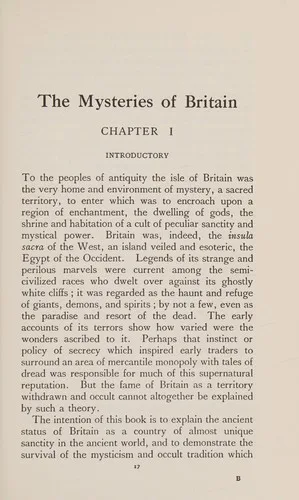





More Free Witchcraft & Paganism Books
View all →