Lectures on the religion of the Semites

 74
74

Lectures on the religion of the Semites
W. Robertson Smith’s Lectures on the Religion of the Semites remains a formidable, if sometimes challenging, cornerstone of religious studies. Its strength lies in Smith’s audacious proposition that religion is fundamentally a social phenomenon, with ritual and sacrifice acting as the glue binding communities to their deities and to each other. The rigorous application of anthropological and historical methods, especially in analyzing pre-Islamic Arabia and ancient Israel, offers a compelling alternative to purely theological readings. A notable limitation, however, is the sometimes dense prose and the sheer volume of ethnographic detail, which can occasionally obscure the overarching arguments for contemporary readers. The discussion on the nature of sacrifice, particularly its role in establishing kinship with the divine, presents a particularly impactful conceptual challenge to conventional interpretations of religious obligation. Despite its age, Smith’s work continues to provoke essential questions about the origins and function of religious life.
This is a vital, albeit demanding, scholarly work for understanding ancient religious structures.
📝 Description
74
W. Robertson Smith's Lectures on the Religion of the Semites, published in 1889, argued ritual preceded dogma.
Originally delivered as lectures, W. Robertson Smith's Lectures on the Religion of the Semites systematically examines the religious practices, beliefs, and social structures of Semitic peoples, including Hebrews, Canaanites, and Arabs. Smith's work challenged prevailing notions by linking religious practices to social organization. He argued that ritual preceded dogma and that sacrifice played a central role in community bonding. Published during a period of intense intellectual ferment in Victorian England, Smith's work emerged amidst burgeoning anthropological and historical-critical methods. It engaged directly with the historical-critical biblical scholarship that was reshaping understandings of scripture. Smith's lectures introduce several key concepts for understanding ancient religion, emphasizing the primacy of communal worship and sacrifice. He suggests that shared ritual meals and offerings were central to social cohesion.
While not strictly an esoteric text in the occult sense, Smith's work engaged with the burgeoning historical-critical methods of the late 19th century. This approach sought to understand ancient religious traditions through their social and historical contexts, rather than solely through theological interpretation. His focus on the practical, communal aspects of religion, and his argument for ritual's precedence over creed, offered a secularizing lens that was controversial for its time. This method of demythologizing sacred practices aligns with broader trends in comparative religion that sought rational explanations for ancient beliefs.
💡 Why Read This Book?
• Gain insight into the concept of communal sacrifice as a foundational social act, as explored in Smith’s detailed analysis of Semitic rituals, moving beyond purely individualistic interpretations of religious devotion. • Understand the historical-critical method applied to religious texts and practices, exemplified by Smith's examination of the ancient Hebrews and their religious development in the late 19th century. • Appreciate the link between religious observance and social cohesion, a central argument Smith develops by analyzing tribal cults and the role of the "god of the tribe" in ancient Semitic societies.
⭐ Reader Reviews
Honest opinions from readers who have explored this book.
❓ Frequently Asked Questions
What is the main thesis of W. Robertson Smith's Lectures on the Religion of the Semites?
Smith's central thesis posits that religion, particularly in ancient Semitic societies, was primarily a social phenomenon. He argued that communal ritual and sacrifice were more fundamental than abstract belief, serving to strengthen social bonds and establish relationships with the divine.
When was Lectures on the Religion of the Semites first published?
The first edition of W. Robertson Smith's Lectures on the Religion of the Semites was published in 1889, following his earlier controversial work on biblical history and criticism.
Which ancient peoples does Smith's work primarily focus on?
Smith's lectures concentrate on the religions of various Semitic peoples, including the ancient Hebrews, Canaanites, and pre-Islamic Arabs, examining their shared religious customs and beliefs.
What was the significance of sacrifice in Smith's analysis?
According to Smith, sacrifice was not merely an offering but a critical act of communion. It served to reinforce the bond between the community and its deity, often involving communal meals that solidified social solidarity.
Did Smith's work face any controversy?
Yes, W. Robertson Smith's scholarly approach, particularly his historical-critical interpretations of biblical texts, led to significant controversy. He faced heresy charges from the University of Cambridge prior to the full publication of these lectures.
How does Smith connect religion to social structure?
Smith argues that religious practices are deeply intertwined with social organization. He suggests that the worship of a 'god of the tribe' reflected and reinforced the community's identity and structure, with rituals serving to maintain social order.
🔮 Key Themes & Symbolism
Ritual Precedes Dogma
A central tenet of Smith's argument is that religious practice, particularly communal ritual and sacrifice, predates and shapes theological doctrine. He posits that shared acts of worship were the primary means by which ancient Semitic communities understood and interacted with their deities. This perspective challenges the notion that religious belief is solely an intellectual or spiritual pursuit, instead grounding it in tangible, social action. The book meticulously examines various sacrificial rites to demonstrate how these communal acts fostered social cohesion and established the framework for religious understanding before the articulation of formal creeds.
Sacrifice as Social Glue
Smith's analysis places immense importance on sacrifice as a mechanism for social bonding and community formation. He describes how shared sacrificial meals and offerings created a sense of kinship, not only among humans but also between the community and its patron deity, the 'god of the tribe'. This act of communion reinforced the collective identity and interdependence of the group. The book details how different forms of sacrifice, from votive offerings to peace-offerings, served distinct but related social functions, binding individuals to their kin, their tribe, and their divine protector.
The 'God of the Tribe'
This concept highlights the deeply personal and communal relationship ancient Semitic peoples had with their deities. The 'god of the tribe' was not an abstract universal deity but a protector and patron intrinsically linked to the specific community's welfare and identity. Smith explores how the worship of such deities reinforced tribal structures and social hierarchies. The book examines the evolution of these tribal cults, suggesting how they formed the basis for later developments in religious thought, including the eventual emergence of monotheistic conceptions.
Evolution of Religious Law
Smith's work also traces the development of religious law and its relationship to evolving social and religious structures. He observed how customs and practices, initially rooted in ritual and social obligation, gradually became codified into religious law. This evolution reflects broader societal changes, including the transition from nomadic to settled life and the increasing complexity of social organization. The book analyzes how legal prescriptions, often tied to purity, sacrifice, and communal participation, helped to maintain order and continuity within Semitic societies over centuries.
💬 Memorable Quotes
Direct passages from the work, attributed to the author.
“The religion of a primitive people is thus a tribal affair, and the god is the patron of the tribe.”
— This statement expresses Smith's view that ancient Semitic religion was fundamentally communal and localized. The deity was not a universal force but a protector and benefactor specifically tied to the identity and well-being of a particular tribe or kinship group.
“Sacrifice was the most important of all the religious acts, as it was the means by which the community renewed its covenant with its god.”
— This interpretation emphasizes the central role of sacrifice in Smith's theory. It was not simply an offering but a vital mechanism for maintaining and strengthening the relationship between the people and their deity, ensuring continued divine favor and protection.
“The worship of the tribe was inseparably connected with the worship of the family.”
— This observation points to the hierarchical structure of religious observance Smith identified. Family cults were integral components of broader tribal worship, demonstrating how religious devotion was embedded within the fundamental social unit of kinship.
“The history of religion is the history of the development of the community.”
— This concise summary reflects Smith's sociological approach. He viewed the evolution of religious ideas and practices as intrinsically linked to the changing nature and organization of human communities over time.
💡 Key Ideas
Editorial paraphrase of the work's core concepts — not direct quotes.
The ritual of the Semites was not a mere echo of their beliefs, but often the very source from which their beliefs sprung.
This paraphrase highlights Smith's core argument that religious practice, especially ritual and sacrifice, was primary. It suggests that the actions and ceremonies performed by the community shaped their understanding and conceptualization of the divine, rather than beliefs dictating rituals.
🌙 Esoteric Significance
Tradition
While not explicitly an esoteric text in the Hermetic or Kabbalistic sense, Smith's work holds significance for certain branches of Western esotericism by providing a scholarly, albeit secular, framework for understanding ancient religious origins. It aligns with traditions that seek deeper, often hidden, meanings in religious practices, viewing them as expressions of fundamental human psychology or social needs rather than solely divine revelation. The focus on ritual, sacrifice, and the communal nature of divinity appeals to practitioners interested in reconstructive paganism or the archetypal dimensions of religion.
Symbolism
Smith’s work implicitly analyzes symbols embedded within Semitic religious practices. The act of sacrifice itself functions as a potent symbol of covenant, communion, and the cyclical nature of life and death. The communal meal following a sacrifice symbolizes social unity and shared destiny with the divine. Furthermore, the concept of the 'god of the tribe' symbolizes the immanent, localized power that protects and defines a community, representing a tangible connection between the spiritual and the earthly realms.
Modern Relevance
Contemporary scholars of religion, anthropology, and sociology of religion continue to engage with Smith's foundational theories, particularly his emphasis on the social function of ritual and sacrifice. Thinkers in fields like ritual studies, comparative religion, and even certain strands of modern paganism draw upon his analyses of ancient Near Eastern cults. His work provides a crucial historical perspective for understanding the academic study of religion and continues to inform discussions on the relationship between religious belief, social structure, and communal identity.
👥 Who Should Read This Book
• Scholars and students of comparative religion and ancient Near Eastern history seeking a foundational text that analyzes the social underpinnings of early religious practices. • Anthropologists interested in the relationship between ritual, social structure, and belief systems, particularly in pre-modern societies. • Individuals exploring the historical-critical methods applied to religious texts and traditions, offering a perspective from the late 19th century intellectual landscape.
📜 Historical Context
W. Robertson Smith’s *Lectures on the Religion of the Semites*, first published in 1889, emerged from a milieu of intense scholarly debate surrounding biblical criticism and the origins of religion. The late 19th century saw the rise of comparative mythology and anthropology, challenging traditional theological interpretations. Smith himself was a controversial figure, having faced heresy charges from the University of Cambridge in 1879 due to his critical approach to scripture, a period that undoubtedly influenced his later work. His approach was deeply informed by the functionalist theories of anthropology, emphasizing the social role of religious practices. He engaged with contemporaries like Julius Wellhausen, whose documentary hypothesis reshaped Old Testament scholarship. Smith’s work stood in stark contrast to prevailing Victorian religious orthodoxy, offering a naturalistic and sociological explanation for ancient religious phenomena, which drew both praise for its rigor and criticism for its perceived secularism.
📔 Journal Prompts
The concept of the 'god of the tribe' and its relation to communal identity.
Reflect on the implications of ritual actions shaping religious belief, as described by Smith.
Analyze the social function of sacrifice in ancient Semitic societies.
Consider the historical context of 1889 and its impact on the study of religion.
Examine how Smith's linking of religion and social structure challenges conventional views.
🗂️ Glossary
Semitic Peoples
A linguistic and cultural grouping of peoples originating in the ancient Near East, encompassing groups such as ancient Hebrews, Canaanites, Arameans, and Arabs, who spoke Semitic languages.
Tribal Cult
A form of religious practice centered around the worship of a deity specifically associated with and protective of a particular tribe or kinship group.
Sacrifice
In the context of Smith's work, an offering made to a deity, often involving the killing of an animal, intended to establish or renew a relationship, express devotion, or seek favor.
Communal Meal
A meal shared by members of a community, often following a sacrifice, symbolizing fellowship, social cohesion, and shared participation in the divine covenant.
Historical-Critical Method
An academic approach used to study religious texts and history, involving critical analysis of sources, historical context, and authorship to understand their development and meaning.
Dogma
A principle or set of principles laid down by an authority as incontrovertibly true; a doctrine, especially one relating to a religious belief.
Votive Offering
An offering made in fulfillment of a vow or pledge, typically presented to a deity in exchange for a favor or in thanksgiving.
🔮 Readers Also Liked
Browse all →









More by W. Robertson Smith
All books →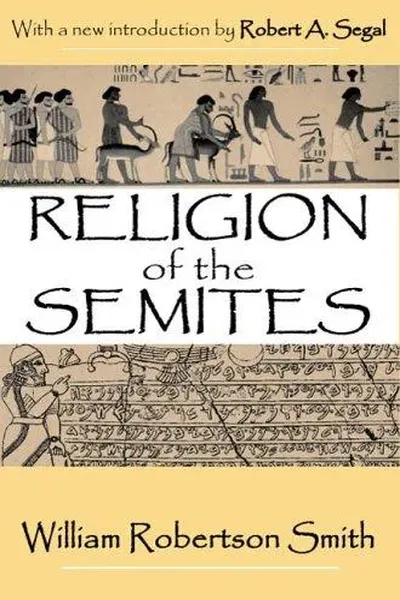
More Free Witchcraft & Paganism Books
View all →