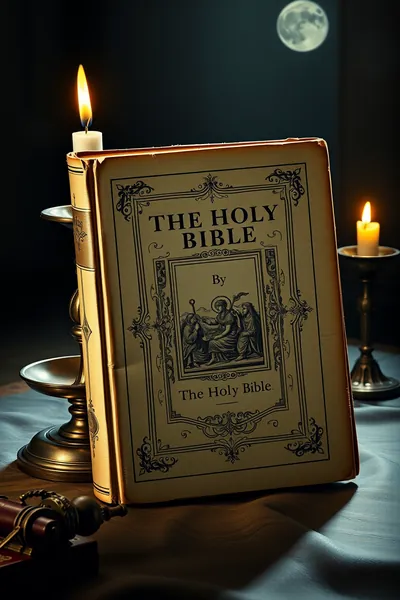
The Mountain That Blinked. Biblical Prophecy. Future Foretold in Scriptures

 77
77

The Mountain That Blinked. Biblical Prophecy. Future Foretold in Scriptures
Steven Doornbos's *The Mountain That Blinked* takes a familiar subject—biblical prophecy—and injects it with a jolt of modern urgency. The central conceit, a mountain emitting timed pulses that mirror the "silence in heaven" from Revelation's seventh seal, is a potent hook. This isn't just abstract exegesis; it's prophecy made manifest through what appears to be a geological anomaly. The work's strength lies in its direct, almost journalistic approach to connecting scriptural text with a concrete, contemporary phenomenon. However, the narrative occasionally falters by leaning too heavily on the premise without fully exploring the implications for human agency or the broader theological landscape beyond apocalyptic timelines. The passage describing the scientific community's initial dismissal of the mountain's signals, only to be confounded by their perfect, thirty-minute periodicity, is particularly effective in highlighting the book's core tension. Doornbos presents a compelling argument for re-examining prophecy as a potentially observable, rather than merely historical, event.
📝 Description
77
Steven Doornbos's 2023 book links a glowing mountain to Revelation's seventh seal.
The Mountain That Blinked argues that biblical prophecy is not a relic of the past but an active, unfolding phenomenon. Steven Doornbos focuses on a mountain that emits regular light pulses, a geological event initially dismissed by science. The precise timing of these pulses, however, corresponds directly to the "silence in heaven about the space of half an hour" mentioned in Revelation chapter 8. This alignment suggests a tangible, modern manifestation of end-times prophecy.
Doornbos's work appeals to those interested in eschatology, comparative religion, and the intersection of scientific observation and spiritual interpretation. It is particularly relevant for readers who examine biblical texts from unconventional viewpoints or seek to connect prophetic scriptures with current global events. The book also offers material for individuals fascinated by potential signs of the apocalypse, or for those who find significance in patterns and synchronicity across different eras.
This book enters a tradition of biblical interpretation that seeks direct correlation between scriptural predictions and observable reality. Such interpretations have a history stretching from medieval millenarianism to 19th-century prophetic movements. Doornbos revisits the concept of visible signs accompanying eschatological events, a theme present in late antiquity and revived during periods like the Reformation. Unlike purely theological analyses, his work integrates geological observation with scriptural timelines.
💡 Why Read This Book?
• Gain a new perspective on biblical prophecy by examining how contemporary natural phenomena, like the "mountain emitting strange pulses," might align with ancient scriptural predictions. • Understand the historical tension between scientific explanation and prophetic interpretation, as explored through the initial reactions to the mountain's signals. • Explore the concept of "future foretold" as a potentially observable reality, prompting reflection on the Book of Revelation's "seventh seal" in a modern context.
⭐ Reader Reviews
Honest opinions from readers who have explored this book.
❓ Frequently Asked Questions
What specific biblical prophecy does 'The Mountain That Blinked' focus on?
The book centers on the prophecy found in the Book of Revelation, specifically referencing the "seventh seal" and the "silence in heaven about the space of half an hour."
What is the main event described in 'The Mountain That Blinked'?
The core event is a remote mountain beginning to emit precise, regular pulses of light every thirty minutes, which are then identified as matching the timing of a biblical prophecy.
When was 'The Mountain That Blinked' first published?
The book by Steven Doornbos was first published on March 17, 2026.
What scientific explanation is initially proposed for the mountain's pulses?
Scientists initially believe the pulses are a geological anomaly, a natural phenomenon related to the mountain's structure or activity.
How does the book connect the mountain's pulses to prophecy?
The connection is made through the precise timing of the pulses—every thirty minutes—which mirrors the duration of the "silence in heaven" mentioned in Revelation when the seventh seal is opened.
What is the author's name for 'The Mountain That Blinked'?
The author of 'The Mountain That Blinked' is Steven Doornbos.
🔮 Key Themes & Symbolism
Observable Prophecy
This theme re-frames biblical prophecy from abstract prediction to a tangible, observable event. The "mountain emitting strange pulses" serves as the nexus, where geological anomaly intersects with divine timing. The work challenges readers to consider if prophetic signs are meant to be seen and measured, moving beyond mere historical interpretation to active observation of the present moment. It posits that the precise, thirty-minute intervals of the light pulses are not coincidental but a direct, empirical manifestation of scriptural passages, particularly the "seventh seal" from the Book of Revelation.
Synchronicity of Signs
The book explores the profound synchronicity between natural phenomena and ancient prophetic texts. It suggests that the universe might be operating on a schedule that directly correlates with divine pronouncements. The "mountain that blinked" becomes a symbol of this cosmic alignment, where scientific observation reveals patterns that echo spiritual decrees. This theme invites contemplation on whether these alignments are mere coincidences or deliberate signposts, urging a re-evaluation of how we perceive and interpret anomalies in the natural world through a prophetic lens.
The Seventh Seal Manifest
Central to the narrative is the interpretation of the "seventh seal" from the Book of Revelation. The book posits that the "silence in heaven about the space of half an hour" is not a metaphorical pause but a literal, timed event. The mountain's regular, thirty-minute pulses are presented as the earthly echo or precursor to this heavenly silence. This interpretation challenges traditional eschatological timelines by suggesting that the opening of seals might be marked by discernible, measurable occurrences that signal the progression towards future events foretold in scripture.
Skepticism vs. Revelation
This theme examines the inevitable conflict between scientific rationalism and the acceptance of prophetic phenomena. When the mountain begins its rhythmic pulsing, the initial scientific response is to categorize it as a geological anomaly. However, the uncanny precision of the timing forces a confrontation with the possibility of supernatural or prophetic influence. The book highlights how established paradigms can resist evidence that doesn't fit, creating a tension between observable fact and ingrained skepticism, particularly when those facts seem to confirm ancient prophecies.
💬 Memorable Quotes
Direct passages from the work, attributed to the author.
“"And when He had opened the seventh seal, there was silence in heaven about the space of half an hour."”
— This direct quote from Revelation 6:1 serves as the foundational prophetic text. The book's premise hinges on finding an observable, earthly parallel to this heavenly silence, suggesting the prophecy is not merely symbolic but tied to timed events.
“The pulses were too precise. Every thirty minutes. Perfectly timed.”
— This highlights the scientific observation that moves beyond dismissing the phenomenon as random. The regularity and precision are key elements that lead to the connection with prophecy, suggesting an intelligent, deliberate source rather than a natural anomaly.
“What if the events of Biblical prophecy suddenly began... today?”
— This is the central speculative question posed by the book. It shifts the focus of prophecy from a distant future or past to an immediate, present-day unfolding, urging readers to consider current events as potential fulfillments of ancient predictions.
“At first scientists believe it is a geological anomaly.”
— This reflects the initial, rationalistic response to the unexplained phenomenon. It sets up the conflict between scientific skepticism and the eventual, startling realization that the anomaly might signify something far more profound and foretold.
“And suddenly the world realizes some...”
— This is an incomplete sentence from the blurb, implying a dramatic, world-altering realization. It suggests that the discovery connecting the mountain's pulses to prophecy triggers a global understanding of prophecy's imminent relevance.
🌙 Esoteric Significance
Tradition
While not explicitly tied to a single esoteric lineage, *The Mountain That Blinked* engages with the Judeo-Christian prophetic tradition, a wellspring for many Western esoteric schools. Its focus on observable signs and celestial/earthly synchronicity echoes Hermetic principles of correspondence and the idea that "as above, so below." The book's premise of a hidden, divinely timed order manifesting in the physical world also appeals to Kabbalistic concepts of divine emanation and the unfolding of cosmic plans, albeit interpreted through an apocalyptic lens rather than mystical union.
Symbolism
The primary symbol is the 'mountain that blinked,' representing a point of intersection between the material world (geology) and the divine or prophetic realm. Its rhythmic pulsing symbolizes divine timing and the measurable unfolding of prophecy, directly referencing the 'half an hour' silence of the seventh seal. Another subtle symbol is 'silence in heaven,' which, when mirrored by earthly pulses, suggests a disruption or prelude to a significant cosmic event, a pause before a divine action or revelation.
Modern Relevance
Contemporary thinkers and practitioners in fields like comparative eschatology, spiritual emergence, and even certain fringe scientific communities might find resonance here. The work speaks to a modern fascination with unexplained phenomena and the search for meaning in a complex world, echoing trends seen in New Age thought and discussions around consciousness. The idea of prophecy as an observable, measurable event could appeal to those seeking empirical validation for spiritual concepts or seeking to understand current global events through a lens of cosmic significance.
👥 Who Should Read This Book
• Students of eschatology and biblical prophecy seeking contemporary interpretations of end-times texts. • Readers interested in the intersection of science, spirituality, and unexplained phenomena, particularly those intrigued by geological anomalies with potential symbolic meaning. • Individuals who engage with comparative religion and are curious about how ancient prophecies might manifest in observable, modern events.
📜 Historical Context
Published in 2026, *The Mountain That Blinked* arrives in an era saturated with information and rapidly evolving technological capabilities, yet still prone to anxieties about global futures. It revisits the historical tradition of prophetic interpretation that has ebbed and flowed for centuries, particularly gaining traction during periods of societal upheaval. Thinkers from Joachim of Fiore in the 12th century, who proposed historical epochs tied to divine plans, to early 20th-century figures like Hal Lindsey, who popularized apocalyptic scenarios, have sought to decode signs of the end times. Doornbos's work diverges by introducing a concrete, potentially observable natural phenomenon—the pulsing mountain—as a focal point, moving beyond purely textual exegesis. This places it in conversation with contemporary scientific discourse on geology and atmospheric phenomena, while simultaneously engaging with a readership historically drawn to millenarian thought and the search for divine order within current events.
📔 Journal Prompts
The mountain's precise thirty-minute pulses: what modern synchronicity does this echo for you?
Reflect on the initial scientific dismissal of the mountain's signals versus the eventual realization of prophetic alignment.
Consider the symbolism of a 'mountain that blinked' within your own understanding of spiritual or natural signs.
How does the concept of the "seventh seal" manifest in your personal or global perspective?
Explore the tension between observable phenomena and ingrained skepticism when confronting the potentially prophetic.
🗂️ Glossary
Seventh Seal
A passage in the Book of Revelation (6:1) describing a period of silence in heaven following the opening of the seventh seal by Jesus Christ, often interpreted as a significant moment before divine judgment or revelation.
Biblical Prophecy
Predictions or declarations concerning future events purportedly revealed by divine inspiration, found within the scriptures of various religions, particularly prominent in the Old and New Testaments.
Geological Anomaly
A feature or event related to the Earth's structure or processes that deviates significantly from the norm or expected geological behavior, often studied by scientists.
Eschatology
The branch of theology concerned with the final destiny of the soul and of humankind, including beliefs about the end of the world, judgment, and the afterlife.
Synchronicity
The experience of two or more events that are apparently causally unrelated or unlikely to occur together by chance, yet are perceived as occurring meaningfully together. Coined by Carl Jung.
Future Foretold
The concept that events of the future have already been determined or predicted, often through divine revelation, prophecy, or other mystical means.
Apocalypse
In religious contexts, often refers to a revelation or prophecy concerning the end of the world and the ultimate destiny of humanity, frequently involving dramatic events and divine intervention.
This book appears in 1 collection
🔮 Readers Also Liked
Browse all →








From the “Biblical Prophecy” Collection
View all →







More Free Sacred Texts & Gnosticism Books
View all →