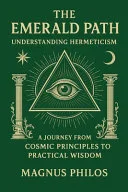
The Emerald Path
 73
73

The Emerald Path
Magnus Philos’s *The Emerald Path* attempts to reintroduce the reader to the core Hermetic doctrines, particularly those found in the writings attributed to Hermes Trismegistus. The book’s strength lies in its clear articulation of foundational concepts like the All and the principle of correspondence. Philos avoids overly academic jargon, making the material accessible. However, the work occasionally feels more like a commentary on existing interpretations than a direct engagement with the primary texts. The section discussing the 'Divine Mind' is particularly illustrative, offering a comprehensible entry point into complex Gnostic and Hermetic ideas. A limitation is the lack of engagement with critical scholarship regarding the historical dating of the Hermetic texts, presenting them with a degree of unquestioned antiquity. Ultimately, *The Emerald Path* serves as a competent, though not groundbreaking, primer on Hermetic thought for the uninitiated.
📝 Description
73
Magnus Philos's The Emerald Path, published in 2025, illuminates Hermeticism's core principles.
Magnus Philos's 2025 book, The Emerald Path, examines Hermeticism not as a relic but as a vital tradition that fuses philosophy, religion, and what the author calls 'divine science.' The work guides readers through the essential teachings attributed to Hermes Trismegistus. It is written for those seeking a deeper grasp of Western esotericism, including students of Hermeticism, alchemical practitioners, and individuals interested in comparative spirituality. A basic interest in philosophical thought and abstract ideas is recommended.
The book engages with the historical roots of Hermeticism, which began in Hellenistic Egypt with foundational texts like the Corpus Hermeticum and the Emerald Tablet. These writings, attributed to Hermes Trismegistus, combined Greek philosophy and Egyptian religion. The tradition saw significant revivals, influencing Renaissance figures such as Marsilio Ficino and Giordano Bruno. Its impact extended to later esoteric groups like the Rosicrucians and Freemasons. Philos's study acknowledges this long historical thread.
Hermeticism originated in Hellenistic Egypt, drawing from the philosophical syntheses found in the Corpus Hermeticum and the Emerald Tablet, attributed to Hermes Trismegistus. This tradition merges Greek philosophical concepts with Egyptian religious thought. Its influence resurfaced prominently during the Renaissance, affecting thinkers like Ficino and Bruno, and subsequently shaped movements such as Rosicrucianism and Freemasonry. Magnus Philos's The Emerald Path situates itself within this historical and intellectual lineage, connecting its teachings to this enduring esoteric current.
💡 Why Read This Book?
• Gain a structured understanding of Hermeticism’s core principles, including the concept of 'As Above, So Below,' as presented in Chapter 3, which offers a departure from superficial New Age interpretations. • Grasp the historical significance of Hermes Trismegistus and the Hermetic tradition’s influence from Hellenistic Egypt through the Renaissance, as detailed in the historical context sections. • Explore the symbolic language of alchemy as a metaphor for spiritual development, a key theme discussed throughout the work, providing practical interpretive tools.
⭐ Reader Reviews
Honest opinions from readers who have explored this book.
❓ Frequently Asked Questions
What is the primary focus of The Emerald Path?
The book focuses on Hermeticism, presenting its philosophy, spirituality, and divine science as a unified truth derived from the teachings of Hermes Trismegistus.
When was The Emerald Path first published?
The Emerald Path was first published in 2025, making it a contemporary exploration of ancient Hermetic wisdom.
Who is Magnus Philos?
Magnus Philos is the author of The Emerald Path, a contemporary scholar or practitioner dedicated to elucidating esoteric traditions.
What does 'As Above, So Below' mean in Hermeticism?
This principle, central to Hermetic thought, suggests a fundamental correspondence between the microcosm (humanity, the Earth) and the macrocosm (the universe, the Divine).
Does the book discuss alchemy?
Yes, The Emerald Path explores the alchemical symbolism often used within Hermeticism to represent spiritual truths and processes of transformation.
Is this book suitable for beginners in esoteric studies?
Yes, the book aims to provide an accessible understanding of Hermeticism for those new to the subject, avoiding overly technical language where possible.
🔮 Key Themes & Symbolism
The Principle of Correspondence
Central to Hermetic philosophy is the concept of 'As Above, So Below.' The Emerald Path elaborates on this foundational tenet, illustrating how the macrocosmic order reflects within the microcosm of human consciousness and the material world. This principle serves as a key for understanding the interconnectedness of all things, suggesting that diligent observation of the outer world can reveal truths about inner states and vice versa. The book uses this to frame the entire Hermetic worldview.
Divine Mind and Creation
The work explores the Hermetic understanding of the 'All' or the Divine Mind as the ultimate source of existence. It posits that creation is an emanation from this singular, all-encompassing consciousness. The text guides the reader to contemplate this origin point, discussing how individual consciousness is a spark of this greater Mind. Understanding this concept is presented as crucial for spiritual awakening and aligning oneself with the cosmic order.
Spiritual Transformation and Gnosis
The Emerald Path frames Hermeticism as a path toward inner transformation and the attainment of gnosis, or direct spiritual knowledge. It discusses the soul's journey through various stages of purification and enlightenment. The book suggests that by applying Hermetic principles, individuals can transcend limitations and achieve a state of higher awareness, realizing their divine potential and connection to the One.
The Emerald Tablet's Legacy
While not solely focused on the Emerald Tablet, the book acknowledges its foundational importance within the Hermetic tradition. It discusses how the enigmatic verses of this ancient text encapsulate core Hermetic principles, including the unity of all things and the transformative power of divine science. The work interprets the Tablet as a symbolic map for the alchemical and spiritual seeker.
💬 Memorable Quotes
Direct passages from the work, attributed to the author.
“The All is Mind; the All is within the Mind.”
— This statement expresses the Hermetic view of a singular, conscious universe, positing that reality originates from and exists within a universal intelligence.
“What is known cannot be lost; what is understood becomes part of the soul.”
— This suggests that true knowledge, once integrated, leads to permanent spiritual growth and cannot be erased, emphasizing the transformative power of understanding.
“The path unfolds not through seeking outward, but through inward realization.”
— This highlights the introspective nature of spiritual development in Hermeticism, emphasizing self-discovery over external pursuits.
“To know the divine is to know oneself, for the spark of the divine resides within.”
— This expresses the Hermetic idea of the divine immanence, linking self-knowledge directly to the understanding of the ultimate source of all.
💡 Key Ideas
Editorial paraphrase of the work's core concepts — not direct quotes.
Every effect has its cause, and every cause its effect; thus all things are linked.
This paraphrases the principle of Cause and Effect, a core Hermetic law illustrating the intricate web of interconnectedness in the cosmos.
🌙 Esoteric Significance
Tradition
The Emerald Path firmly resides within the Western Esoteric tradition, specifically drawing from Hermeticism. It builds upon the philosophical and spiritual framework established by the Hermetic texts, which blend Gnostic, Neoplatonic, and alchemical elements. The work seeks to present these teachings in a manner that is both faithful to their historical roots and relevant to contemporary spiritual exploration, positioning itself as a guide to understanding the 'hidden light' within existence.
Symbolism
Key symbols explored include the Emerald Tablet itself, representing foundational wisdom and the principle of transformation. The concept of 'As Above, So Below' acts as a pervasive symbolic motif, illustrating the interconnectedness of cosmic planes. The text also likely examines alchemical symbols, such as the Ouroboros (representing unity and cyclical completion) and the Caduceus of Hermes (symbolizing balance, communication, and mediation between realms), interpreting them as metaphors for spiritual processes.
Modern Relevance
Contemporary thinkers and practitioners in fields like depth psychology, consciousness studies, and comparative religion find resonance in Hermeticism's holistic worldview. Schools of modern occultism and various meditation and self-awareness practices implicitly or explicitly draw upon Hermetic principles of mental discipline and universal correspondence. The Emerald Path contributes to this ongoing dialogue by offering a clear exposition of these enduring ideas for a new generation.
👥 Who Should Read This Book
• Students of Western Esotericism: Individuals seeking a foundational understanding of Hermetic philosophy, its history, and core tenets, presented in a clear and accessible manner. • Comparative Religion Scholars: Researchers interested in the syncretic origins of Hermeticism and its influence on Gnosticism, Neoplatonism, and later esoteric movements. • Spiritual Seekers: Those exploring paths of self-knowledge and inner transformation who are drawn to philosophical traditions that emphasize the unity of the cosmos and the divine spark within.
📜 Historical Context
The intellectual landscape into which *The Emerald Path* emerges is one deeply influenced by centuries of esoteric thought, tracing its roots to Hellenistic Egypt. The Hermetic tradition, primarily embodied in the Corpus Hermeticum and the enigmatic Emerald Tablet, synthesized Greek philosophy with Egyptian mysticism. Its resurgence during the Renaissance, championed by figures like Marsilio Ficino in the 15th century, profoundly impacted Western esotericism, Neoplatonism, and early scientific inquiry. Contemporaries like Giordano Bruno further developed Hermetic concepts, often facing significant opposition. While *The Emerald Path* (2025) is a modern text, it engages with this historical lineage, bridging ancient wisdom with contemporary seekers. It navigates a tradition that has historically coexisted with, and sometimes clashed with, dominant religious and philosophical paradigms, influencing movements from Rosicrucianism to modern occultism.
📔 Journal Prompts
The principle of 'As Above, So Below' implies macrocosmic-microcosmic links; what outer phenomenon currently mirrors an inner state for you?
Reflect on the concept of the 'Divine Mind' presented in The Emerald Path; how does this perspective alter your view of individual consciousness?
Consider the symbolic meaning of the Emerald Tablet as a map for transformation; what personal 'gold' are you seeking to refine?
Explore the idea of gnosis as presented in the book; what form of direct spiritual knowledge do you aspire to attain?
Contemplate the historical reach of Hermeticism; which Renaissance thinker's engagement with these ideas most intrigues you?
🗂️ Glossary
Hermeticism
A philosophical, religious, and esoteric tradition based on the purported teachings of Hermes Trismegistus, blending Greek philosophy with Egyptian mysticism and alchemy.
As Above, So Below
A fundamental Hermetic principle stating that the principles governing the cosmos (macrocosm) are reflected in the individual and the material world (microcosm).
Divine Science
In the context of Hermeticism, this refers to the understanding of the divine laws and principles that govern the universe, often seen as attainable through wisdom and spiritual insight.
Gnosis
From the Greek word for 'knowledge,' gnosis refers to spiritual or esoteric knowledge, particularly the intuitive understanding of divine mysteries and the true nature of reality.
Corpus Hermeticum
A collection of twenty-five Greek philosophical and religious works from the Hellenistic period, attributed to the legendary figure Hermes Trismegistus.
Macrocosm
The entirety of the universe or the cosmos, often contrasted with the microcosm.
Microcosm
The individual human being or the Earth, seen as a miniature representation of the universe (macrocosm).