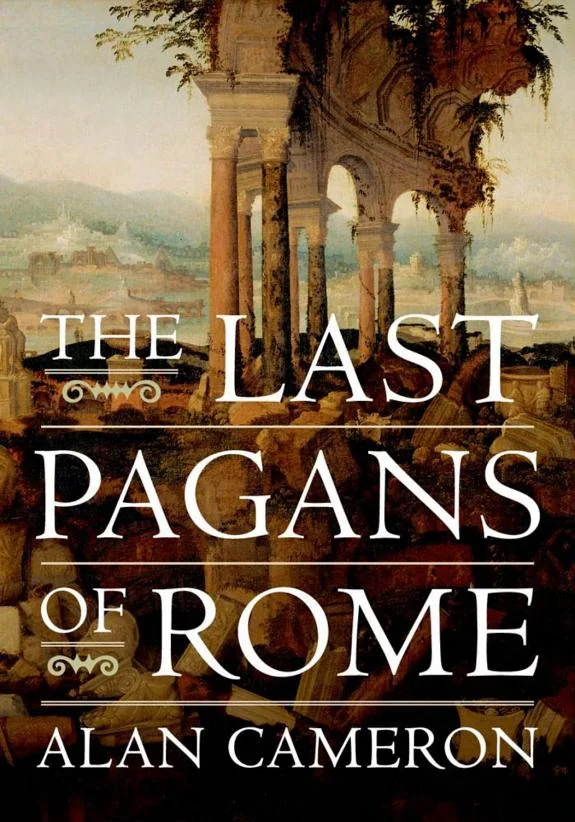
The Last Pagans of Rome
 77
77

The Last Pagans of Rome
Cameron’s meticulous examination of the late Roman pagan aristocracy offers a corrective to simplistic historical narratives. He demonstrates with compelling detail how classical traditions persisted not merely as remnants, but as active forces shaping the cultural landscape. A particular strength lies in his analysis of Rufinus’ account of the Battle of the Frigidus, revealing how Christian chroniclers themselves acknowledged the formidable pagan opposition. One limitation, however, is the dense academic prose which, while precise, may present a barrier for the non-specialist reader. The discussion of pagan literary circles and their patronage of classical texts, for instance, is illuminating but demands close attention. Ultimately, *The Last Pagans of Rome* provides a vital, scholarly perspective on a crucial transitional period.
📝 Description
77
Alan Cameron's 1990 book challenges the idea that Roman paganism vanished quickly.
Alan Cameron's *The Last Pagans of Rome* scrutinizes the continued presence and influence of Roman paganism in the late antique period. The book argues against a simple narrative of paganism's swift disappearance, presenting evidence that a vibrant pagan aristocracy actively shaped cultural and intellectual life well into the fifth century CE. Cameron moves beyond basic timelines to analyze the deliberate strategies employed by pagan elites to preserve their traditions as Christianity became dominant.
The late fourth and early fifth centuries CE marked a time of significant religious and political change in the Roman Empire. While decrees against paganism and events like the Battle of the Frigidus in 394 CE are often presented as decisive moments, Cameron suggests a more complex reality. The empire faced internal strife and external threats, creating a context where influential families and intellectual groups continued to practice and support pagan traditions, often discreetly. The work details concepts like 'pagan resilience,' showing how Roman elites adapted their ancestral cults through literary patronage, art that subtly honored older gods, and philosophical arguments for polytheism. Cameron also examines how the label 'pagan' itself shifted, frequently being applied by Christians to nonconformists rather than representing a unified self-identity.
This study situates itself within the historical study of Western pagan revivals by examining the tangible survival of pre-Christian beliefs and practices in the late Roman world. It offers a scholarly lens through which to understand the complex interplay of ancient belief systems and their persistence beyond official suppression. By detailing the strategies of pagan elites, the book illuminates how certain philosophies and cultic practices were maintained, providing historical context for later esoteric traditions that draw upon classical paganism.
💡 Why Read This Book?
• Learn how Roman paganism persisted beyond the 4th century CE, challenging the notion of a sudden Christian takeover, as detailed in the analysis of the aftermath of the Battle of the Frigidus (394 CE). • Understand the specific strategies pagan aristocrats employed, such as literary patronage and artistic propaganda, to maintain their traditions and influence in the face of increasing Christianization. • Gain insight into the complex evolution of religious identity in late antiquity, moving beyond a binary of pagan versus Christian to appreciate the spectrum of belief and practice that existed.
⭐ Reader Reviews
Honest opinions from readers who have explored this book.
❓ Frequently Asked Questions
What evidence does Alan Cameron present for the continued influence of paganism in 5th-century Rome?
Cameron highlights the patronage of pagan literary circles by Roman aristocrats, the continued commissioning of art with pagan themes, and the philosophical arguments defending polytheism, suggesting active cultural and intellectual engagement rather than mere survival.
How does *The Last Pagans of Rome* challenge traditional views of Christianity's triumph?
The book argues against a swift, decisive victory for Christianity by demonstrating the significant power and influence of a largely pagan aristocracy well into the 5th century, actively sponsoring and promoting their ancestral cults.
What was the significance of the Battle of the Frigidus in 394 CE according to the book?
While often seen as a final pagan defeat, Cameron's work uses Rufinus' account to illustrate the battle as a confrontation where the Eastern Emperor Theodosius faced a formidable pagan-supported usurper, Eugenius, highlighting the enduring strength of pagan forces.
Who were the primary patrons of pagan culture in the period discussed?
The book focuses on the largely pagan aristocracy in Rome and the Eastern Empire. These elites actively sponsored literary figures, artists, and scholars who continued to champion classical learning and pagan traditions.
Does the book discuss specific pagan deities or rituals?
While the focus is on the socio-political and intellectual persistence of paganism, the work implicitly refers to the cults and traditions patronized by the aristocracy, exploring the broader cultural framework within which specific deities and rituals were maintained.
What is the academic field of Alan Cameron's work?
Alan Cameron's *The Last Pagans of Rome* is situated within the academic fields of late antique studies, classical history, and the history of religion, offering a scholarly analysis of the transition from paganism to Christianity.
🔮 Key Themes & Symbolism
Pagan Resilience Strategies
This theme explores how Roman paganism adapted rather than vanished. Cameron details the sophisticated methods employed by the pagan aristocracy, including the strategic patronage of classical literature and the arts. This wasn't mere nostalgia; it was an active effort to maintain cultural hegemony and philosophical influence. The work examines how traditional cults and philosophical schools like Neoplatonism continued to offer a viable worldview, challenging the inevitability of Christian dominance and demonstrating a persistent, organized intellectual and cultural resistance.
The Shifting Definition of 'Pagan'
The book addresses how the term 'pagan' itself evolved, often becoming a Christian designation for those outside the faith rather than a unified self-identity. Cameron illustrates that individuals and groups might hold syncretic beliefs or simply resist Christian imposition without adhering to a singular pagan doctrine. This nuance is crucial for understanding the complex religious field of late antiquity, where boundaries were fluid and identities were negotiated amidst profound societal changes.
Literary and Artistic Patronage
A central focus is the role of elite patronage in sustaining pagan traditions. Cameron highlights how wealthy Roman families commissioned works of literature, philosophy, and art that subtly or overtly promoted classical values and pagan deities. This patronage served not only to preserve ancient culture but also as a form of propaganda, subtly countering Christian narratives and reinforcing the prestige of the old ways among the ruling classes well into the 5th century.
The Battle of the Frigidus as a Turning Point
Cameron re-examines Rufinus' account of the Battle of the Frigidus (394 CE) not as a definitive end to paganism, but as a stark illustration of its continued power. The confrontation between Theodosius and Eugenius, supported by significant pagan elements, demonstrates that the empire's religious future was far from settled. This event underscores the persistence of pagan military and political influence, even as Christianity gained official ascendancy.
💬 Memorable Quotes
Direct passages from the work, attributed to the author.
“A largely pagan aristocracy remained a powerful and active force well into the fifth century.”
— This statement expresses the core argument: paganism's end was not sudden. It posits that elite Romans actively sustained their traditions, influencing culture and politics, thus complicating the simple narrative of Christian triumph.
“Rufinus' vivid account... represents it as the final confrontation between paganism and Christianity.”
— The work uses this description of the Battle of the Frigidus to highlight how even Christian chroniclers recognized the significant pagan forces at play, suggesting paganism was a formidable power, not a defeated relic.
“Sponsoring pagan literary circles, patronage of the classics, and propaganda for the old cults in art and literature.”
— This phrase details the active methods used by pagan elites to maintain their influence. It points to concrete actions like funding writers and commissioning art that upheld traditional beliefs and aesthetics.
“The main focus of much modern scholarship...”
— The original blurb implies a critique of prior academic focus, suggesting that previous studies may have oversimplified the decline of paganism. This work aims to provide a more complex and nuanced understanding.
“The Eastern Emperor Theodosius and the Western usurper Eugenius by the River Frigidus in 394.”
— This specific historical event serves as a focal point for discussing the clash between established Christian authority (Theodosius) and a regime with significant pagan support (Eugenius), illustrating the ongoing religious tensions.
🌙 Esoteric Significance
Tradition
While not explicitly aligned with a single esoteric lineage like Hermeticism or Kabbalah, *The Last Pagans of Rome* appeals to traditions that value the preservation and understanding of pre-Christian European spiritual and philosophical systems. It speaks to the broader esoteric interest in the survival of ancient wisdom, particularly the philosophical underpinnings of Roman paganism and its intellectual currents, offering historical context for later revivals.
Symbolism
The book implicitly engages with symbols of Roman paganism by discussing their continued patronage in art and literature. While specific symbols like the eagle standard or representations of Jupiter might not be exhaustively analyzed for esoteric meaning, their presence in elite culture signifies the enduring power of traditional Roman iconography and the divine forces they represented.
Modern Relevance
Contemporary practitioners and scholars of Western Esotericism, particularly those interested in historical Paganism, Reconstructionism, and the philosophical roots of Western thought, draw on works like Cameron's. It provides essential historical grounding for understanding the resilience of these ancient traditions and informs modern attempts to revive or reinterpret classical pagan philosophies and practices.
👥 Who Should Read This Book
• Scholars of late antiquity and religious history seeking nuanced perspectives on the decline of Roman paganism beyond simplistic narratives of Christian conquest. • Readers interested in the history of Western Esotericism and the philosophical underpinnings of ancient belief systems, providing crucial context for later pagan revivals. • Students of classical literature and art who want to understand the socio-political motivations behind elite patronage in the late Roman Empire.
📜 Historical Context
Alan Cameron's *The Last Pagans of Rome* emerged in 2011, engaging with decades of scholarship on late antiquity. The era itself, spanning roughly the 4th to 6th centuries CE, was characterized by the Roman Empire's transition from polytheism to Christianity. Key figures like Emperor Theodosius I sought to consolidate Christian power, enacting laws against pagan practices and presiding over events like the Battle of the Frigidus in 394 CE. However, competing schools of thought persisted; Neoplatonism, for instance, offered a sophisticated philosophical framework for pagan adherents. While Cameron's work focuses on the persistence of paganism, contemporaries like Peter Brown had already begun emphasizing the complex, gradual nature of Christianization. Reception of such works often involves scholarly debate regarding the extent and nature of pagan survival, with Cameron contributing a detailed case for the active role of the Roman aristocracy.
📔 Journal Prompts
The concept of 'pagan resilience' as explored through elite patronage.
Rufinus' portrayal of the Battle of the Frigidus and its implications.
The evolution of the term 'pagan' in late Roman society.
Strategies employed by the Roman aristocracy to sustain old cults.
The role of classical education in preserving pagan thought.
🗂️ Glossary
Battle of the Frigidus
A significant battle in 394 CE between the Eastern Roman Emperor Theodosius I and the Western Roman usurper Eugenius. It is often cited as a key event in the Christianization of the Roman Empire, though its interpretation is debated.
Pagan Aristocracy
The wealthy landowning noble class in the Roman Empire, particularly in the late antique period, who often maintained traditional Roman religious beliefs and practices despite the rise of Christianity.
Literary Patronage
The practice by wealthy individuals or rulers of providing financial support and protection to writers, poets, and scholars, enabling them to create and disseminate their works, often to promote specific cultural or political agendas.
Usurper
In Roman history, an individual who illegitimately seizes power, often challenging the established emperor or imperial authority, as exemplified by Eugenius.
Classical Cults
The traditional religious practices and worship of the gods and goddesses inherited from ancient Greece and Rome, which persisted in various forms into the late antique period.
Theodosius I
Eastern Roman Emperor from 379 to 395 CE, who played a critical role in establishing Nicene Christianity as the state church of the Roman Empire and issued decrees against paganism.
Eugenius
A Western Roman Emperor proclaimed in 392 CE, who briefly challenged Theodosius I. His reign was associated with a resurgence of pagan tolerance and support.
This book appears in 1 collection
🔮 Readers Also Liked
Browse all →


![Cruels effets de la vengeance du Cardinal de Richelieu, ou Histoire des diables de Loudun, de la possession des religieuses ursulines, et de la condamnation et du suplice [sic] d'Urbain Grandier, curé de la même ville. 1716: Iss 53](/img/thumb/cruels-effets-de-la-vengeance-du-cardinal-de-richelieu-ou-histoire-des-diables-de-loudun-de-la-possession-des-religieuses-ursulines-et-de-la-condamnation-et-du-suplice-sic-d-urbain-grandier-cur-de-la-.webp)





From the “Paganism” Collection
View all →








More Free Witchcraft & Paganism Books
View all →