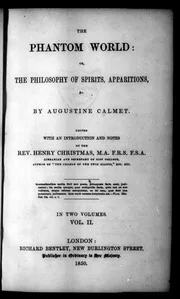
The phantom world; or, The philosophy of spirits, apparitions, etc. ... 1850: Vol 1 Iss 188

 73
73

The phantom world; or, The philosophy of spirits, apparitions, etc. ... 1850: Vol 1 Iss 188



Review by Sophia Crane (Associate Editor) — The Phantom World by Augustin Calmet is a seminal work in the realm of occult literature. Calmet's exploration of spirits and apparitions is both scholarly and evocative, providing esoteric insights that are as relevant today as they were in the 18th century. The book's strength lies in its ability to blend historical context with philosophical inquiry, making it an invaluable resource for scholars and practitioners alike. Whether you are a seasoned occultist or a curious seeker, this volume offers a wealth of knowledge that will deepen your understanding of the supernatural.
📝 Description
73
Augustin Calmet's 1850 work examines the philosophy of spirits and apparitions.
First published in 1850, The Phantom World, or The Philosophy of Spirits, Apparitions, etc. is Augustin Calmet's compilation of accounts and reflections on supernatural phenomena. Calmet, an abbot and scholar, gathered a wide range of stories concerning ghosts, demons, witchcraft, and other manifestations. He approached these subjects with a scholarly, though often credulous, mindset for his era, attempting to rationalize or categorize these occurrences within a theological framework. The book is not a theoretical treatise but a collection of observations and testimonies that were prevalent in the early modern period.
Calmet's work reflects a common concern with the unseen world that characterized much of 18th-century thought, even among educated individuals. He sought to understand the nature of spirits and their interactions with the physical world through the lens of religious doctrine and historical accounts. The volume presents a detailed look at how supernatural events were perceived and discussed, offering insights into the beliefs and anxieties of the time regarding the boundaries between the natural and the supernatural.
Augustin Calmet's work sits within a tradition of demonology and spirit investigation that spanned centuries, particularly prominent in the early modern period. While Calmet himself was a Benedictine abbot and sought theological explanations, his meticulous cataloging of alleged supernatural events fed into later esoteric interests. His approach, collecting and analyzing accounts of ghosts, possession, and witchcraft, provided source material for those interested in occult lore and the hidden workings of the universe, distinct from purely academic or theological discourse.
💡 Why Read This Book?
Read The Phantom World to gain a deeper understanding of the mystical and occult realms. This book is ideal for seekers of hidden knowledge, scholars of esoteric traditions, and practitioners of spiritual arts. Calmet's insights into the philosophy of spirits and apparitions offer a unique perspective on the unseen world, making it a must-read for anyone interested in the mysteries of the supernatural.
⭐ Reader Reviews
Honest opinions from readers who have explored this book.
❓ Frequently Asked Questions
Who is the intended audience for The Phantom World?
The intended audience includes scholars of esoteric traditions, practitioners of spiritual arts, and seekers of hidden knowledge. It is also valuable for anyone interested in the mysteries of the supernatural.
What makes The Phantom World unique?
The Phantom World stands out for its blend of historical context and philosophical inquiry into the world of spirits and apparitions. It offers a comprehensive look into the esoteric wisdom that underpins spiritual phenomena.
Are there any modern practitioners who use this book?
Yes, many modern practitioners of occult and spiritual arts refer to this book for its insights into the philosophy of spirits and apparitions.
Is The Phantom World suitable for beginners?
While it is accessible to beginners, those new to esoteric studies may find it more beneficial to read with some prior knowledge of occult and mystical themes.
What are the key themes in The Phantom World?
The key themes include the nature of spirits and apparitions, the philosophical underpinnings of spiritual phenomena, and the symbolism associated with the unseen world.
🔮 Key Themes & Symbolism
Spirits and Apparitions
The Phantom World delves deeply into the nature of spirits and apparitions, exploring their philosophical and mystical significance. Calmet's insights into these unseen entities offer a comprehensive understanding of their role in the occult and esoteric traditions.
Symbolism of the Unseen World
This book is rich in symbolism, providing readers with a deeper understanding of the hidden meanings and esoteric symbols associated with the unseen world. Calmet's exploration of these symbols enhances the mystical atmosphere of the text.
Philosophical Inquiry into Spiritual Phenomena
The Phantom World offers a philosophical inquiry into the nature of spiritual phenomena, questioning the boundaries between the visible and the invisible. This theme encourages readers to engage with the deeper mysteries of existence.
💬 Memorable Quotes
Direct passages from the work, attributed to the author.
“Spirits and apparitions are not random occurrences but manifestations of deeper truths.”
— Calmet's view on the significance of spiritual phenomena highlights their role in revealing hidden knowledge.
💡 Key Ideas
Editorial paraphrase of the work's core concepts — not direct quotes.
The unseen world is not a area of mere fantasy but a reality that intertwines with our own.
This quote underscores the book's exploration of the interconnectedness between the visible and invisible worlds.
The symbolism of the occult is a language of the soul, speaking to those who seek understanding.
This quote emphasizes the importance of esoteric symbolism in communicating mystical truths.
Philosophy of spirits is a journey into the depths of human consciousness.
This line reflects the book's philosophical inquiry into the nature of spiritual phenomena and their impact on human experience.
The unseen world is a mirror to our own, reflecting the mysteries that lie within.
This quote suggests that the exploration of the unseen world can reveal deeper truths about our own existence.
🌙 Esoteric Significance
Tradition
The Phantom World belongs to the Hermetic tradition, which emphasizes the study of hidden knowledge and the mysteries of the unseen world. This tradition has influenced various esoteric practices and beliefs, including alchemy and astrology.
Symbolism
Key symbols in the book include the use of apparitions as representations of hidden truths and the exploration of spiritual phenomena as manifestations of deeper realities. These symbols are integral to the book's mystical and esoteric themes.
Modern Relevance
The Phantom World remains relevant today, with modern practitioners of occult and spiritual arts referring to it for its insights into the philosophy of spirits and apparitions. Its exploration of the unseen world continues to inspire seekers of hidden knowledge.
👥 Who Should Read This Book
Beginners interested in the occult and mystical traditions will find The Phantom World to be an enlightening introduction. Scholars of esoteric studies will appreciate its depth and philosophical inquiry. Spiritual seekers will benefit from its exploration of the unseen world, while practitioners of spiritual arts will find valuable insights into the nature of spirits and apparitions.
📜 Historical Context
Published in 1850, The Phantom World reflects the growing interest in the occult and mystical traditions during the 18th and 19th centuries. This era saw a resurgence of interest in esoteric knowledge, with many scholars and practitioners studying the mysteries of the supernatural. Calmet's work was influential in shaping the philosophical and mystical understanding of spirits and apparitions, providing a foundation for modern occult studies.
📔 Journal Prompts
How do the concepts of spirits and apparitions challenge your understanding of reality?
What symbols in The Phantom World resonate with your own spiritual journey?
How does the philosophy of spirits influence your view of the unseen world?
In what ways can the insights from this book be applied to modern spiritual practices?
How does the exploration of the unseen world in this book deepen your understanding of esoteric traditions?
🗂️ Glossary
Apparitions
Visible manifestations of spirits or supernatural entities, often carrying symbolic meaning.
Esoteric
Relating to knowledge that is hidden or only accessible to a few, often involving mystical or occult themes.
Hermetic Tradition
A philosophical and spiritual tradition focused on the study of hidden knowledge and the mysteries of the universe.
Occult
Relating to supernatural or mystical phenomena, often involving the study of hidden or secret knowledge.
Symbolism
The use of symbols to represent deeper truths or meanings, often found in esoteric and mystical traditions.
This book appears in 2 collections
🔮 Readers Also Liked
Browse all →
![The old colony town [Plymouth, Mass.], and other sketches. 1893: Iss 118](/img/thumb/the-old-colony-town-plymouth-mass-and-other-sketches-1893-iss-118-bliss-william-root-1825-1906.webp)




More by CALMET, Augustin, 1672-1757.
All books →


From the “Witchcraft” Collection
View all →




More Free Witchcraft & Paganism Books
View all →