The Kybalion

 80
80

The Kybalion
The Kybalion's enduring appeal lies in its stark, almost mathematical presentation of esoteric principles. The "Seven Principles" are laid out with an air of ancient authority, offering a seemingly complete framework for understanding the cosmos and the individual's place within it. Its strength is this very conciseness; it provides potent conceptual tools without extensive narrative. However, its primary limitation is the very anonymity and lack of verifiable historical linkage to ancient Hermetic texts that the authors imply. The claim of "three initiates" passing down this wisdom is more assertion than evidence. A passage like the explanation of the Principle of Vibration – "The difference between different manifestations of energy... is solely the rate of vibration" – is emblematic of its direct, axiomatic style. While compelling, it demands faith from the reader rather than offering scholarly substantiation. It functions best as a philosophical prompt rather than a historical document.
📝 Description
80
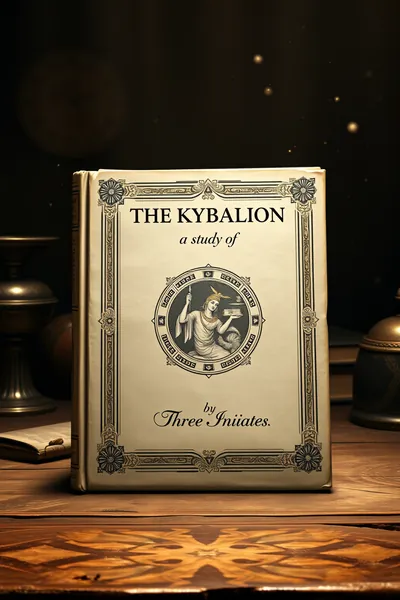
Published in 1908, The Kybalion distills seven Hermetic principles.
The Kybalion, attributed to the "Three Initiates," presents a concise summary of Hermetic philosophy. It outlines seven principles that the authors claim govern the universe, functioning as a philosophical primer rather than a historical text. The book aims to guide readers toward understanding mental causation and universal laws through a specific metaphysical framework. Its brevity makes it approachable, but the ideas are intended for serious reflection.
This work is suited for individuals beginning their study of Hermeticism or those interested in the esoteric foundations of various spiritual paths. Readers who value aphoristic wisdom and structured philosophical systems will appreciate its content. It offers a starting point for exploring metaphysical concepts or deepening one's knowledge of traditions centered on the power of thought and the nature of reality.
The Kybalion emerged in 1908 amidst a Western surge of interest in spiritualism and esoteric thought. It aligns with the Hermetic tradition, a body of knowledge attributed to Hermes Trismegistus. The book's anonymous authorship and its focus on universal laws and mental causation reflect common themes in occult societies of the era, such as the Hermetic Order of the Golden Dawn. It contributed to the popularization of these ideas outside specialized circles.
💡 Why Read This Book?
• Understand the Principle of Mentalism: Grasp the core Hermetic tenet that the All is Mind, and the universe is a mental construct, offering a unique perspective on consciousness and reality creation. • Explore the Principle of Correspondence: Learn how the concept of "as above, so below" applies to understanding macrocosmic and microcosmic connections, as detailed in its dedicated section. • Contemplate the Principle of Vibration: Gain insight into the idea that all phenomena are merely different frequencies of energy, a foundational concept for understanding change and manifestation.
⭐ Reader Reviews
Honest opinions from readers who have explored this book.
❓ Frequently Asked Questions
What is the main philosophy presented in The Kybalion?
The Kybalion primarily presents Hermetic philosophy, focusing on seven core principles that are said to govern the universe. It posits that reality is fundamentally mental and governed by specific, immutable laws.
Who are the 'Three Initiates' mentioned as the authors?
The "Three Initiates" are the pseudonymous authors of The Kybalion. Their identities have never been officially revealed, adding to the book's mystique and its connection to ancient, anonymous wisdom traditions.
When was The Kybalion first published?
The Kybalion was first published in 1908, a period marked by significant interest in esoteric and spiritual movements in the Western world.
What is the Principle of Mentalism in The Kybalion?
The Principle of Mentalism is the first and most fundamental principle, stating that 'The All is Mind; the Universe is Mental.' It suggests that thought is the ultimate reality and the foundation of all existence.
Does The Kybalion offer practical applications?
Yes, while presenting abstract principles, The Kybalion is intended to offer practical application. Understanding these laws is meant to empower individuals to consciously influence their lives and circumstances.
Is The Kybalion related to Hermeticism?
Absolutely. The Kybalion is a modern exposition of Hermeticism, a philosophical and religious tradition attributed to Hermes Trismegistus. It distills key Hermetic teachings into seven principles.
🔮 Key Themes & Symbolism
The Seven Hermetic Principles
The foundational structure of The Kybalion, these seven principles—Mentalism, Correspondence, Vibration, Polarity, Rhythm, Cause and Effect, and Gender—are presented as immutable laws governing all existence. Each principle offers a lens through which to view the universe, from the nature of thought (Mentalism) to the cyclical patterns of life (Rhythm) and the generation of all things (Gender). The book systematically unpacks these concepts, suggesting that by understanding and applying them, individuals can gain mastery over their circumstances and achieve a higher state of consciousness. The interplay between these principles forms a coherent, albeit abstract, metaphysical system.
The Power of the Mental Universe
Central to The Kybalion is the Principle of Mentalism, which posits that the ultimate reality is Mind. The entire universe, including all its phenomena, is seen as a mental creation of 'The All.' This concept challenges conventional materialism, suggesting that thought precedes and creates form. The book explores how our own minds are participants in this universal mental field, implying that by understanding and controlling our thoughts, we can influence our reality. This perspective forms the basis for many practical applications within Hermeticism, emphasizing the mind's creative and causative power.
Universal Laws and Their Application
Beyond abstract philosophy, The Kybalion frames its principles as practical laws that can be studied and applied. The principle of Cause and Effect, for instance, highlights that every cause has an effect and every effect has a cause, urging conscious action. Similarly, understanding Rhythm, the ebb and flow of all things, can help individuals navigate life's cycles more effectively. The book suggests that knowledge of these laws is not merely academic but is the key to personal transformation and achieving harmony with the cosmos. It encourages a shift from passive experience to active participation based on understanding universal mechanics.
The Transmutation of Mental States
The Kybalion details methods for mental transmutation, particularly through the application of the Principle of Polarity and Mentalism. By understanding that apparent opposites are merely different degrees of the same fundamental substance or energy, one can learn to shift their mental state from one pole to another. This involves mastering one's own thoughts and emotions, essentially changing one's vibration to align with desired outcomes or states of being. The book presents this not as mere wishful thinking, but as a precise mental science grounded in the laws of the universe.
💬 Memorable Quotes
Direct passages from the work, attributed to the author.
“The lips of wisdom are closed, except to the ears of Understanding.”
— This aphorism underscores the idea that true wisdom is not readily accessible to everyone. It requires a receptive and developed state of consciousness, an "Understanding," to truly grasp the profound truths presented.
“All causes have their effects; all effects have their causes. "Find the cause."”
— This highlights the Principle of Cause and Effect. It suggests that every event has a preceding cause and that by investigating phenomena, one can uncover the underlying reasons, enabling a more conscious interaction with the world.
“The lips of wisdom are closed, except to the ears of Understanding.”
— This aphorism underscores the idea that true wisdom is not readily accessible to everyone. It requires a receptive and developed state of consciousness, an "Understanding," to truly grasp the profound truths presented.
“As above, so below; as below, so above.”
— This expresses the Principle of Correspondence, suggesting a fundamental unity and mirroring between different planes of existence, from the grandest cosmic scale to the smallest individual experience.
“The All is Mind; the Universe is Mental.”
— This is the core statement of the Principle of Mentalism, asserting that the fundamental reality of existence is consciousness or Mind, and that the physical world is a manifestation of this mental essence.
🌙 Esoteric Significance
Tradition
The Kybalion is a modern exposition of Western Hermeticism, a tradition attributed to the legendary figure Hermes Trismegistus. It distills core Hermetic tenets into seven principles, presenting them as universal laws. While drawing from ancient Hermetic concepts, its systematic, almost axiomatic presentation is characteristic of early 20th-century esoteric literature, distinguishing it from earlier grimoires or philosophical dialogues. It serves as a bridge, making complex Hermetic ideas accessible to a wider audience seeking foundational metaphysical understanding.
Symbolism
The book itself doesn't rely heavily on overt symbolic imagery within its text, but the 'Three Initiates' and the number seven are significant. Seven is a number of completion and perfection across many mystical traditions, including Hermeticism, Kabbalah, and Gnosticism. The implied secrecy of the 'Three Initiates' reflects the tradition of esoteric knowledge being passed from master to disciples, emphasizing direct transmission and inner realization over public dissemination.
Modern Relevance
The Kybalion's principles, particularly Mentalism and Vibration, continue to influence modern New Thought, the Law of Attraction movement, and various self-help and manifestation philosophies. Contemporary spiritual teachers and practitioners often reference its core ideas when discussing consciousness, reality creation, and personal empowerment. Its accessible format makes it a frequent entry point for individuals exploring metaphysical concepts beyond mainstream religious or scientific frameworks.
👥 Who Should Read This Book
• Aspiring students of Hermetic philosophy: Individuals seeking a clear, foundational introduction to the core tenets of Hermeticism, presented in a structured, principled format. • Seekers of metaphysical understanding: Those interested in exploring concepts of universal laws, the nature of consciousness, and the mind's role in shaping reality. • Comparative religion and philosophy researchers: Scholars and enthusiasts looking to understand a significant 20th-century interpretation of ancient esoteric traditions and their influence.
📜 Historical Context
Published in 1908, The Kybalion emerged during a fervent period for esoteric thought in the West. The late 19th and early 20th centuries witnessed a proliferation of spiritualist movements, Theosophy, and revived interest in ancient mysteries, partly fueled by figures like Helena Blavatsky. The book's anonymous "Three Initiates" authorship tapped into the era's fascination with secret societies and hidden knowledge, aligning with the resurgence of Hermeticism. It offered a structured, accessible interpretation of Hermetic philosophy, distinct from the more elaborate ceremonial magic practiced by groups like the Hermetic Order of the Golden Dawn. Its concise presentation of seven principles made Hermetic concepts digestible for a broader audience, contributing significantly to their popularization, though its direct lineage to ancient Hermetic texts remains a subject of debate within scholarly circles.
📔 Journal Prompts
The Principle of Mentalism and the nature of your reality.
How does the Principle of Correspondence manifest in your daily life?
Reflect on the concept of Vibration as presented in the book.
Applying the Principle of Cause and Effect to a recent personal challenge.
The meaning of Rhythm in relation to personal habits and external events.
🗂️ Glossary
The All
The ultimate reality or absolute, conceived as a single, infinite, living Mind. It is the source and substance of all things, often equated with God or the Absolute.
Hermes Trismegistus
A legendary Hellenistic figure, syncretism of the Greek god Hermes and the Egyptian god Thoth. He is considered the mythical author of the Hermetic corpus, a body of esoteric texts.
Mentalism
The first Hermetic principle, stating that the All is Mind and the Universe is Mental. It posits that thought is the fundamental reality and the basis of all phenomena.
Correspondence
The second Hermetic principle, often summarized as 'As above, so below; as below, so above.' It signifies the relationship and mirroring between different planes of existence.
Vibration
The third Hermetic principle, stating that nothing rests; everything moves; everything vibrates. Differences in phenomena are attributed to varying rates of vibration.
Polarity
The fourth Hermetic principle, asserting that all things exist in dualities, and these opposites are merely different degrees of the same thing. It allows for the transmutation of mental states.
Rhythm
The fifth Hermetic principle, describing the ebb and flow, the swing of the pendulum, the regular advance and retreat inherent in all things. It governs cycles and patterns.
🔮 Readers Also Liked
Browse all →








More by Three Initiates
All books →



More Free Spiritual Development Books
View all →