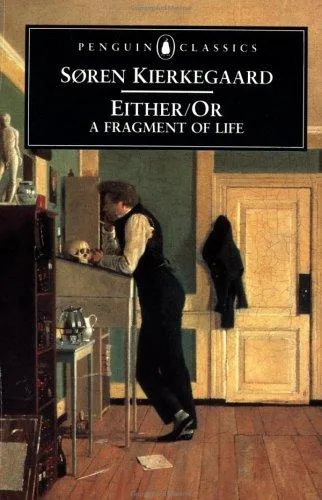
Enten-eller
 76
76

Enten-eller
Kierkegaard's *Enten-Eller* is less a single argument and more a profound exploration of two poles of human experience. The brilliance lies in its dual presentation, allowing the reader to inhabit the seductive logic of the aesthetic before confronting the demanding clarity of the ethical. One particular strength is the character of Don Juan in the aesthetic section, presented not as a literary figure but as an embodiment of pure sensuousness and immediacy, a concept that feels startlingly modern. However, the sheer volume and the density of the arguments, particularly in the latter half concerning the ethical, can be demanding. The 'Symphony' section, for instance, is an extended meditation that requires sustained attention. The work’s limitation is its inherent challenge to easy categorization; it resists being neatly summarized, demanding a personal wrestling with its ideas. Ultimately, *Enten-Eller* offers a challenging, yet vital, framework for considering the fundamental choices that constitute a life.
📝 Description
76
Søren Kierkegaard's *Enten-Eller* was published in 1920, presenting two distinct ways of living.
First published in 1920, Søren Kierkegaard's *Enten-Eller*, translated as *Either/Or*, lays out two contrasting modes of existence: the aesthetic and the ethical. The work is organized as a collection of papers and letters, supposedly gathered by Victor Eremita. Through this structure, Kierkegaard examines the core decisions that shape human lives and self-awareness.
The book is suited for readers deeply engaged in philosophy, especially those interested in existentialism, ethics, and the nature of personal truth. It speaks to individuals facing major life decisions, who are searching for ways to understand commitment and the significance of individual accountability. Readers familiar with Kierkegaard's other writings, like *Fear and Trembling* or *The Sickness Unto Death*, will recognize recurring themes.
*Enten-Eller* appeared decades after Kierkegaard's death in 1855, during a period of significant philosophical development. Its focus on individual choice and subjective experience contrasted with the systematic philosophies then common in academia, such as Georg Wilhelm Friedrich Hegel's rationalism.
While *Enten-Eller* is a seminal text in existentialist philosophy, its focus on the radical individual choice and the subjective experience of truth places it within a broader esoteric tradition that questions external systems of meaning. Kierkegaard's method of indirect communication and his emphasis on the internal, lived reality of faith and ethics resonate with traditions that prioritize inner transformation over abstract doctrine. The work's examination of despair and the search for authentic selfhood aligns with perennial concerns found in mystical and introspective spiritual paths.
💡 Why Read This Book?
• Understand the existential choice between living for immediate pleasure and embracing commitment and duty, as presented through the contrasting 'aesthetic' and 'ethical' stages detailed in the work. • Grasp the concept of the 'either/or' not as a simple dilemma, but as a fundamental existential decision that shapes one's entire reality, a core idea explored in the book's structure. • Analyze the nature of despair and boredom as byproducts of an uncommitted aesthetic existence, a theme vividly illustrated through the character of Don Juan in the first part of the book.
⭐ Reader Reviews
Honest opinions from readers who have explored this book.
❓ Frequently Asked Questions
When was Søren Kierkegaard's Enten-Eller first published?
Although written earlier, Søren Kierkegaard's *Enten-Eller* was first published in 1920, long after his death in 1855. This publication date places it within the early 20th-century philosophical landscape.
What are the main philosophical concepts explored in Enten-Eller?
The book primarily explores the contrast between the aesthetic and ethical modes of existence. It examines the 'either/or' as a fundamental existential choice, the nature of despair, boredom, and the concept of personal responsibility.
Who is Victor Eremita, mentioned in Enten-Eller?
Victor Eremita is presented as the fictional editor of the collected papers in *Enten-Eller*. He is a literary device used by Kierkegaard to frame the contrasting philosophical arguments within the text.
How does the aesthetic stage differ from the ethical stage in Enten-Eller?
The aesthetic stage emphasizes immediate gratification, pleasure, and avoidance of commitment, often leading to boredom. The ethical stage, in contrast, involves choice, responsibility, duty, and enduring commitment.
Is Enten-Eller considered an existentialist work?
Yes, *Enten-Eller* is widely considered a foundational text of existentialism, even though the term was not in common use during Kierkegaard's lifetime. It deeply influences later existentialist thinkers through its focus on individual freedom, choice, and subjective truth.
What is the significance of Don Juan in the context of Enten-Eller?
Don Juan serves as the prime example of the aesthetic individual in the first part of *Enten-Eller*. He embodies sensuous immediacy and the pursuit of infinite desire, representing a life lived without ethical commitment.
🔮 Key Themes & Symbolism
The Aesthetic vs. Ethical Life
The core of *Enten-Eller* lies in its stark contrast between two fundamental ways of living. The aesthetic life is presented as one of immediacy, sensory experience, and avoidance of commitment, exemplified by the figure of Don Juan. This mode, while offering fleeting pleasure, ultimately leads to boredom and despair. The ethical life, conversely, is defined by choice, responsibility, and commitment to duty and universal principles. This sphere offers a more stable, though demanding, path to selfhood and meaning, requiring a conscious decision to embrace one's role and obligations.
The 'Either/Or' as Existential Choice
Kierkegaard elevates the logical proposition 'either/or' into a profound existential reality. The choice between the aesthetic and ethical is not merely intellectual but a radical decision that constitutes the individual. This 'either/or' is the defining moment of freedom and responsibility, where one chooses the very framework of their existence. It is a choice that cannot be bypassed or resolved through compromise, but requires a definitive commitment to one path over the other, shaping one's identity and future.
Boredom and Despair
Central to the critique of the aesthetic life is the concept of boredom (ennui). Kierkegaard portrays boredom not as simple idleness, but as a profound existential emptiness arising from the lack of engagement and commitment. This state is a precursor to despair, the 'sickness unto death,' which is the failure to be oneself or the desire not to be. The aesthetic individual, constantly seeking novelty, ultimately finds this pursuit hollow, leading to a deeper existential malaise that the ethical life seeks to overcome through commitment.
Subjectivity and Truth
In line with his philosophical project, Kierkegaard emphasizes the primacy of subjective truth. The 'either/or' choice is not about discovering an objective fact but about making a passionate, personal commitment. Truth is found in the individual's relationship to their beliefs and choices, rather than in abstract, universal systems. The book challenges readers to confront their own existence and make authentic choices, underscoring that the most significant truths are those that are lived and internalized through personal engagement.
💬 Memorable Quotes
Direct passages from the work, attributed to the author.
“Marry, and you will regret it; do not marry, you will also regret it; marry or do not marry, you will regret it either way.”
— This iconic statement illustrates the inescapable nature of regret and the profound difficulty of existential choice. It suggests that any significant life decision carries the potential for future dissatisfaction, emphasizing the burden of freedom.
“Boredom is the root of all evil.”
— This statement, often attributed to Kierkegaard within the context of the aesthetic section, points to the profound existential emptiness that arises from a life devoid of commitment and meaningful engagement. It is a state of profound spiritual and psychological decay.
“The greatest danger, that of losing one's self, can pass off unnoticeably.”
— This observation captures the subtle peril of failing to establish an authentic self. It suggests that the erosion of one's identity can occur gradually, without dramatic events, often through a passive acceptance of external influences or a lack of personal decision-making.
“Life can only be understood backwards; but it must be lived forwards.”
— This aphorism expresses the tension between retrospective understanding and prospective action. It implies that while wisdom about life emerges from reflection on past experiences, the actual living of life requires moving forward with imperfect knowledge and future-oriented choices.
💡 Key Ideas
Editorial paraphrase of the work's core concepts — not direct quotes.
The choice is the deciding factor. By choosing, the individual transcends the immediacy of his existence.
This paraphrased concept highlights Kierkegaard's central thesis: that genuine selfhood is not a given but is forged through the act of choosing. The moment of decision is what allows an individual to move beyond mere existence and actively define who they are.
🌙 Esoteric Significance
Tradition
While not strictly aligned with a single esoteric lineage like Hermeticism or Kabbalah, *Enten-Eller* profoundly impacts existentialist and philosophical psychology, which often intersects with esoteric thought. Its emphasis on radical subjective choice and the creation of meaning through will aligns with certain Gnostic and voluntarist traditions that prioritize the individual's inner spiritual journey and self-determination over external dogma or deterministic systems.
Symbolism
The primary symbolic division in *Enten-Eller* is the contrast between the 'aesthetic' and the 'ethical.' The aesthetic is symbolized by figures like Don Juan, representing boundless desire and immediate sensation, while the ethical is embodied by the Judge, symbolizing duty, law, and commitment. The very structure of 'either/or' functions as a potent symbol of the fundamental existential crossroads that every individual faces.
Modern Relevance
Contemporary thinkers in fields ranging from existential psychology and psychotherapy to post-structuralist philosophy continue to engage with Kierkegaard's concepts. His exploration of anxiety, choice, and authenticity remains relevant for understanding the human condition in a secularized and often overwhelming modern world. Practices focused on self-creation and mindful decision-making often draw implicitly or explicitly on the philosophical groundwork laid by *Enten-Eller*.
👥 Who Should Read This Book
• Students of existential philosophy seeking to understand the origins of key concepts like subjective truth, anxiety, and the 'leap of faith,' with *Enten-Eller* providing foundational texts. • Individuals undergoing significant life transitions or grappling with difficult decisions, who can gain conceptual tools for framing their choices and understanding the weight of commitment. • Readers interested in comparative religion and philosophy, seeking to explore the tension between faith, reason, and lived experience as articulated by an important thinker outside the mainstream academic traditions of his time.
📜 Historical Context
Søren Kierkegaard’s *Enten-Eller*, first published in 1920, arrived long after the philosopher’s death in 1855. Its delayed publication meant it entered the intellectual landscape decades after its initial conception, influencing the burgeoning field of existentialism. The work served as a significant counterpoint to the dominant systematic philosophy of Georg Wilhelm Friedrich Hegel, which emphasized reason and historical progress. Kierkegaard’s focus on individual subjective experience, choice, and faith challenged Hegelian rationalism. While Kierkegaard was largely unknown during his lifetime, his ideas gained traction in the early 20th century, resonating with thinkers grappling with the aftermath of World War I and a growing sense of individual alienation. The existentialist movement, which would fully bloom mid-century with figures like Jean-Paul Sartre and Albert Camus, owes a substantial debt to Kierkegaard's early explorations of freedom and anxiety.
📔 Journal Prompts
The choice between the aesthetic and ethical life: Which dominant mode shapes your daily existence?
Victor Eremita's role as editor: How does the framing of ideas influence their reception?
The character of Don Juan as an aesthetic ideal: What immediate desires do you currently prioritize?
The Judge's ethical framework: What universal principles do you find yourself committed to?
The burden of regret: How do you reconcile past choices with present living?
🗂️ Glossary
Aesthetic Stage
A mode of existence characterized by the pursuit of pleasure, immediate sensory experience, and avoidance of commitment or responsibility. It often leads to boredom and despair.
Ethical Stage
A mode of existence defined by commitment, responsibility, choice, and adherence to universal duties and principles. It offers a more stable foundation for selfhood.
Either/Or
In Kierkegaard's philosophy, this is not merely a logical choice but a fundamental existential decision that shapes an individual's entire life and identity.
Don Juan
In *Enten-Eller*, a literary representation of the aesthetic individual, embodying sensuous desire, immediacy, and a life lived without ethical constraint.
Boredom (Ennui)
An existential state of profound emptiness and lack of engagement resulting from a life devoid of commitment and meaning, often a precursor to despair.
Despair
The 'sickness unto death,' a spiritual condition arising from a failure to be oneself or the desire not to be oneself, stemming from a lack of authentic selfhood.
Victor Eremita
The fictional editor who 'discovers' and presents the papers in *Enten-Eller*, serving as a literary device to frame Kierkegaard's philosophical arguments.
🔮 Readers Also Liked
Browse all →









More by Søren Kierkegaard
All books →
More Free Spiritual Development Books
View all →