Three Initiates
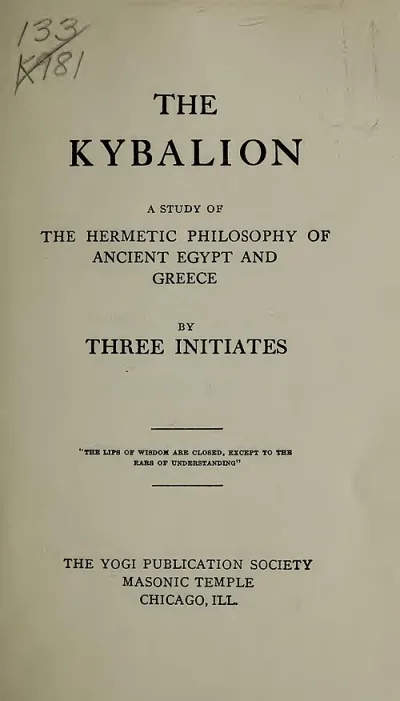
The Kybalion is a 1908 book attributed to 'Three Initiates' presenting Hermetic principles influenced by New Thought.
Published in 1908, 'The Kybalion: A Study of the Hermetic Philosophy of Ancient Egypt and Greece' is a work attributed to 'Three Initiates.' It aims to transmit the teachings of Hermes Trismegistus. While it incorporates elements found in ancient Hermetic writings, such as mentalism, the principle of 'as above, so below,' and the concept of dualistic opposites, its overall structure and content draw more heavily from modern occult authors, particularly those within the New Thought movement, to which William Walker Atkinson, often identified as one of the 'Three Initiates,' belonged. The book has been significantly influential in New Age circles since the mid-20th century.
The title 'Kybalion' itself appears to be a fabricated term, lacking any known ancient Greek origin, likely created to lend an aura of antiquity to the text. The book's central framework is built upon seven Hermetic principles: Mentalism, Correspondence, Vibration, Polarity, Rhythm, Cause and Effect, and Gender. These principles, as presented in the book, outline a philosophical system where the All is Mind, and the universe operates through interconnected laws and dualities. While some concepts echo ancient Hermeticism, scholars note significant departures, such as the Kybalion's anti-theological stance and focus on personal mental transformation, contrasting with the traditional Hermetica's emphasis on divine reverence and unification.
The Seven Hermetic Principles
The Kybalion posits that the entirety of Hermetic philosophy is founded upon seven core principles. These are: The Principle of Mentalism, stating that the Universe is fundamentally mental ('The All is Mind; the Universe is Mental'). The Principle of Correspondence, articulated as 'As above, so below; as below, so above,' signifying a connection between different planes of existence. The Principle of Vibration asserts that constant motion and change are inherent to all things ('Nothing rests; everything moves; everything vibrates'). The Principle of Polarity describes the inherent duality in everything, where opposites are identical in nature but differ in degree, and extremes meet. The Principle of Rhythm illustrates the ebb and flow present in all phenomena, akin to a pendulum's swing. The Principle of Cause and Effect emphasizes universal law, where every cause has a corresponding effect, and chance is merely unrecognized law. Finally, the Principle of Gender states that masculine and feminine principles are present in all things and manifest across all planes.
Relationship to Ancient Hermetica
The Kybalion shares certain philosophical concepts with ancient and medieval Hermetic texts, including philosophical mentalism, the idea of correspondence ('as above, so below'), and the presence of gendered polar opposites. However, its overall character is considered more aligned with early 20th-century occultism and the New Thought movement. Scholars point out that some principles, like vibration, have origins in thinkers outside the Hermetic tradition, such as David Hartley. Furthermore, significant divergences exist between The Kybalion and traditional Hermetica. For instance, The Kybalion adopts an anti-theological stance, whereas traditional Hermeticism heavily emphasizes theology. The book's focus on the practitioner's 'mental transmutation' also contrasts with the traditional Hermetic goal of reverence for and unification with the divine. Consequently, The Kybalion is often viewed as a modern interpretation rather than a direct continuation of historical Hermetic philosophy.
Key Ideas
- The seven Hermetic principles (Mentalism, Correspondence, Vibration, Polarity, Rhythm, Cause and Effect, Gender)
- The universe is fundamentally mental.
- Correspondence between different planes of existence ('As above, so below').
- Everything exists in dualities and flows with rhythm.
- Influence of New Thought philosophy on Hermetic concepts.
Notable Quotes
“The All is Mind; the Universe is Mental.”
“As above, so below; as below, so above.”
“Nothing rests; everything moves; everything vibrates.”
“Everything is dual; everything has poles; everything has its pair of opposites; like and unlike are the same; opposites are identical in nature, but different in degree; extremes meet; all truths are but half-truths; all paradoxes may be reconciled.”
“Everything flows, out and in; everything has its tides; all things rise and fall; the pendulum-swing manifests in everything; the measure of the swing to the right is the measure of the swing to the left; rhythm compensates.”