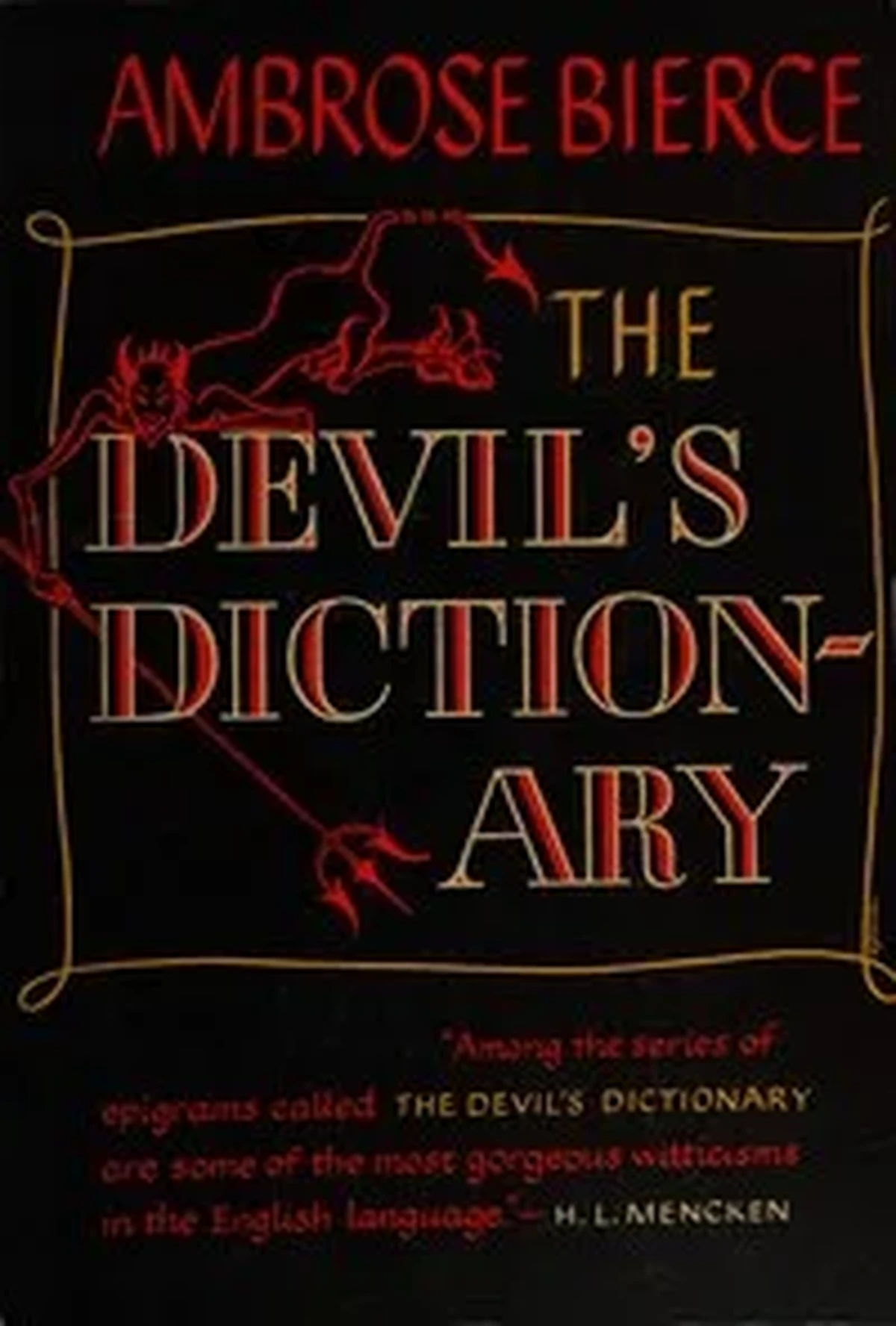
The Devil's Dictionary
 72
72

The Devil's Dictionary
Bierce's "The Devil's Dictionary" is a potent antidote to earnestness, a collection of definitions that functions more as a philosophical scalpel than a mere word list. Its strength lies in its relentless wit and the startling accuracy of its cynicism; the 1925 compilation solidified its place as a unique American literary artifact. The work's unflinching dissection of "Success" as "theINATION of failure" remains particularly resonant, cutting through platitudes with surgical precision. However, the relentless negativity can occasionally feel monotonous; the sheer volume of barbed observations, while individually brilliant, sometimes leads to a sense of overwhelming bleakness. One particularly striking entry defines "Faith" as "an illogical belief in the occurrence of the impossible." The book's enduring appeal is its courage to voice the unspoken, often uncomfortable, truths about our motivations and societal constructs. It's a necessary, if bracing, read.
📝 Description
72
Ambrose Bierce's The Devil's Dictionary first appeared in book form in 1925, years after his disappearance.
Ambrose Bierce's The Devil's Dictionary is a collection of sardonic definitions and epigrams, not a standard lexicon. Bierce, a Civil War veteran and journalist, used his sharp wit to satirize language, society, and human nature. He redefined common words, exposing absurdities and hypocrisies with dark humor. Each entry functions as a short, critical essay, covering concepts from "Abstinence" to "Zeal" with a cynical perspective.
This book appeals to readers who enjoy linguistic playfulness, philosophical satire, and skepticism. It is for those who find amusement in definitions that reveal underlying truths through mockery and inversion. The work offers a unique perspective for understanding the critical currents of the late 19th and early 20th centuries, particularly for students of American literature and cultural history.
Serialization of the definitions began as early as 1881 in "The Wasp" magazine. The full compilation in 1925 occurred after Bierce's mysterious disappearance in Mexico around 1913. This period saw widespread muckraking journalism and growing disillusionment with institutions. Bierce's work offered a biting, materialistic counterpoint to the era's reform movements and philosophical idealism.
While not overtly occult, Bierce's dictionary engages with a form of philosophical skepticism that questions established dogma and societal pretenses. His cynical redefinitions can be seen as a secular form of gnosis, stripping away conventional meanings to reveal perceived hidden realities or absurdities. This approach aligns with certain esoteric traditions that seek direct, unvarnished understanding beyond societal or religious pronouncements, though Bierce's method is rooted in sharp wit rather than mysticism.
💡 Why Read This Book?
• You will learn to critically re-examine definitions of common concepts, understanding how language shapes perception, as exemplified by Bierce's redefinition of "Truth" as "a poor and shabbily dressed man..." • You will gain a sharper eye for hypocrisy in public discourse and personal interactions, recognizing the "Politeness" he defines as "the painted veil put on by society to conceal its nakedness." • You will develop a more nuanced appreciation for American satirical literature of the late 19th century, seeing how Bierce's work diverged from more optimistic contemporaries.
⭐ Reader Reviews
Honest opinions from readers who have explored this book.
❓ Frequently Asked Questions
When was Ambrose Bierce's 'The Devil's Dictionary' first published as a complete book?
While its definitions appeared in periodicals earlier, "The Devil's Dictionary" was first compiled and published as a complete book in 1925, several years after Bierce's disappearance around 1913.
What is the primary style of writing in 'The Devil's Dictionary'?
The book is characterized by its satirical and cynical style. Bierce uses epigrams and pointed definitions to mock human folly, societal conventions, and abstract concepts.
Is 'The Devil's Dictionary' considered a work of philosophy?
While not a systematic philosophical treatise, it functions as a work of philosophical satire. It probes the nature of reality, truth, and human motivation through a skeptical and often materialistic lens.
What historical events influenced Ambrose Bierce's writing?
Bierce's experiences as a Union soldier in the American Civil War significantly shaped his cynical outlook, which is evident in his unflinching and often grim definitions.
Can 'The Devil's Dictionary' be found online for free?
Yes, due to its age, "The Devil's Dictionary" is in the public domain and widely available for free online through various digital archives and library websites.
What is Bierce's definition of 'Orthodoxy'?
Bierce defines "Orthodoxy" as "an impudent attempt to make reason do the work of revelation."
🔮 Key Themes & Symbolism
Skepticism and Nihilism
The work is steeped in a profound skepticism, questioning the sincerity of human motives and the validity of established institutions. Bierce's definitions often reveal a nihilistic undercurrent, suggesting a lack of inherent meaning or moral order. Concepts like "Morality" are redefined to expose their conditional or self-serving nature, reflecting a worldview where altruism is suspect and self-interest reigns supreme. This theme challenges readers to confront uncomfortable truths about human behavior and societal structures, presenting a stark alternative to more optimistic philosophical outlooks prevalent in the era.
Linguistic Deconstruction
Bierce masterfully deconstructs language, demonstrating how words can be used to obscure as much as they reveal. By providing his own, often inverted, definitions, he exposes the malleability of meaning and the potential for linguistic manipulation. His redefinition of "Education" as "the leading of human beings into the vanity of their own minds" exemplifies this. The dictionary format itself becomes a vehicle for critiquing the very notion of objective definition, suggesting that all language is, to some extent, subjective and politically charged, a tool for persuasion and control.
Critique of Social Institutions
From religion and politics to marriage and law, no institution escapes Bierce's satirical gaze. He dissects "Government" as "organized injustice," and "Law" as "a perpetual paper war." This pervasive critique targets the hypocrisy and self-serving nature he perceived within these structures. The work serves as a powerful commentary on the gap between proclaimed ideals and lived realities, exposing the often-grubby machinations that underpin societal order. His definitions reveal a deep disillusionment with the mechanisms of power and influence.
The Absurdity of Existence
Underlying the sharp wit is a profound sense of the absurd. Bierce's definitions often highlight the inherent contradictions and nonsensical aspects of human endeavors and beliefs. The entry for "Heaven" – "A place where the wicked cease from troubling you, and you, alas, cease from troubling your wicked" – expresses this. This theme suggests that much of human striving and belief systems are ultimately futile or misguided, leading to a darkly humorous recognition of life's inherent irrationality and the often-comical nature of our attempts to impose order.
💬 Memorable Quotes
Direct passages from the work, attributed to the author.
“Love: A temporary insanity curable by marriage.”
— This definition satirizes the romantic ideal of love, reducing it to a fleeting mental affliction that is, unfortunately, often made permanent by the institution of matrimony.
“Patriotism: The last refuge of a scoundrel.”
— Bierce suggests that appeals to patriotism are often a manipulative tactic used by disreputable individuals to gain public support or deflect criticism when all other arguments fail.
“Success: TheINATION of failure.”
— This cynical take on achievement implies that reaching a goal is not an end in itself, but merely a pause before the inevitable decline or the realization that the goal was meaningless.
“Faith: An illogical belief in the occurrence of the impossible.”
— Here, faith is stripped of its spiritual or hopeful connotations, presented instead as a form of irrationality, a willful ignorance of probability and evidence.
“Orthodoxy: An impudent attempt to make reason do the work of revelation.”
— This definition critiques established religious or dogmatic beliefs, suggesting that they impose irrational doctrines under the guise of reasoned argument, defying logical scrutiny.
🌙 Esoteric Significance
Tradition
While not overtly tied to a specific esoteric lineage like Hermeticism or Kabbalah, "The Devil's Dictionary" shares a kinship with traditions that emphasize gnosis through skepticism and the unveiling of hidden truths. Its method of deconstructing conventional language and revealing the mundane or self-serving motivations behind seemingly noble concepts aligns with Gnostic critiques of the material world and its deceptive appearances. The work's focus on exposing illusion and questioning received wisdom can be seen as a secular, albeit cynical, form of esoteric inquiry, aiming to awaken the reader from dogmatic slumber.
Symbolism
The primary 'symbol' in the dictionary is language itself, weaponized to expose underlying realities. Words like "Truth," "Virtue," and "God" are stripped of their idealized connotations, revealing the often-unpleasant human or societal constructs beneath. The act of defining becomes a ritualistic act of demystification. The dictionary format, traditionally a source of order and certainty, is subverted into a tool for revealing chaos and absurdity, symbolizing the illusory nature of human attempts to categorize and control existence.
Modern Relevance
Bierce's work continues to be relevant for contemporary thinkers and practitioners interested in critical theory, postmodern philosophy, and various forms of modern occultism that emphasize deconstruction and the subversion of established power structures. His linguistic skepticism finds echoes in contemporary critiques of media manipulation and political rhetoric. Various writers and commentators who explore existentialism, absurdism, and the darker aspects of human psychology often cite Bierce as an influence, appreciating his unflinching portrayal of the human condition stripped bare of comforting illusions.
👥 Who Should Read This Book
• Students of American literature and cultural history seeking to understand the critical and satirical voices of the late 19th and early 20th centuries. • Readers interested in philosophical satire and linguistic analysis who enjoy dissecting the nuances of language and challenging conventional definitions. • Individuals drawn to skeptical philosophies and existential themes, who appreciate a darkly humorous perspective on human nature and societal institutions.
📜 Historical Context
Ambrose Bierce's "The Devil's Dictionary" emerged from the crucible of late 19th and early 20th-century American journalism and literature, a period marked by both fervent optimism and profound social critique. While the book was formally compiled in 1925, its seeds were sown much earlier, with definitions appearing in San Francisco periodicals like "The Wasp" starting in the 1880s. Bierce, a veteran of the Civil War and a sharp-tongued commentator, honed his satirical style in an era of burgeoning muckraking journalism. His work offered a dark counterpoint to the prevailing Progressive Era's reformist zeal and the philosophical currents of Pragmatism championed by figures like William James. Unlike the more idealistic writers of the time, Bierce’s definitions championed a stark, often materialistic, worldview. His work received limited formal academic attention during his lifetime, perhaps due to its perceived cynicism and unconventional format, but its serialization ensured a readership familiar with his biting commentary.
📔 Journal Prompts
The definition of "Ambition" as "An overweening desire to be loved when one is too old to hate." Consider the implications of this specific temporal framing.
Bierce's entry for "Belief": "An island in the sandy desert of doubt."
Analyze the satirical function of redefining "Courage" as "A perfect contempt of death."
Reflect on the concept of "Diplomacy" as "the art of saying 'nice doggie' until you can find a rock."
Consider the implications of "Happiness": "A good disposition, our natural teeth not yet all deserted by the gums."
🗂️ Glossary
Epigram
A concise, witty, and often paradoxical statement expressing a single thought or observation. Bierce's definitions frequently take the form of epigrams.
Satire
The use of humor, irony, exaggeration, or ridicule to expose and criticize people's stupidity or vices, particularly in the context of contemporary politics and other topical issues.
Cynicism
An attitude characterized by a general distrust of others' motives, believing that people are motivated purely by self-interest.
Skepticism
An attitude of doubt towards claims that are generally accepted. It questions the certainty of knowledge and belief.
Muckraking
The action of searching out and publicizing scandalous information about famous people or exposing misconduct in politics and business. Bierce was a practitioner of this journalistic style.
Gnosticism
A complex set of religious ideas and systems originating in the first centuries AD that emphasizes knowledge, especially mystical or esoteric insight, into divinity and the nature of the universe.
Materialism
A philosophical viewpoint that matter is the fundamental substance in nature, and that all phenomena, including mental states and consciousness, are results of material interactions.
🔮 Readers Also Liked
Browse all →








More by Ambrose Bierce
All books →

More Free Spiritual Development Books
View all →