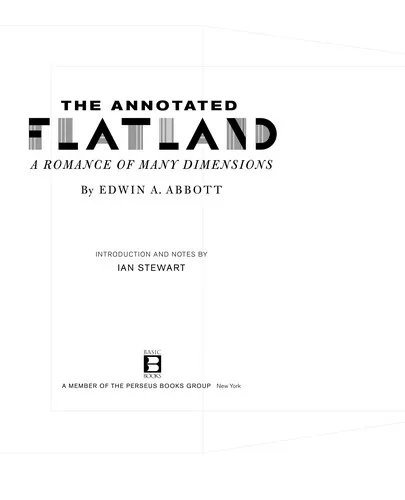
Flatland
 74
74

Flatland
Edwin Abbott Abbott's "Flatland" is far more than a quaint Victorian fantasy; it's a sharp, often humorous, dissection of societal constraints and perceptual limitations. The narrative's strength lies in its elegant simplicity, using the geometry of its world to mirror the rigid social geometries of late 19th-century England. Abbott's portrayal of A. Square's dawning awareness, particularly his struggle to comprehend the Sphere's existence beyond his two-dimensional plane, is masterfully executed. The book's limitation, however, is its dense allegorical nature, which can occasionally overshadow the narrative's momentum for readers less inclined towards philosophical allegory. A particularly striking passage is A. Square's description of trying to explain his world to the Sphere, only to be met with incomprehension of his limitations. "Flatland" endures as a clever exploration of perspective and societal structure.
📝 Description
74
Edwin Abbott Abbott published "Flatland" in 1884, a novella that uses geometry to critique Victorian society.
Edwin Abbott Abbott's 1884 novella "Flatland" presents itself as a travelogue from a two-dimensional world. The story follows A. Square, a polygon living in a world of geometric shapes, who encounters a sphere from a higher dimension. This experience challenges his understanding of reality and the limits of his perception. Abbott uses this narrative to allegorically comment on social hierarchy, geometric ideas, and the constraints of thought.
The work is suited for intellectually curious individuals interested in speculative fiction, philosophy, and the history of science. Readers who enjoy allegorical storytelling and understated social criticism will find value in "Flatland." It appeals to those who like to consider abstract concepts like dimensionality, perception, and the nature of existence through imaginative stories. Students of mathematics and geometry may find it offers a fresh perspective, as might those interested in Victorian literature and its social critiques.
Published in 1884, "Flatland" appeared during a time of significant scientific and social shifts. The novella's exploration of dimensions and its use of geometry to represent social strata can be seen through the lens of late Victorian interest in abstract thought and alternative realities. Abbott, a theologian, likely intended the work to critique the rigid class structure of his era by employing geometric analogies. It also reflects contemporary scientific discussions, including early considerations of non-Euclidean geometries, which were beginning to influence intellectual circles.
💡 Why Read This Book?
• Understand the limitations of perspective by examining A. Square's struggle to grasp the Sphere's existence, mirroring how societal or personal biases can obscure higher truths. • Analyze social hierarchy through the geometric castes of Flatland, offering a unique lens on class structures and the arbitrary nature of social stratification. • Explore the concept of higher dimensions, as introduced by the Sphere, which can inspire contemplation on unseen realities and the potential for expanded consciousness.
⭐ Reader Reviews
Honest opinions from readers who have explored this book.
❓ Frequently Asked Questions
What is the primary allegorical meaning of "Flatland"?
"Flatland" primarily functions as an allegory for social hierarchy and the limitations of perception. The geometric shapes representing social classes in Flatland critique Victorian class structures, while the discovery of a third dimension symbolizes transcending narrow viewpoints.
When was "Flatland" first published, and what was its initial reception?
"Flatland" was first published anonymously in 1884. Its initial reception was modest, but it gained significant recognition over time for its unique blend of mathematical concept and social commentary.
Who is the main protagonist of "Flatland"?
The main protagonist is A. Square, a resident of the two-dimensional world of Flatland. He is a middle-class citizen whose encounter with a Sphere from a three-dimensional world challenges his entire understanding of reality.
How does "Flatland" relate to geometry and mathematics?
The novella uses geometric principles as its foundational structure, exploring concepts of dimensions, shapes, and spatial reasoning. It serves as an accessible introduction to thinking about geometry beyond the familiar three dimensions.
What is the significance of the Sphere in the story?
The Sphere represents a being from a higher dimension (three-dimensional space) encountering Flatland. It acts as a catalyst for A. Square's awakening, demonstrating the existence of realities beyond immediate perception and challenging the inhabitants' limited worldview.
Is "Flatland" considered a work of science fiction?
Yes, "Flatland" is often considered an early work of science fiction, specifically a novella. It utilizes speculative concepts (higher dimensions) to explore philosophical and social themes, predating many modern science fiction conventions.
🔮 Key Themes & Symbolism
The Nature of Perception
The work deeply explores how our perceived reality is shaped by our dimensional limitations. A. Square's inability to comprehend the Sphere, and vice versa, highlights how ingrained assumptions and sensory input dictate our understanding. This theme invites readers to question the boundaries of their own perception, considering whether there are higher realities or truths that remain inaccessible due to our current framework of understanding, much like the geometric inhabitants of Flatland are blind to the third dimension.
Social Hierarchy and Class
Abbott employs the geometric structure of Flatland to satirize the rigid class system of Victorian England. The social standing of polygons is determined by their number of sides, with Circles (considered the highest form) at the top and irregular shapes at the bottom. This numerical basis for status reflects the arbitrary and often unearned privileges associated with class distinctions, prompting reflection on how societies construct and maintain hierarchies based on seemingly superficial criteria.
The Concept of Dimensions
Fundamentally, , "Flatland" is a thought experiment on dimensionality. By presenting a world confined to two dimensions and introducing a character from a three-dimensional space, Abbott makes abstract mathematical and philosophical concepts tangible. The narrative encourages readers to contemplate the possibility of dimensions beyond our familiar three, challenging our intuitive understanding of space and existence and hinting at a grander cosmic architecture.
Enlightenment and Awakening
The Sphere's visit acts as a catalyst for A. Square's spiritual and intellectual awakening. His subsequent attempts to convey the existence of higher dimensions to his peers, and their subsequent persecution of him, illustrate the resistance to new ideas and the societal tendency to silence those who challenge the status quo. This theme speaks to the often-painful process of enlightenment and the difficulties of sharing transformative knowledge.
💬 Memorable Quotes
Direct passages from the work, attributed to the author.
“We Space-Dwellers are a mathematical race; you are, in the best of your caste, only an arithmetic race.”
— This statement, attributed to the Sphere, underscores the fundamental difference in cognitive capacity and understanding between different dimensional existences. It suggests that higher dimensions allow for a more comprehensive grasp of mathematical and spatial realities, positioning the two-dimensional beings as limited to simpler calculations.
💡 Key Ideas
Editorial paraphrase of the work's core concepts — not direct quotes.
I declare myself to be the greatest of all the Circles.
This quote, representing the arrogance often found at the apex of hierarchical structures, highlights the self-importance that can accompany perceived superiority. In Flatland, this relates to the Circles' belief in their supreme understanding and place in society, mirroring human tendencies toward hubris.
To imagine a Line is possible to us; to imagine a Point is possible; but to imagine a Circle... is impossible.
This paraphrased concept illustrates the profound difficulty of conceiving of entities or realities that lie beyond one's immediate experiential framework. It expresses the core challenge faced by the inhabitants of Flatland when confronted with concepts outside their two-dimensional existence.
I am the first to be convinced of the existence of the Third Dimension.
This paraphrased statement signifies A. Square's central moment of realization and acceptance of a reality beyond his own. It represents the personal journey of intellectual breakthrough and the courage required to embrace truths that contradict established beliefs.
We have no means of communicating our experiences to our geometrical brethren.
This paraphrased reflection speaks to the inherent isolation and difficulty of conveying profound, paradigm-shifting insights to those who lack the framework to comprehend them. It highlights the gap between lived experience and shared understanding, a common challenge in communicating esoteric or advanced concepts.
🌙 Esoteric Significance
Tradition
While not strictly adhering to a single esoteric lineage, "Flatland" speaks to Gnostic and Hermetic traditions emphasizing the limitations of material perception and the existence of higher, unseen realities. Its allegorical structure, revealing a higher truth beyond mundane existence, echoes Gnostic cosmology's hierarchical planes of being. The emphasis on geometric forms also aligns with Pythagorean and Neoplatonic thought, which viewed numbers and geometry as fundamental to the cosmos.
Symbolism
The primary symbol is Flatland itself, representing the mundane, limited world of sensory experience and conventional understanding. The Sphere symbolizes higher consciousness, spiritual enlightenment, or a being from a more evolved dimensional plane. The polygons, particularly the Circles, represent the societal elite and their rigid adherence to established norms and hierarchies, resistant to new knowledge.
Modern Relevance
Contemporary thinkers in fields ranging from theoretical physics (string theory, M-theory) to consciousness studies and philosophy of mind draw parallels with "Flatland." Its concepts of dimensional limitations and the subjective nature of reality inform discussions on artificial intelligence, virtual reality, and the quest for understanding consciousness. Spiritual and New Age movements often cite it as an accessible introduction to concepts of higher consciousness and expanded perception.
👥 Who Should Read This Book
• Students of philosophy and metaphysics seeking accessible introductions to concepts of dimensionality and epistemology. • Readers interested in Victorian literature and social commentary who appreciate allegorical narratives. • Aspiring mathematicians and scientists looking for imaginative explorations of geometric principles beyond the standard curriculum.
📜 Historical Context
Published in 1884, "Flatland: A Romance of Many Dimensions" by Edwin Abbott Abbott emerged during a period of significant intellectual ferment in Victorian England. The late 19th century witnessed burgeoning interest in higher mathematics, including non-Euclidean geometries, and theoretical physics, alongside a deeply entrenched social stratification. Abbott, an educator and theologian, utilized the novella's geometric allegory to critique the rigid social hierarchy of his era, equating social standing with the number of sides possessed by geometric shapes. This era also saw the rise of spiritualism and theosophy, though Abbott's work is primarily a philosophical and social commentary rather than a direct engagement with occult movements. The scientific and philosophical currents of the time, including discussions of four-dimensional space popularized by figures like Charles Hinton, provided fertile ground for Abbott's imaginative exploration of dimensionality. While not directly engaging with contemporaries like H.G. Wells, whose own speculative fiction would soon capture the public imagination, Abbott's work stands as a precursor to conceptual science fiction.
📔 Journal Prompts
A. Square's encounter with the Sphere.
The social structure dictated by the number of sides.
The Sphere's description of the three-dimensional world.
The fear and persecution A. Square faces after his awakening.
The concept of a Circle's true form versus its perceived form.
🗂️ Glossary
Flatland
The fictional two-dimensional world inhabited by polygons, serving as the primary setting and allegorical representation of limited perception and societal structure.
A. Square
The narrator and protagonist, a resident of Flatland who gains awareness of the third dimension after an encounter with a Sphere.
Sphere
A character from the three-dimensional world (Spaceland) who visits Flatland, acting as a catalyst for A. Square's enlightenment and representing higher consciousness.
Polygon
Inhabitants of Flatland, characterized by their geometric shapes. Their social status is determined by their number of sides, with higher numbers indicating greater social standing.
Circle
The highest social class in Flatland, perceived as perfect beings. In reality, they are polygons with an extremely high number of sides, appearing round from a two-dimensional perspective.
Spaceland
The hypothetical three-dimensional world from which the Sphere originates, representing a reality beyond the comprehension of Flatland's inhabitants.
Line
A one-dimensional entity, considered a lower form of existence within the geometric hierarchy of Flatland.
🔮 Readers Also Liked
Browse all →









More by Edwin Abbott Abbott
All books →
More Free Spiritual Development Books
View all →