The irregular at Magic High School

 81
81

The irregular at Magic High School
Satō's *The Irregular at Magic High School* presents a meticulously constructed world where magic functions as a quantifiable, almost technological, discipline. The series' strength lies in its detailed exposition of this system, particularly through the lens of the segregated First High School. The distinction between "Blooms" and "Weeds" immediately establishes a compelling social hierarchy that Tatsuya, the titular irregular, disrupts. However, the narrative's focus on intricate magical mechanics and Tatsuya's overwhelming, almost infallible, abilities can occasionally overshadow character development. A particularly striking element is the exploration of magic as a tool of state power, evident in the military applications and security protocols depicted. While the plot can become dense with technical explanations, the underlying themes of societal prejudice and the definition of skill remain potent. Ultimately, the series offers a unique blend of academic setting and high-stakes action, though its pacing may challenge readers seeking more immediate emotional arcs.
📝 Description
81
Tsutomu Satō's light novel series, first serialized in 2011, imagines magic as a formalized technology.
Set in a near future where magic is a quantifiable skill, First High School trains magicians. Students are sorted into "Blooms," those with high magical aptitude, and "Weeds," those with less. The story follows Tatsuya Shiba and his sister Miyuki as they navigate this academic and social hierarchy. The series weaves political intrigue and military applications of magic into its world-building. Magic is not presented as a mystical force but as a subject of academic study and technological application.
This narrative appeals to readers who appreciate "soft" magic systems integrated into societal and technological frameworks. It features academy settings, complex sibling relationships, and action sequences grounded in scientifically explained magic. The detailed world-building treats magic as a measurable ability, distinct from purely arcane powers. The series emerged during a period of increasing popularity for light novels and manga that blended science fiction and fantasy within educational settings.
While not strictly esoteric in the traditional sense, the series engages with themes of inherent ability versus learned skill, and how societal structures form around perceived differences in talent. The classification of students into "Blooms" and "Weeds" reflects a societal impulse to categorize and rank individuals based on aptitude, a concept that echoes in various philosophical and social discussions about meritocracy and determinism. The treatment of magic as a technological discipline rather than a spiritual one also reframes occult or supernatural elements within a rational, scientific framework.
💡 Why Read This Book?
• Gain an understanding of magic as a codified technological system, as explored through the "psion" and "activation sequence" concepts, offering a unique perspective beyond traditional fantasy. • Experience a detailed depiction of a stratified educational environment akin to the "Blooms" and "Weeds" system, prompting reflection on meritocracy and social division. • Witness the integration of magic into military and security frameworks, as seen in the "Magician" designation, providing insights into the practical, real-world implications of arcane abilities.
⭐ Reader Reviews
Honest opinions from readers who have explored this book.
❓ Frequently Asked Questions
When was The Irregular at Magic High School first published?
The light novel series *The Irregular at Magic High School* by Tsutomu Satō began its serialization in 2011, predating its manga and anime adaptations.
What is the primary setting for The Irregular at Magic High School?
The primary setting is First High School, a specialized academy for magicians in a near-future Japan, which segregates students based on their magical aptitude.
What does the term 'irregular' refer to in the book's title?
The term 'irregular' refers to Tatsuya Shiba, who despite possessing immense practical magical power, is classified as a 'Weed' due to his low theoretical magical scores.
How is magic depicted in The Irregular at Magic High School?
Magic is depicted as a quantifiable skill, almost a form of technology, governed by specific psions and activation sequences, making it subject to scientific study and engineering.
Are there any real-world philosophical concepts reflected in the book?
The series touches upon concepts of meritocracy, societal stratification, and the ethical implications of advanced technology (in this case, magic) being weaponized, echoing debates found in social philosophy.
What is the relationship between Tatsuya and Miyuki?
Tatsuya and Miyuki are siblings, with Tatsuya being fiercely protective of Miyuki, who is portrayed as his younger sister and a highly gifted magician.
🔮 Key Themes & Symbolism
Magic as Quantifiable Technology
The series radically redefines magic, presenting it not as arcane mystery but as a science governed by psions and activation sequences. This approach treats magical ability as a skill to be trained, measured, and even engineered, akin to advanced programming or physics. The academy setting of First High School is built around this premise, with rigorous academic curricula dedicated to understanding and manipulating these magical forces. This perspective allows for detailed exploration of magical weaponry, theoretical applications, and the societal impact of a world where such abilities are standardized and taught.
Social Stratification and Meritocracy
A central theme is the rigid social hierarchy imposed by magical aptitude, epitomized by the division of students into "Blooms" (academically superior) and "Weeds" (practically skilled but theoretically lacking). This system creates a distinct meritocracy where societal value is directly tied to one's magical classification. The narrative questions the fairness and efficacy of such a system, particularly through the character of Tatsuya, the "irregular" who defies these categories. It explores the prejudices and limitations that arise when individuals are defined solely by a quantifiable metric.
The Role of Magic in Governance and Warfare
The series extensively depicts how magic integrates into the structures of power, particularly within military and national security contexts. "Magicians" are not just students but often serve as specialized operatives, soldiers, and guardians. This theme studies the ethical considerations of weaponizing magical abilities and the geopolitical implications of nations possessing such advanced capabilities. The narrative showcases organized magical combat, espionage, and defense strategies, treating magic as a critical component of state power and international relations.
Sibling Dynamics and Protection
The profound bond between Tatsuya and Miyuki Shiba is a driving force in the narrative. Tatsuya's protective nature towards Miyuki, who is presented as more conventionally powerful and admired, forms a core emotional element. This relationship explores themes of loyalty, sacrifice, and the complex interplay of strength and vulnerability. Their dynamic often serves as a moral compass within the story, highlighting personal values amidst political machinations and societal pressures.
💬 Memorable Quotes
Direct passages from the work, attributed to the author.
“Magic is not a miracle, but a science.”
— This statement captures the series' foundational premise: magic is treated as a quantifiable discipline, subject to study, engineering, and systematic application, distinguishing it from mystical or supernatural interpretations.
“Weeds are not useless.”
— This sentiment challenges the school's rigid categorization, suggesting that practical skill and application hold inherent value, even if they don't align with theoretical academic standards.
“My brother's power is not for the weak.”
— Spoken by Miyuki, this highlights Tatsuya's immense, often terrifying, capabilities and implies a level of control and application reserved for specific, serious circumstances.
“True strength lies in understanding one's limitations.”
— While Tatsuya often appears limitless, this underlying concept suggests that self-awareness, even of one's own overwhelming power, is a form of profound strength.
“The system defines us, but we can redefine the system.”
— This reflects the struggle of characters like Tatsuya to operate within and ultimately challenge the established social and academic structures of the magic high school.
🌙 Esoteric Significance
Tradition
While not directly aligned with a specific historical esoteric tradition like Hermeticism or Kabbalah, *The Irregular at Magic High School* engages with a modern, technologically-inflected interpretation of esoteric principles. It echoes Gnostic ideas of a structured, hierarchical reality and the potential for individuals to transcend limitations through knowledge and will. The concept of magic as a systematized force, manipulable through specific knowledge and techniques, shares a conceptual lineage with ceremonial magic and the Western Esoteric tradition's focus on understanding and applying universal laws.
Symbolism
The primary symbolic motif is the dichotomy of "Blooms" and "Weeds," representing a rigid, externally imposed classification system versus inherent potential and practical application. This mirrors alchemical concepts of separating and refining elements, or the Kabbalistic Tree of Life’s structured emanations. Another symbol is the "psion," the fundamental particle of magic, which functions as a secularized 'aether' or 'mana,' a tangible yet unseen force that underpins reality and can be manipulated by the initiated or trained.
Modern Relevance
Contemporary practitioners of technomancy and futurist occultism might find resonance in the series' depiction of magic as code or advanced science. Thinkers exploring transhumanism and the integration of technology with human capabilities can draw parallels to Tatsuya's engineered abilities. The series' exploration of societal control through quantifiable metrics also speaks to modern concerns about data, surveillance, and algorithmic governance, offering a fictional lens through which to examine these issues.
👥 Who Should Read This Book
• Aspiring world-builders and writers seeking to integrate scientific principles into fantasy magic systems, learning from the detailed construction of psionics and activation sequences. • Readers interested in social commentary presented through speculative fiction, particularly those intrigued by narratives exploring meritocracy, prejudice, and societal stratification. • Fans of academy-setting stories with action and political intrigue, who appreciate protagonists with exceptional, though often misunderstood, abilities navigating complex hierarchies.
📜 Historical Context
The publication of *The Irregular at Magic High School* in 2011 coincided with a flourishing period for Japanese light novels and web fiction, a trend significantly amplified by online platforms like Shōsetsuka ni Narō. This era saw authors experimenting with intricate world-building and blending genres, with Tsutomu Satō’s work fitting into the popular vein of academy-based fantasy and science fiction. Contemporary authors such as Kōshi Tachibana with *Date A Live* (serialized from 2011) and Reki Kawahara’s *Sword Art Online* (published 2009) were also exploring similar narrative spaces, featuring protagonists with extraordinary abilities navigating structured, often dangerous, environments. The series' detailed approach to magic as a form of technology resonated with a readership increasingly drawn to systematic, internally consistent fantasy rulesets, differentiating it from the more traditional, less scientifically explained magic prevalent in earlier fantasy literature. Its success contributed to the broader phenomenon of light novels gaining mainstream recognition and extensive multimedia adaptations.
📔 Journal Prompts
The concept of "Blooms" versus "Weeds" and its implications for societal value.
Tatsuya's status as an "irregular" and the definition of true strength.
Analyzing magic as a quantifiable technology versus an inherent mystical force.
The ethical considerations of weaponized magic in national security.
Miyuki's perception of Tatsuya's overwhelming power.
🗂️ Glossary
Psion
The fundamental unit of magical energy in the series, analogous to subatomic particles, which can be manipulated to produce magical effects.
Activation Sequence
The specific mental command or process required to channel psions and manifest a magical effect, similar to executing a computer program.
Bloom
A student at First High School with high theoretical magical aptitude, placing them in the elite academic track.
Weed
A student at First High School with low theoretical magical aptitude but often possessing strong practical skills, placed in the lower academic track.
Magician
An individual trained to use magic, often employed in military, security, or specialized professional roles due to their abilities.
Eidos
A conceptual framework or image that a magician uses to interface with and manipulate psions, influencing the type and effect of magic cast.
Nodes
Specific points or structures within the human body or the environment that are crucial for the generation and manipulation of psions.
🔮 Readers Also Liked
Browse all →







More by Satō, Tsutomu (Comic book author)
All books →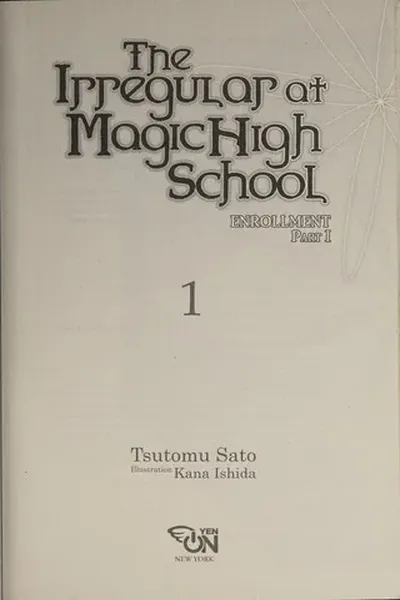





More Free Magic & Ritual Books
View all →