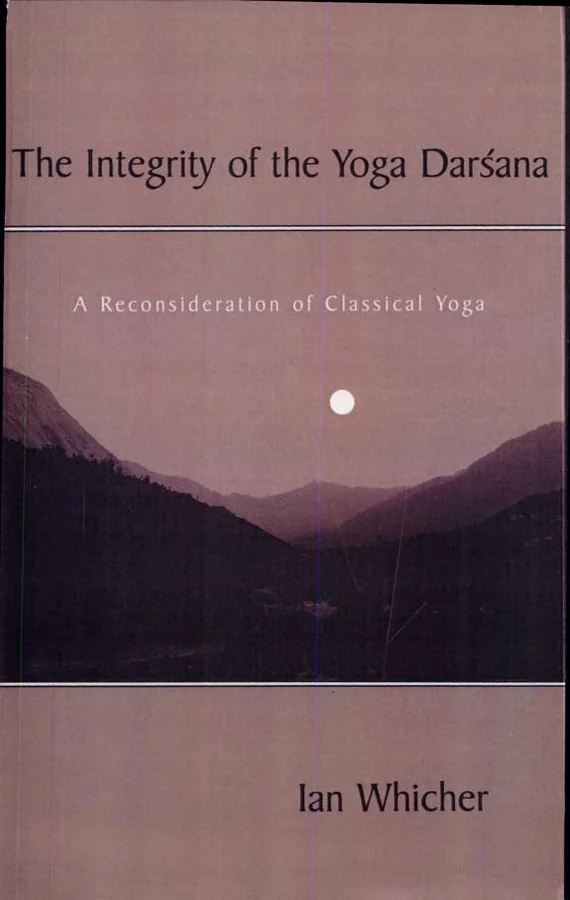
The Integrity of the Yoga Darśana
 71
71

The Integrity of the Yoga Darśana
Ian Whicher’s *The Integrity of the Yoga Darśana* is a vital corrective to the pervasive notion that classical Yoga advocates for a total abandonment of the phenomenal world. Whicher meticulously unpacks the Yoga Sutras, presenting a compelling case that Patañjali’s system offers a framework for living more fully and authentically within existence, rather than fleeing from it. His analysis of *viveka-khyāti* (discriminative discernment) as the mechanism for liberation, rather than mere ascetic withdrawal, is particularly sharp. The limitation, perhaps inherent in such focused academic scholarship, is that the prose can be dense, demanding close attention from the reader. A passage where Whicher dissects the subtle interplay between *samādhi* and embodied experience highlights the book’s rigor. Ultimately, this work is essential for anyone seeking to understand the philosophical depth of Yoga beyond contemporary trends.
📝 Description
71
Ian Whicher's 1998 book challenges the idea that Patañjali's Yoga Sutras demand worldly renunciation.
The Integrity of the Yoga Darśana scrutinizes Patañjali's classical Yoga Sutras, arguing against interpretations that call for complete detachment from the world. Ian Whicher proposes that the text actually supports an integrated approach, allowing practitioners to live fully without egoic entanglement. This scholarly study investigates the philosophical foundations of yoga, paying close attention to its claims about knowledge and existence.
Whicher's central argument focuses on *viveka-khyāti*, or discriminative discernment, and its importance for liberation. He explains how this discernment, developed through yoga practice, helps one distinguish the seer (*puruṣa*) from what is seen (*prakṛti*). This awareness, he contends, does not require withdrawal but a different way of being in the world, one free from the distortions of attachment and aversion.
This work engages with the philosophical traditions of classical Indian thought, specifically the Darśana schools. It addresses interpretations of yoga that have shaped spiritual practice for centuries, examining the tension between renunciation and active participation in life. By focusing on the Yoga Sutras, Whicher places his analysis within a lineage of texts that have profoundly influenced contemplative disciplines.
💡 Why Read This Book?
• Gain a philosophical understanding of *viveka-khyāti* as presented in Patañjali's Yoga Sutras, moving beyond simplistic notions of detachment to grasp a method for engaged living. • Understand the historical academic context of Yoga studies, specifically how scholars like Ian Whicher in 1998 challenged prevailing interpretations of asceticism versus worldly engagement. • Learn how the Yoga Darśana, as analyzed by Whicher, offers a framework for transcending egoic identification with worldly phenomena, fostering a more integrated and liberated experience of reality.
⭐ Reader Reviews
Honest opinions from readers who have explored this book.
❓ Frequently Asked Questions
Does Ian Whicher's book suggest abandoning yoga practice?
No, *The Integrity of the Yoga Darśana* argues for a deeper, more integrated understanding of yoga practice as described in Patañjali's Yoga Sutras, emphasizing engagement with the world rather than its rejection.
What is the main philosophical argument of 'The Integrity of the Yoga Darśana'?
The book's core argument is that the Yoga Sutras advocate for a path of liberation through discriminative discernment (*viveka-khyāti*), enabling fuller participation in life without enslavement to worldly identification.
When was 'The Integrity of the Yoga Darśana' first published?
The book was first published on January 1, 1998, placing it within a significant period of academic discourse on Yoga philosophy.
Who is Patañjali and why is he important to this book?
Patañjali is traditionally credited as the compiler of the Yoga Sutras, the foundational text analyzed in Whicher's work. His sutras form the basis of classical Yoga philosophy.
What does 'Yoga Darśana' refer to in the book's title?
'Yoga Darśana' refers to the philosophical system of Yoga, one of the six orthodox schools of Hindu philosophy, as codified in Patañjali's Yoga Sutras.
Does this book discuss modern yoga studios?
No, *The Integrity of the Yoga Darśana* focuses exclusively on the classical philosophical text of Patañjali's Yoga Sutras and its historical interpretations, not contemporary commercial yoga practices.
🔮 Key Themes & Symbolism
Liberation Through Discernment
The central thesis asserts that Patañjali's Yoga Sutras do not promote ascetic withdrawal but liberation through *viveka-khyāti*, or discriminative discernment. This concept involves a profound understanding of the self (*puruṣa*) distinct from the contents of consciousness and the material world (*prakṛti*). This discernment is cultivated not to escape reality, but to engage with it free from misidentification and suffering, allowing one to live more fully and authentically.
Reinterpreting Asceticism
Whicher challenges the common Western perception of Yoga as solely an ascetic practice aimed at detachment from the world. He argues that the 'abandonment' referred to in the Sutras pertains to the abandonment of ignorance and misidentification, not the physical world itself. The goal is a transformed relationship with existence, where worldly activities are performed with clarity and non-attachment, rather than a cessation of activity.
The Nature of Identification
A significant theme is the exploration of *asmitā* (ego or identification) and its role in perpetuating suffering. The book details how the Yoga system aims to dissolve false identifications with the body, mind, and egoic constructs. By understanding what one is *not*, the practitioner can realize their true nature as pure consciousness, enabling a more integrated and less reactive engagement with the external world.
Epistemology of Yoga
The work examines the epistemological framework of Yoga, examining how knowledge is acquired and validated within Patañjali's system. Concepts like *pramāṇa* (valid means of knowledge) and the role of meditation in achieving direct experiential insight are discussed. This focus highlights Yoga not merely as a set of techniques but as a sophisticated philosophical approach to understanding reality and one's place within it.
💬 Memorable Quotes
Direct passages from the work, attributed to the author.
“The Yoga-Sutras do not advocate abandonment of the world.”
— This core statement expresses the book's central argument, positing that Patañjali's path is not about escaping reality but about transforming one's relationship to it through self-knowledge.
“Liberation is achieved through discriminative discernment (*viveka-khyāti*).”
— This highlights the primary mechanism for spiritual freedom within the Yoga system as analyzed by Whicher, emphasizing clear perception over mere renunciation.
“The goal is to distinguish *puruṣa* from *prakṛti*.”
— This directly references the fundamental dualism in Samkhya-Yoga philosophy, which Whicher uses to explain how understanding one's true nature leads to liberation from suffering.
“Asceticism pertains to the abandonment of ignorance, not external objects.”
— This interpretation clarifies that the 'renunciation' in Yoga is internal – a shedding of delusion and misperception – rather than a physical rejection of the world.
💡 Key Ideas
Editorial paraphrase of the work's core concepts — not direct quotes.
One lives more fully in the world without being enslaved by worldly identification.
This paraphrased concept illustrates the practical outcome of practicing Yoga according to this interpretation: enhanced presence and freedom from egoic bondage in daily life.
🌙 Esoteric Significance
Tradition
While rooted in the classical Indian Samkhya-Yoga philosophical tradition, a lineage deeply influential within various esoteric streams, Whicher's work offers a perspective that can inform broader esoteric studies. It aligns with traditions that seek inner transformation for a more integrated worldly existence, rather than solely focusing on transcendence or occult powers. It speaks to the Hermetic principle of 'As Above, So Below' by suggesting that inner clarity leads to a more authentic engagement with the outer world.
Symbolism
The primary conceptual 'symbol' explored is *viveka-khyāti* (discriminative discernment), representing the enlightened perception that separates the true self (*puruṣa*) from the phenomenal world (*prakṛti*). Another motif is the concept of *samādhi*, not as mere trance, but as a state of profound, integrated awareness that enhances, rather than negates, one's capacity for action and understanding in the world.
Modern Relevance
Whicher's reinterpretation of Yoga’s purpose finds resonance today among practitioners and scholars disillusioned with the commercialization and superficialization of yoga in the West. Contemporary thinkers in contemplative studies and applied ethics draw upon this nuanced understanding to explore how ancient wisdom traditions can offer frameworks for navigating modern life's complexities with greater presence and ethical clarity, bridging the gap between spiritual insight and daily existence.
👥 Who Should Read This Book
• Students of classical Indian philosophy: Those studying the six orthodox schools of Hinduism will find a rigorous, philosophically grounded analysis of the Yoga Darśana, enhancing their understanding of Patañjali's system. • Yoga practitioners seeking depth: Individuals practicing yoga who wish to move beyond asana and explore the profound philosophical underpinnings of the tradition will gain a valuable perspective on its ultimate aims. • Comparative religion scholars: Researchers interested in how spiritual traditions are interpreted and adapted across cultures will find this work a case study in the critical re-evaluation of foundational texts.
📜 Historical Context
Published in 1998, Ian Whicher's *The Integrity of the Yoga Darśana* entered a scholarly landscape where interpretations of Patañjali's Yoga Sutras were often polarized. The late 20th century saw a surge in academic interest in Yoga, alongside its burgeoning popularity in the West, which frequently led to simplified or devotional readings detached from its philosophical rigor. Whicher's work engaged directly with the philosophical debates surrounding the text, particularly challenging interpretations that presented Yoga as purely an escapist path. He was part of a cohort of scholars, including Edwin Bryant, who were meticulously analyzing the Sanskrit sources and their philosophical underpinnings. The book offered a sophisticated counter-narrative to the prevailing Western understanding of yoga as primarily a physical or mystical practice, situating it within its classical Indian philosophical context and engaging with the nuances of its epistemology and ontology.
📔 Journal Prompts
Patañjali's concept of *viveka-khyāti* as a means to live more fully.
The distinction between abandoning ignorance and abandoning the world.
The role of *asmitā* (identification) in the Yoga Sutras.
How the Yoga Darśana's epistemological framework informs practice.
The implications of *puruṣa* and *prakṛti* for worldly engagement.
🗂️ Glossary
Yoga Darśana
The philosophical system of Yoga, one of the six classical schools of Indian philosophy, primarily codified in Patañjali's Yoga Sutras.
Patañjali
The sage traditionally credited with compiling the Yoga Sutras, the foundational text for classical Yoga philosophy.
Viveka-khyāti
Discriminative discernment; the key insight in Yoga philosophy that distinguishes the true self (*puruṣa*) from all that is not the self (*prakṛti*).
Puruṣa
In Samkhya-Yoga philosophy, pure consciousness; the self or spirit, which is unchanging and unaffected by the material world.
Prakṛti
In Samkhya-Yoga philosophy, primordial matter or nature; the fundamental substance from which the material universe and the mind arise.
Asmitā
Ego, self-sense, or identification; the mistaken sense of 'I-am-ness' that binds one to the cycle of suffering.
Samādhi
A state of profound meditative absorption or concentration; in Yoga, it refers to advanced stages of meditative attainment, culminating in liberation.
This book appears in 1 collection
🔮 Readers Also Liked
Browse all →









From the “Yoga” Collection
View all →





More Free Occult Philosophy Books
View all →