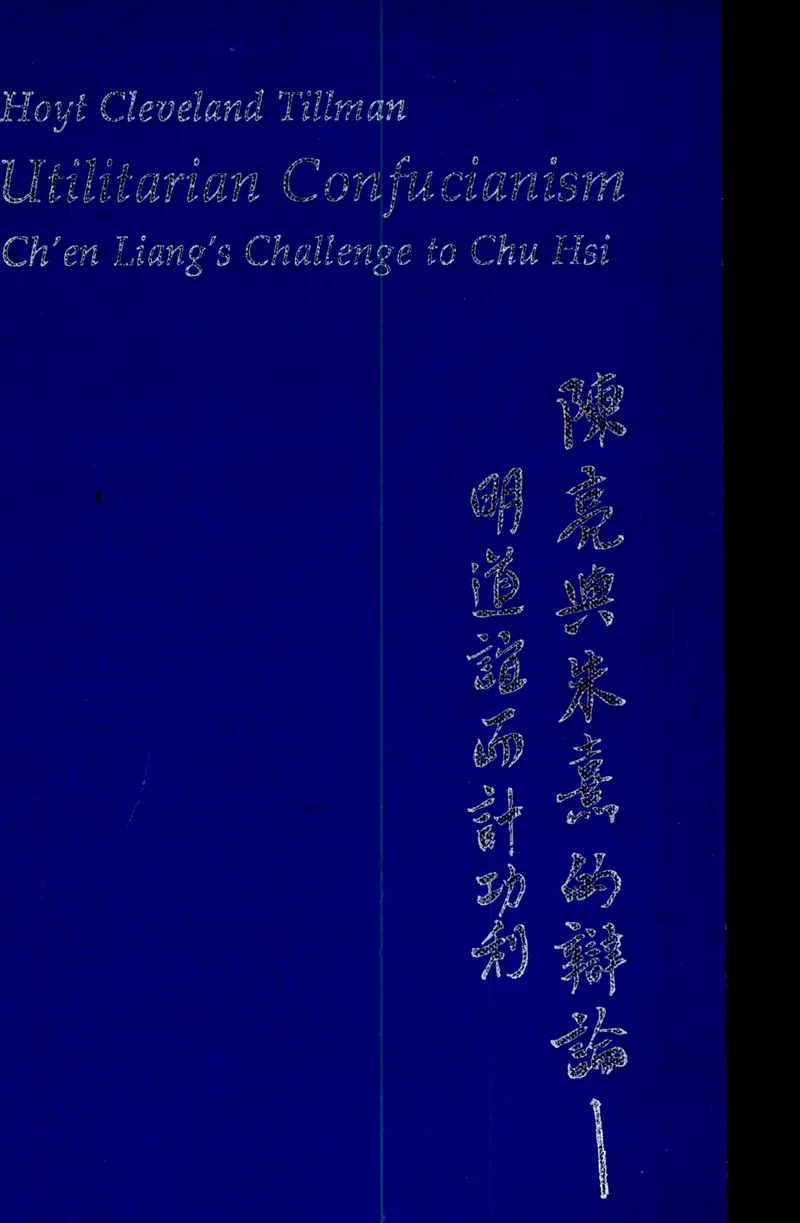
Utilitarian Confucianism
 76
76

Utilitarian Confucianism
Hoyt Cleveland Tillman's Utilitarian Confucianism offers a precise dissection of the intellectual currents that shaped Neo-Confucian thought during the Southern Sung period. The book's signal strength lies in its meticulous contextualization of the Chu Hsi-Ch'en Liang debate, moving beyond abstract philosophical differences to illuminate how these ideas were deeply intertwined with the personal and political lives of the thinkers. Tillman avoids hagiography, presenting both Chu Hsi and Ch'en Liang as complex figures wrestling with profound questions of governance and ethics. A limitation, however, is the dense academic prose which, while accurate, may pose a barrier for readers less steeped in Sung dynasty intellectual history. The exploration of Ch'en Liang's concept of 'utilitarianism'—his emphasis on practical efficacy in addressing current questions—is particularly illuminating, offering a vital counterpoint to more purely metaphysical interpretations of Confucianism. This work is essential for understanding the internal dynamism of Neo-Confucianism.
📝 Description
76
In 1993, Hoyt Cleveland Tillman analyzed a critical intellectual debate in Southern Sung China concerning Chu Hsi and Ch'en Liang.
This book examines the philosophical dispute between Chu Hsi and Ch'en Liang during the Southern Sung dynasty. Chu Hsi, a prominent Neo-Confucian, developed a metaphysical and ethical system. In contrast, Ch'en Liang blended Confucian humanism with practical, utilitarian ideas to tackle contemporary challenges. Tillman places this debate within its specific socio-historical setting.
The analysis focuses on how each thinker interpreted fundamental Confucian ideas such as jen (benevolence) and li (propriety/principle). Chu Hsi emphasized cultivating inner moral character and adhering to metaphysical doctrines. Ch'en Liang, while acknowledging these, prioritized their application to real social and political issues. He argued for Confucianism's effectiveness based on its capacity to resolve practical problems.
The volume is intended for scholars and advanced students of Chinese intellectual history, comparative philosophy, and political thought. It is particularly useful for those interested in the development of Confucianism beyond its classical forms. Readers seeking to understand the conflict between abstract ethics and practical governance in a non-Western framework will also find value here.
While not strictly esoteric in the sense of occult or mystical traditions, this work engages with a form of intellectual history that can be considered esoteric due to its specialized focus. It delves into the complex philosophical arguments of Chu Hsi and Ch'en Liang, whose debates shaped a major school of thought within Chinese civilization. Understanding their interpretations of core Confucian concepts requires a deep engagement with the philosophical traditions and historical context they inhabited, setting it apart from general philosophical inquiry.
💡 Why Read This Book?
• Understand the philosophical tension between abstract principle and practical governance, as exemplified by the Chu Hsi and Ch'en Liang debate in the Southern Sung dynasty. • Grasp how historical events, such as the Jurchen invasion in 1127, influenced the development of Neo-Confucianism and its interpretations. • Explore Ch'en Liang's unique synthesis of Confucian humanism with a pragmatic, 'utilitarian' approach to solving contemporary political and social problems.
⭐ Reader Reviews
Honest opinions from readers who have explored this book.
❓ Frequently Asked Questions
What is the primary intellectual conflict explored in Utilitarian Confucianism?
The book primarily analyzes the philosophical divergence between Chu Hsi, the architect of Neo-Confucianism, and Ch'en Liang, who proposed a more utilitarian and humanistic application of Confucian principles to contemporary issues.
What historical period does Utilitarian Confucianism focus on?
The work centers on the Southern Sung dynasty, specifically the intellectual climate during the 12th century, a period marked by significant political upheaval and philosophical reevaluation in China.
Who were Chu Hsi and Ch'en Liang?
Chu Hsi (1130-1200) was a preeminent Neo-Confucian philosopher whose ideas became orthodox. Ch'en Liang (1143-1194) was a contemporary philosopher who challenged Chu Hsi's interpretations by emphasizing practical governance and utilitarian concerns.
What does 'utilitarian Confucianism' mean in the context of Ch'en Liang's philosophy?
For Ch'en Liang, it meant prioritizing the effective application of Confucian ethics to solve real-world problems and address current societal needs, rather than focusing solely on metaphysical speculation or abstract moral cultivation.
What is the significance of the Southern Sung dynasty for this debate?
The Southern Sung dynasty (1127-1279) was a period of political crisis following the Jurchen invasion, which intensified debates about how Confucianism should respond to practical challenges and societal needs.
What is Neo-Confucianism?
Neo-Confucianism is a philosophical movement that emerged during the Tang and Sung dynasties, attempting to revitalize Confucianism by incorporating metaphysical and cosmological elements, with Chu Hsi being its most influential synthesizer.
🔮 Key Themes & Symbolism
Pragmatism in Neo-Confucianism
This theme explores the tension between abstract metaphysical principles and practical, utilitarian concerns within Neo-Confucian thought. It highlights Ch'en Liang's challenge to Chu Hsi's orthodoxy by emphasizing the efficacy of Confucian ethics in addressing contemporary political and social problems. The work demonstrates how philosophical systems can adapt or be reinterpreted to engage with the pressing issues of their time, suggesting that a philosophy's value is often measured by its ability to effect tangible change.
Intellectual Debate as Social Force
Utilitarian Confucianism illustrates how philosophical debates are not merely academic exercises but potent forces shaping societal norms and governance. The conflict between Chu Hsi and Ch'en Liang reflects broader anxieties and aspirations within the Southern Sung dynasty. Their differing interpretations of Confucian texts reveal how intellectuals grapple with tradition when confronted with political crisis and the need for effective leadership.
The Role of Humanism in Ethics
The book examines the integration of Confucian humanism with utilitarian considerations. Ch'en Liang's philosophy exemplifies a concern for human welfare and societal improvement, arguing that ethical principles must be grounded in their ability to benefit people. This contrasts with Chu Hsi's emphasis on a more comprehensive cosmological and moral order, prompting a consideration of how humanistic values are best served through philosophical practice.
Contextualizing Philosophical Orthodoxy
Tillman's work provides a crucial lens through which to view the establishment and challenge of philosophical orthodoxy. Chu Hsi's synthesis became the dominant form of Neo-Confucianism, yet Ch'en Liang's alternative offered a vital counter-narrative. Understanding this dynamic reveals how intellectual traditions evolve, facing internal critiques that test their relevance and adaptability over centuries.
💬 Memorable Quotes
Direct passages from the work, attributed to the author.
“Ch'en Liang represented an admixture of Confucian humanism with utilitarian approaches to current questions.”
— This concise statement captures Ch'en Liang's distinctive philosophical stance. It positions him as a thinker who sought to bridge the gap between deeply held ethical values and the practical demands of governing and societal improvement in his era.
“Chu Hsi, principal architect of Neo-Confucianism.”
— This highlights Chu Hsi's monumental influence in systematizing and popularizing Neo-Confucian thought. His synthesis became the standard interpretation for centuries, making any challenge to his framework a significant intellectual event.
“The debate... and its place in the lives of the two philosophers within a detailed intellectual and historical context.”
— This indicates the book's commitment to biographical and historical grounding. It suggests that the philosophical disagreements were not abstract but deeply embedded in the personal experiences and socio-political realities faced by Chu Hsi and Ch'en Liang.
“Analysis of the debate between Chu Hsi... and Ch'en Liang.”
— This phrasing emphasizes the core analytical task of the book: dissecting the specific points of contention between these two influential figures and understanding the intellectual underpinnings of their differing perspectives.
“Utilitarian approaches to current questions.”
— This phrase points to Ch'en Liang's focus on pragmatism and problem-solving. It suggests an emphasis on finding effective solutions to immediate challenges rather than adhering strictly to established doctrines or abstract ideals.
🌙 Esoteric Significance
Tradition
While Utilitarian Confucianism primarily engages with socio-political philosophy, its focus on the application of principles and the nature of effective governance can be seen as touching upon the practical or 'active' dimension often explored in esoteric traditions. Many esoteric paths emphasize not just inner transformation but also its outward manifestation and impact on the world. The debate between Chu Hsi and Ch'en Liang appeals to questions about how inner cultivation (moral or spiritual) translates into effective external action, a perennial concern in traditions seeking to harmonize the individual, society, and the cosmos.
Symbolism
The core concepts debated, such as 'jen' (benevolence) and 'li' (principle/propriety), function symbolically within Confucianism, representing the ideal ethical states and the underlying order of the universe. Chu Hsi's emphasis on 'li' often points to a structured, cosmic order, while Ch'en Liang's focus on 'utilitarian' application suggests a more dynamic, human-centered symbolism where ethical action is symbolized by tangible positive outcomes and societal well-being. The historical context of the Southern Sung itself, a period of displacement and rebuilding, can be seen as a symbol for the perennial human struggle to establish order and meaning amidst chaos.
Modern Relevance
The intellectual tension between principled idealism and pragmatic problem-solving, as articulated by Chu Hsi and Ch'en Liang respectively, remains highly relevant today. Contemporary political philosophy, ethical theory, and even discussions within spiritual communities often grapple with this dichotomy. Thinkers and practitioners interested in applied ethics, social justice movements, and effective leadership can draw insights from Ch'en Liang's emphasis on actionable solutions and the critique of purely theoretical approaches. The work speaks to modern concerns about the efficacy of ideals in a complex world.
👥 Who Should Read This Book
• Scholars of East Asian philosophy and intellectual history seeking a deep dive into the Neo-Confucian synthesis and its internal critiques. • Students of comparative political theory interested in how different cultures have approached the balance between ethical ideals and pragmatic governance. • Individuals fascinated by the evolution of philosophical traditions and how historical events shape abstract thought, particularly concerning Confucianism's enduring influence.
📜 Historical Context
Utilitarian Confucianism is firmly rooted in the tumultuous intellectual range of the Southern Sung dynasty (1127-1279). This era, following the Jurchen conquest and the establishment of a new regime in the south, was marked by a profound need to reassert cultural identity and find effective governance. Neo-Confucianism, particularly the system elaborated by Chu Hsi (1130-1200), had become the dominant intellectual orthodoxy, offering a comprehensive metaphysical and ethical framework. Ch'en Liang (1143-1194), however, represented a significant intellectual challenge. His philosophy, infused with a pragmatic and utilitarian spirit, emphasized the direct application of Confucian principles to solve pressing contemporary issues. This debate was not merely academic; it occurred within a context where political effectiveness and moral rectitude were under intense scrutiny. Ch'en Liang's approach implicitly questioned the perceived detachment of Chu Hsi's more abstract cosmological and ethical system from the immediate needs of the state and society. The intellectual currents of the time included a strong emphasis on the Classics, but also a growing awareness of the practical failures that had led to the dynasty's territorial losses.
📔 Journal Prompts
The contrast between Chu Hsi's metaphysical principles and Ch'en Liang's utilitarian approach to current questions.
Ch'en Liang's synthesis of Confucian humanism with practical problem-solving.
The impact of the Southern Sung dynasty's political context on philosophical discourse.
The specific challenges Chu Hsi faced in establishing Neo-Confucian orthodoxy.
The role of 'jen' (benevolence) in both Chu Hsi's and Ch'en Liang's philosophies.
🗂️ Glossary
Neo-Confucianism
A philosophical movement that emerged in China from the Tang dynasty onwards, seeking to synthesize the ethical and social teachings of Confucius with metaphysical and cosmological elements from Buddhism and Daoism. Chu Hsi was its most influential systematizer.
Chu Hsi
A central Chinese philosopher (1130-1200) of the Southern Sung dynasty, credited with systematizing Neo-Confucianism. His thought became the orthodox interpretation for centuries, emphasizing 'li' (principle) and 'qi' (vital force).
Ch'en Liang
A Chinese philosopher (1143-1194) of the Southern Sung dynasty, known for his critique of Chu Hsi's system. He advocated for a more pragmatic, utilitarian, and humanistic application of Confucian principles to contemporary issues.
Southern Sung Dynasty
The period of Chinese history from 1127 to 1279, when the ruling Song dynasty was forced to retreat south of the Yangtze River after invasion by the Jurchen Jin dynasty.
Jen (仁)
A core concept in Confucianism, often translated as benevolence, humaneness, goodness, or perfect virtue. It represents the ideal ethical quality of a person and the foundation of a harmonious society.
Li (理)
In Neo-Confucianism, particularly Chu Hsi's thought, 'li' refers to principle, pattern, or order. It is often contrasted with 'qi' (vital force or material energy) and represents the underlying rational structure of the universe and moral norms.
Utilitarianism (in Ch'en Liang's context)
While not modern utilitarianism, Ch'en Liang's approach emphasized the practical efficacy and beneficial consequences of applying Confucian ethics to solve current societal and political problems, prioritizing tangible results.