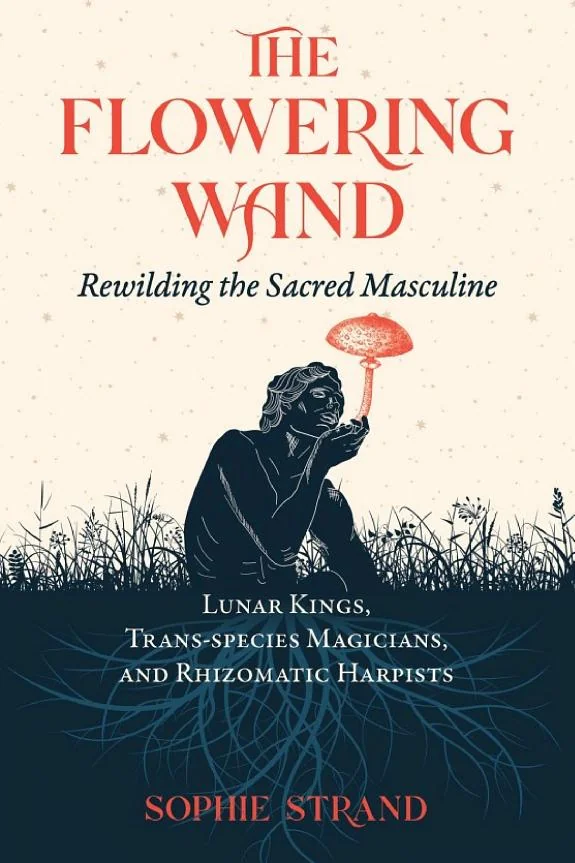
The Flowering Wand
 72
72

The Flowering Wand
Sophie Strand's The Flowering Wand offers a compelling re-reading of sacred masculinity, grounding it not in dominion but in fungal networks and ecological interdependence. The exploration of Osiris as a restorative archetype, supported by the analysis of Orphic mysteries as a subterranean mycelium, is particularly illuminating. Strand adeptly shifts focus from the individual hero's journey to collective, earth-based regeneration. A limitation might be the dense layering of concepts, which occasionally requires careful rereading to fully absorb. However, the reinterpretation of Dionysus as a force of playful, invasive sexuality and ecological disruption provides a vital counterpoint to sterile, patriarchal notions of power. The book ultimately argues for a masculinity that mirrors the earth's own cycles of decay and renewal, a potent and necessary perspective.
📝 Description
72
Sophie Strand's The Flowering Wand (2022) redefines sacred masculinity through ecological systems.
The Flowering Wand examines the ecological dimensions of masculinity, proposing a redefinition beyond patriarchal interpretations. It looks at archetypes and myths through the lens of regenerative systems, particularly fungal networks. The book argues that these ancient narratives hold keys to understanding ecological restoration and spiritual wholeness, moving past conventional heroic journeys. It is for readers interested in the intersection of mythology, ecology, and esotericism. It appeals to those seeking to deconstruct traditional concepts of masculinity and explore alternative spiritual frameworks rooted in nature. Individuals drawn to comparative mythology, deep ecology, and post-patriarchal spiritual thought will find engagement here.
Published in late 2022, The Flowering Wand emerged during a period of heightened global environmental consciousness and renewed interest in ecological spirituality. It follows writers like Timothy Morton and Merlin Sheldrake who were popularizing concepts of fungal intelligence and ecological interconnectedness. The work engages with Jungian archetypes but reinterprets them through a more immanent, earth-based perspective, diverging from earlier, more anthropocentric myth criticism.
This work engages with Jungian psychology, specifically archetypes, but places them within a contemporary ecological framework. It draws parallels between ancient mystery traditions, like the Orphic rites, and contemporary ecological thought, particularly concerning fungal networks and regenerative processes. The book situates itself within a lineage of nature-based spirituality and post-patriarchal thought, reinterpreting mythic figures and narratives through an immanent, earth-centered perspective.
💡 Why Read This Book?
• Gain a new understanding of masculinity by exploring the restorative fungi archetype of Osiris, learning how ancient myths can inform ecological healing and spiritual wholeness. • Discover how the Orphic mysteries are presented as an underground mycelium, revealing a model for interconnectedness between humanity and the living forest. • Grasp the ecological meaning of Dionysus, understanding his role in teaching about invasive species and playful, fluid sexuality beyond rigid patriarchal structures.
⭐ Reader Reviews
Honest opinions from readers who have explored this book.
❓ Frequently Asked Questions
What is the central thesis of The Flowering Wand?
The book's central thesis is that sacred masculinity, when understood through ecological and mythological lenses, is deeply tied to regenerative processes, fungal networks, and the earth's cycles, offering an alternative to patriarchal dominance.
Which ancient myths are reinterpreted in The Flowering Wand?
The book reinterprets myths including the mysteries of Osiris, the Orphic traditions, the legends of Tristan and Merlin, the Grail cycle, and the nature-focused parables attributed to Jesus.
How does Sophie Strand connect fungi to mythology?
Strand uses the 'fungi archetype' to illustrate concepts of underground connection, decay, and regeneration found in figures like Osiris and in the structure of ancient mystery cults like the Orphic.
What is the significance of Dionysus in this work?
Dionysus is presented as a figure who teaches about the dynamics of invasive species and embodies a playful, non-rigid sexuality, offering a model for understanding ecological and social fluidity.
What does the book propose as an alternative to the hero's journey?
The book proposes an ecological model of regeneration and interconnectedness, viewing figures like Tristan and Merlin not through Campbell's singular hero's journey but as part of earth-based cycles.
When was The Flowering Wand first published?
The Flowering Wand was first published on November 29, 2022.
🔮 Key Themes & Symbolism
Fungal Masculinity
This theme redefines masculinity not as dominance but as a regenerative force mirroring fungal networks. It uses the "fungi archetype" to reinterpret figures like Osiris, seeing them as embodying cycles of decay, underground connection, and re-emergence. The book argues this ecological model offers a vital alternative to patriarchal structures, emphasizing interconnectedness and earth-based spirituality over hierarchical power.
Mycelial Mysteries
The Orphic mysteries are framed as a subterranean mycelium, a living network linking forests and people. This concept illustrates how ancient spiritual practices understood deep ecological interconnectedness. It suggests these traditions offer blueprints for contemporary spiritual renewal, demonstrating a way of being that is inherently part of the earth's systems, not separate from them.
Dionysian Ecology
Dionysus is analyzed as a figure embodying ecological principles, particularly concerning invasive species and playful sexuality. His energy represents the wild, often disruptive, yet vital forces of nature. Strand uses this archetype to explore how transgression and fluidity in sexuality and ecology can be sources of creative renewal, challenging conventional notions of order.
Earth-Centric Jesus
Jesus's parables are re-examined through an ecological lens, highlighting his profound connection to the natural world. This perspective moves beyond anthropocentric interpretations to see his teachings as rooted in the regenerative processes of the earth. It positions Jesus as a figure who understood and communicated the spiritual significance of nature's cycles and inherent sacredness.
💬 Memorable Quotes
Direct passages from the work, attributed to the author.
“The Orphic mysteries as an underground mycelium linking forests and people.”
— This signifies a profound connection between ancient spiritual practices and ecological systems. It suggests that these mysteries weren't just abstract rituals but embodied an understanding of the earth's interconnectedness, much like a fungal network.
“The restorative fungi archetype of Osiris.”
— This reframes the Egyptian god Osiris not merely as a ruler or underworld deity, but as a symbol of regeneration and renewal, akin to how fungi break down decay to foster new life.
“Dionysus teaches us about invasive species and playful sexuality.”
— This highlights Dionysus's role as a force of untamed nature and fluid identity. It suggests his mythic energy can teach valuable lessons about ecological dynamics and non-binary expressions of sexuality.
“The ecology of Jesus as depicted in his nature-focused parables.”
— This points to a reading of Jesus's teachings through the lens of natural systems, emphasizing his alignment with the earth's processes and the inherent sacredness of the physical world.
“Liberates Tristan, Merlin, and the Grail legends from the bounds of Campbell’s hero’s journey.”
— This indicates the book offers alternative frameworks for understanding classic myths, moving beyond the singular, individualistic 'hero's journey' to more complex, ecological, and cyclical interpretations.
🌙 Esoteric Significance
Tradition
This work draws from and reinterprets elements found within Hermeticism, Gnosticism, and depth psychology, particularly Jungian thought. However, it significantly departs by centering an immanent, ecological spirituality rather than a transcendent or purely symbolic one. It moves beyond traditional esoteric lineages that often focus on individual enlightenment, instead proposing a collective, earth-bound form of spiritual restoration.
Symbolism
Key symbols include the **mycelial network**, representing interconnectedness, hidden knowledge, and the regenerative power found in decay. The **wand** itself, particularly when "flowering," symbolizes a masculinity that is not about domination but about growth, life-giving force, and deep ecological integration. **Fungi** are central, embodying cycles of death and rebirth essential for spiritual and ecological health.
Modern Relevance
The Flowering Wand appeals to contemporary movements in ecofeminism, queer ecology, and animistic spirituality. Thinkers and practitioners interested in decolonizing spirituality, challenging anthropocentrism, and finding new forms of relating to the non-human world find its arguments particularly relevant today.
👥 Who Should Read This Book
• Students of comparative mythology seeking to move beyond traditional Western frameworks and explore ecological interpretations of ancient stories. • Individuals interested in exploring alternative models of masculinity and spirituality that are grounded in nature and reject patriarchal dominance. • Readers engaged with ecopsychology, deep ecology, and contemporary esoteric thought who are looking for texts that bridge myth, science, and spiritual practice.
📜 Historical Context
Published in November 2022, The Flowering Wand arrived amidst a burgeoning wave of ecological thought and a re-evaluation of patriarchal structures in spiritual discourse. It engages with the legacy of Carl Jung but actively departs from more conventional interpretations of his archetypes, particularly his concept of the 'hero's journey.' Contemporaries like Timothy Morton, whose work on hyperobjects and ecological thought gained prominence in the 2010s, created fertile ground for Strand's ecological mythography. The book can be seen as a response to, or development from, the ecological turn in continental philosophy and ecopsychology. Its focus on mycelial networks and regenerative systems aligns with scientific discoveries and popularizations of fungal intelligence occurring throughout the 2010s and early 2020s, notably through figures like Merlin Sheldrake. The work offers a distinctly feminist and queer lens on masculinity, contrasting with more traditional, often heteronormative, analyses of mythological figures prevalent in earlier 20th-century scholarship.
📔 Journal Prompts
The fungi archetype of Osiris: What does regeneration look like in your own life or community?
Mycelial networks: How can you foster deeper interconnectedness with your local environment?
Dionysian energy: Reflect on the role of playful disruption in natural or social systems.
Jesus's nature parables: What ecological lessons are embedded in the natural world around you?
The flowering wand: In what ways can masculinity be understood as a force for growth rather than control?
🗂️ Glossary
Fungi Archetype
A concept introduced by Strand, reframing mythological figures through the lens of fungal processes: decay, underground connection, regeneration, and symbiotic relationships.
Mycelium
The vegetative part of a fungus, consisting of a network of fine white filaments (hyphae). In the book, it symbolizes interconnectedness, hidden networks, and ecological communication.
Orphic Mysteries
Ancient Greek religious rites associated with Orpheus. Strand interprets them as embodying a profound, earth-based understanding of life, death, and interconnectedness, akin to a mycelial network.
Dionysian Ecology
An approach that views the Greek god Dionysus as a symbol of ecological principles, including the dynamics of invasive species, wild growth, and fluid, non-hierarchical sexuality.
Restorative Masculinity
A concept posited in the book, defining masculinity not through dominance or control, but through its capacity for ecological integration, regeneration, and nurturing life cycles.
Hero's Journey
A narrative archetype identified by Joseph Campbell, describing the typical stages of a hero's adventure. Strand critiques its limitations for understanding ecological and collective myths.
Nature-Focused Parables
Teachings attributed to Jesus that draw heavily on natural imagery and processes, interpreted in the book as reflecting an ecological worldview.
This book appears in 1 collection
🔮 Readers Also Liked
Browse all →









From the “Orphic Mysteries” Collection
View all →







More Free Occult Philosophy Books
View all →