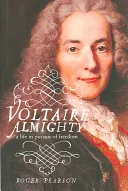
Voltaire Almighty
 72
72

Voltaire Almighty
Pearson's "Voltaire Almighty" presents a compelling, if occasionally dense, portrait of the Enlightenment's most formidable provocateur. The author excels at capturing Voltaire's indomitable spirit, particularly in depicting his protracted battles against religious persecution and censorship, such as the infamous Calas affair. Pearson doesn't shy away from Voltaire's contradictions – his embrace of aristocratic patronage alongside his championing of the common man. A notable strength is the detailed account of Voltaire's literary output and its reception, demonstrating how his plays and essays functioned as potent instruments of social critique. However, the narrative occasionally falters under the weight of its own detail, with some sections feeling more like a chronological listing of events than a deep dive into Voltaire's evolving thought. The book wisely avoids hagiography, presenting a complex figure whose legacy is as contested as his life was controversial. Pearson ultimately delivers a solid, fact-driven biography for those seeking to understand a pivotal figure in the Western intellectual tradition.
📝 Description
72
Roger Pearson's 2017 book examines Voltaire's eighty-four years of challenging societal and religious norms.
Roger Pearson's biography, Voltaire Almighty, details the life of François-Marie Arouet, known as Voltaire, from his birth in 1694 to his death in 1778. The book highlights Voltaire's persistent opposition to societal and religious constraints, noting how he even secured a Christian burial despite clerical opposition. Pearson recounts Voltaire's dual reputation as both a celebrated playwright and poet, and a sharp critic whose dedication to reason and human rights frequently brought him into conflict with authorities.
The work situates Voltaire within the early European Enlightenment, a period marked by a growing emphasis on reason, individualism, and skepticism toward established religious and political power. Pearson discusses how Voltaire, operating in a society still dominated by divine right and ecclesiastical influence, emerged as a prominent voice for civil liberties, religious freedom, and the separation of church and state. His critiques, often expressed through satire and dramatic works, directly engaged with the intellectual debates of his era, contrasting with more conservative philosophical currents and drawing considerable opposition from religious and political institutions.
While Voltaire himself was a product of the Enlightenment's focus on reason and empiricism, his life and writings resonate with a lineage of thinkers who questioned established dogma and sought a more rational understanding of the world. His persistent critique of religious institutions and his advocacy for individual liberty align with esoteric traditions that prioritize inner truth and direct experience over institutionalized belief. The book's focus on his battles against entrenched powers and his championing of secular humanism touches upon themes common in later esoteric movements that sought to reform or replace traditional religious frameworks with more philosophical or humanist approaches.
💡 Why Read This Book?
• Understand the practical application of Enlightenment ideals by studying Voltaire's defense of Jean Calas, illustrating his commitment to justice and challenging religious persecution. • Gain insight into the 18th-century intellectual landscape by examining Voltaire's deistic philosophy and his engagement with contemporary scientific and philosophical thought. • Appreciate the power of satire and literature as tools for social change through Voltaire's prolific career as a playwright and essayist, as detailed in the biographical narrative.
⭐ Reader Reviews
Honest opinions from readers who have explored this book.
❓ Frequently Asked Questions
When was Voltaire alive and what major historical period is he associated with?
Voltaire lived from 1694 to 1778, a period spanning the late Baroque and the height of the European Enlightenment. He is one of its most significant intellectual figures.
What was Voltaire's stance on religion and the church?
Voltaire was a vocal critic of religious intolerance and advocated for freedom of worship. While not an atheist, he was a prominent deist, believing in a creator God but rejecting organized religion's dogma and corruption.
What kind of literary works did Voltaire produce?
He was a prolific writer, known for his plays, poetry, philosophical essays, historical works, and satirical fiction. His writings often carried sharp social and political commentary.
What significant legal or social injustice did Voltaire champion?
Voltaire famously championed the cause of Jean Calas, a Protestant merchant wrongly accused and executed for murdering his son. Voltaire's campaign helped expose the injustice and led to Calas's posthumous exoneration.
What does the title 'Voltaire Almighty' suggest about the book's perspective?
The title likely alludes to Voltaire's immense influence and his often audacious, almost god-like defiance against the established powers of his time, while also perhaps hinting at his own critiques of divine authority.
What was the general reception of Voltaire's ideas during his lifetime?
Voltaire's ideas were met with both widespread admiration and fierce opposition. He was celebrated in salons and by intellectual circles but also faced censorship, exile, and imprisonment for his critiques.
🔮 Key Themes & Symbolism
Critique of Religious Intolerance
The work details Voltaire's fervent opposition to religious persecution and dogma, a central theme exemplified by his tireless advocacy in the Calas affair (1762-1765). Pearson illustrates how Voltaire used his platform to challenge the Catholic Church's dominance and advocate for the rights of religious minorities, particularly Protestants in France. This theme underscores his belief that reason and secular law should supersede sectarian fanaticism, a radical stance in 18th-century Europe.
Advocacy for Reason and Secularism
Central to Voltaire's philosophy, as explored in the book, is an unwavering commitment to human reason and empirical observation over superstition and blind faith. Pearson highlights Voltaire's deistic beliefs, positing a creator but rejecting the interventionist God of organized religion. This intellectual current fueled his arguments for secular governance, freedom of thought, and the separation of church and state, laying groundwork for modern secular societies.
Freedom of Speech and Civil Liberties
Voltaire Almighty examines Voltaire's lifelong crusade for freedom of expression and his famous (though possibly apocryphal) assertion, 'I disapprove of what you say, but I will defend to the death your right to say it.' The biography showcases how his writings, often provocative and satirical, directly challenged censorship and arbitrary authority, advocating for the fundamental right of individuals to voice their opinions without fear of reprisal.
The Role of Literature in Social Change
Pearson emphasizes how Voltaire masterfully employed various literary forms—plays, essays, and satirical tales like 'Candide'—as potent weapons for social and political commentary. The book demonstrates that Voltaire viewed literature not merely as entertainment but as a vital tool for disseminating Enlightenment ideals, exposing societal ills, and provoking critical thought among a broad readership, thereby driving intellectual and cultural reform.
💬 Memorable Quotes
Direct passages from the work, attributed to the author.
“A rebel from start to finish (1694 - 1778), Voltaire was an ailing and unwanted bastard child who refused to die; and when he did consent to expire some eighty-four years later, he secured a Christian burial despite a bishop's ban.”
— This opening salvo immediately establishes Voltaire's defiant nature and his lifelong struggle against societal and religious constraints. It frames his biography as a narrative of persistent will, even in death, highlighting his ability to navigate and ultimately subvert institutional opposition.
“his barbed wit and commitment to human reason got him...”
— This phrase points to the double-edged sword of Voltaire's intellectual arsenal. His sharp intellect and dedication to rational thought were the source of his influence but also led to significant conflict and persecution, marking him as a controversial figure.
“the toast of society for his plays and verse”
— This description captures Voltaire's initial success and popularity within aristocratic and intellectual circles. It contrasts with his later reputation as a radical critic, showing the evolution of his public persona and the risks he took by challenging established powers.
“Despite a bishop's ban.”
— This detail succinctly illustrates Voltaire's enduring defiance and his ability to exert influence even posthumously. It highlights the power struggle between his secular legacy and the authority of the Church, emphasizing his victory in securing a recognized burial.
“one of the major forces behind the European Enlightenment.”
— This statement positions Voltaire as an important figure in one of history's most transformative intellectual movements. It underscores the book's focus on his foundational role in shaping modern Western thought concerning reason, liberty, and tolerance.
🌙 Esoteric Significance
Tradition
While Voltaire himself was primarily a figure of the secular Enlightenment, his intellectual lineage can be traced through the Hermetic and Renaissance humanist traditions that emphasized reason and rediscovered classical wisdom. His deism, while distinct from organized esotericism, shares a foundation with certain mystical traditions in positing a divine order accessible through contemplation and reason, albeit rejecting supernatural revelation. His work's emphasis on individual liberty and critical inquiry aligns with certain strands of Gnosticism that challenged established religious hierarchies.
Symbolism
Within Voltaire's work, symbols often serve as vehicles for critique rather than mystical revelation. However, his persistent use of the 'infamous' (l'infâme) to denote religious superstition and fanaticism functions symbolically, representing the oppressive forces he battled. The image of the enlightened individual, armed with reason, stands as a symbol of progress against the darkness of ignorance and dogma. His advocacy for justice, particularly in the Calas case, symbolically champions the triumph of secular law and human rights over religious persecution.
Modern Relevance
Voltaire's enduring legacy is profoundly felt in contemporary debates surrounding freedom of speech, secularism, and human rights. Modern secular humanist movements and liberal political thought directly echo his arguments against religious extremism and for the separation of church and state. Thinkers and activists advocating for free expression in the face of authoritarianism or religious fundamentalism often draw upon his historical example and philosophical defense of open discourse.
👥 Who Should Read This Book
• Students of the Enlightenment seeking a biography that details the life and intellectual battles of a central figure. • Readers interested in the history of secularism and the evolution of religious tolerance in Western thought. • Individuals drawn to biographies of controversial intellectuals who challenged societal norms and faced significant opposition for their beliefs.
📜 Historical Context
Voltaire emerged during the ascendant phase of the European Enlightenment, a period characterized by a fervent belief in reason, empirical evidence, and human progress, often in direct opposition to the entrenched religious and political authorities of the Ancien Régime. He was a contemporary of thinkers like Jean-Jacques Rousseau and Denis Diderot, though often at odds with them, and his work engaged critically with the philosophical currents of both rationalism and empiricism. His prolific output, particularly his sharp critiques of religious intolerance and his advocacy for civil liberties, placed him squarely at the center of intellectual ferment. The reception of his ideas was polarized; while celebrated in progressive salons and by enlightened monarchs like Frederick the Great of Prussia, his writings frequently led to censorship, book burnings, and his own periods of exile or imprisonment, notably in the Bastille. This environment of intellectual challenge and societal resistance defined his career and solidified his status as a key figure in the secularization of European thought.
📔 Journal Prompts
Voltaire's critique of religious intolerance, particularly concerning the Calas affair.
The tension between Voltaire's deism and organized religion.
How Voltaire's advocacy for freedom of speech shaped Enlightenment discourse.
The symbolic representation of 'l'infâme' in Voltaire's writings.
Voltaire's use of literature as a tool for social and political change.
🗂️ Glossary
Enlightenment
An 18th-century intellectual and cultural movement emphasizing reason, individualism, skepticism, and science, challenging traditional authority, especially religious and political.
Deism
A philosophical belief in a creator God who does not intervene in the universe. Deists rely on reason and observation rather than divine revelation or religious dogma.
Calas Affair
The wrongful accusation and execution of Jean Calas, a Protestant, in 1762 for allegedly murdering his son. Voltaire championed Calas's case, exposing the religious prejudice involved and leading to a posthumous exoneration.
Ancien Régime
The political and social system in France before the Revolution of 1789, characterized by absolute monarchy and a rigid social hierarchy.
Secularism
The principle of separating religious institutions from the state and public life, ensuring freedom of religion and belief for all citizens.
Baroque
A style of art, music, and architecture prevalent in Europe from the early 17th to mid-18th centuries, characterized by drama, grandeur, and elaborate ornamentation.
Bastille
A medieval fortress in Paris used as a state prison. Its storming in 1789 marked an important moment in the French Revolution; Voltaire was imprisoned there earlier in his life.
This book appears in 1 collection
🔮 Readers Also Liked
Browse all →









From the “Enlightenment” Collection
View all →
![ERIC ED085284: World History. Volumes I and II. [Sahuarita High School Career Curriculum Project].](/img/thumb/eric-ed085284-world-history-volumes-i-and-ii-sahuarita-high-school-career-curriculum-project-eric.webp)


More Free Occult Philosophy Books
View all →