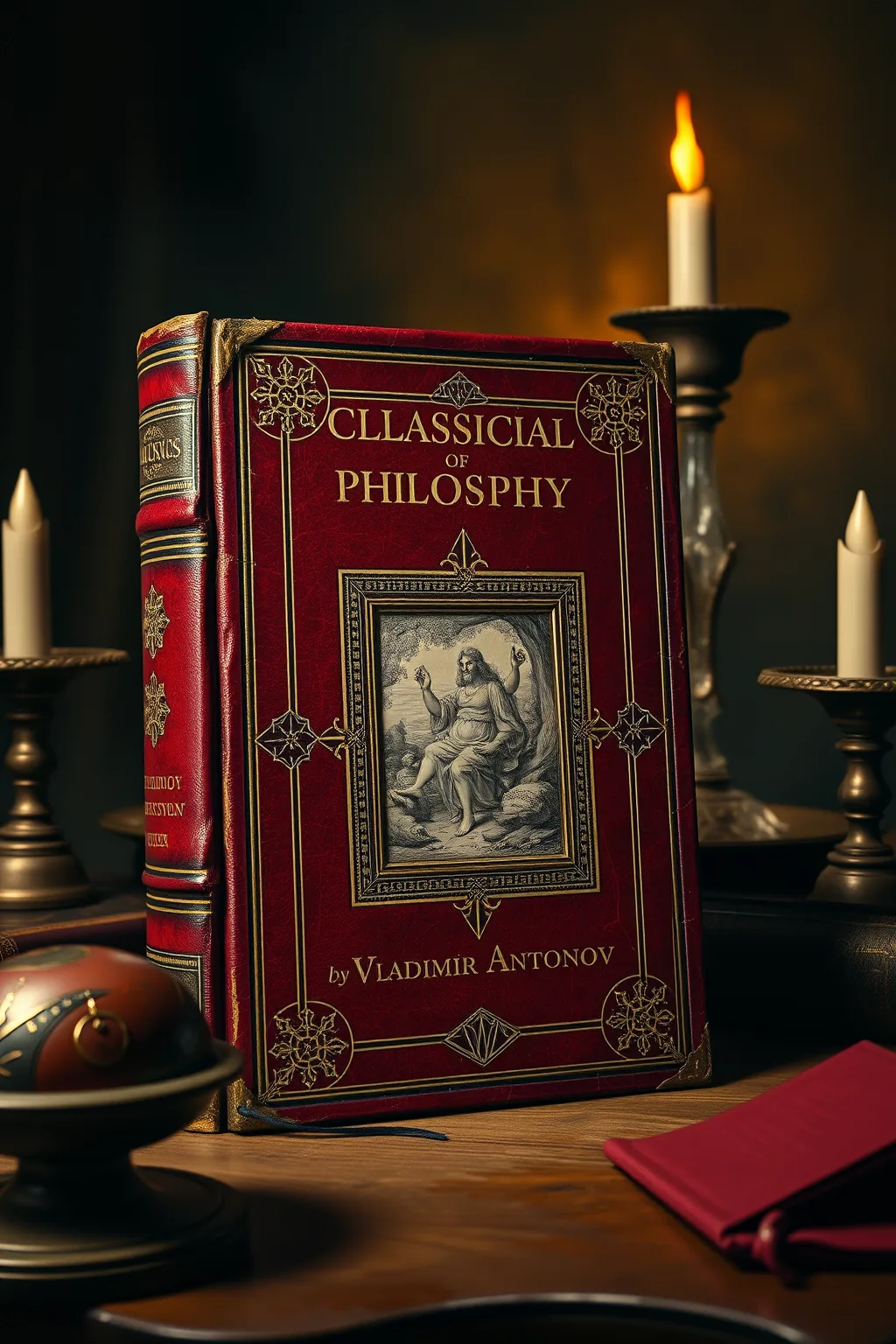
Classics of Spiritual Philosophy and the Present
 73
73

Classics of Spiritual Philosophy and the Present



Vladimir Antonov's 'Classics of Spiritual Philosophy and the Present' is an indispensable compendium for the serious student of the esoteric. Antonov masterfully navigates the vast landscape of global spiritual thought, distilling complex philosophies into accessible yet profound insights. Its strength lies in its ability to connect ancient wisdom to contemporary spiritual challenges, offering not just historical context but practical guidance for personal evolution. This is a work that rewards deep study, illuminating the shared wellsprings of human spiritual aspiration and providing tools for the dedicated practitioner. Highly recommended for seekers and scholars alike.
📝 Description
73
Vladimir Antonov's 'Classics of Spiritual Philosophy and the Present' examines spiritual thought from Pythagoras to modern masters.
This collection by Vladimir Antonov presents spiritual teachings across different eras and traditions. Antonov focuses on the connections between various esoteric systems, from ancient mystics like Pythagoras and Krishna to Christian teachings, shamanism, and Buddhist enlightenment. The book aims to show the common threads in spiritual understanding and practice throughout history.
It acts as a guide for those interested in personal spiritual growth. The text covers topics like self discovery and the path to divine realization. Readers will find discussions on the perennial philosophy, the structure of the cosmos, and humanity's shared pursuit of truth. The book seeks to broaden perception and inspire spiritual awakening.
This work is situated within the study of esoteric philosophies, which explore hidden or inner knowledge distinct from exoteric or public religious doctrines. It traces connections between disparate mystical and occult traditions, suggesting a unified underlying spiritual reality. The book engages with concepts often found in the Western esoteric tradition, such as the perennial philosophy, and draws parallels with Eastern spiritual paths and indigenous shamanic practices.
✍️ Author
Vladimir Antonov
Vladimir Pavlovich Antonov-Saratovsky (Russian: Владимир Павлович Антонов-Саратовский; 31 July 1884 – 3 August 1965) was a Russian revolutionary, Soviet jurist, and statesman..
💡 Why Read This Book?
This book offers a rare, comprehensive journey through humanity's most profound spiritual insights. It bridges ancient wisdom with modern challenges, serving as a practical guide for self-realization. Ideal for seekers of truth, students of comparative religion, and practitioners of spiritual disciplines seeking a deeper understanding of perennial philosophy.
⭐ Reader Reviews
Honest opinions from readers who have explored this book.
❓ Frequently Asked Questions
What is the primary focus of this book?
The book's primary focus is to explore the evolution and interconnectedness of spiritual philosophy across diverse traditions, offering insights for contemporary spiritual development and understanding.
Which historical figures and traditions are covered?
It encompasses figures like Pythagoras and Krishna, and traditions including Christianity, Shamanism, Buddhism, and teachings from individual spiritual masters.
Is this book suitable for beginners in spiritual study?
Yes, while comprehensive, it's structured to guide readers through complex ideas, making it accessible for those new to spiritual philosophy, acting as an excellent foundational text.
What makes this book unique compared to other spiritual philosophy collections?
Its unique strength lies in Vladimir Antonov's synthesis, highlighting the underlying unity of disparate traditions and presenting them as a continuous, relevant path for present-day spiritual growth.
Can this book be used as a practical guide for spiritual development?
Absolutely. The foreword explicitly states its potential as a manual for spiritual development, offering actionable wisdom and perspectives for personal growth and self-discovery.
🔮 Key Themes & Symbolism
The Perennial Philosophy
This theme looks at the concept of a universal, unchanging truth that underlies all religious and spiritual traditions. Antonov meticulously traces this thread through ancient texts and teachings, revealing how diverse cultures and eras have articulated the same fundamental principles of existence, consciousness, and the divine. It explores the common ground shared by mystics and sages across continents and centuries, offering a unifying perspective on humanity's spiritual quest and the inherent oneness of all being.
Spiritual Evolution and Practice
Beyond historical survey, the book functions as a practical manual for personal spiritual growth. It illuminates the 'how-to' of spiritual disciplines, drawing from the practices and insights of masters throughout history. Antonov presents the journey of spiritual evolution not as an abstract concept, but as an achievable path through dedicated effort, self-awareness, and the cultivation of higher consciousness. Readers are guided to understand the stages of development and the inner work required for profound transformation.
The Unity of Diverse Traditions
A central tenet of this work is the profound interconnectedness of seemingly disparate spiritual paths. Antonov demonstrates how traditions like Shamanism, Buddhism, and Christianity, despite their unique expressions, often share core esoteric principles and ultimate goals. This theme emphasizes that true spiritual understanding transcends dogma and ritual, pointing towards a universal experience of the divine that can be accessed through various means, fostering tolerance and a deeper appreciation for the richness of human spiritual heritage.
💬 Memorable Quotes
Direct passages from the work, attributed to the author.
“Ancient wisdom echoes in the silent spaces between our thoughts.”
— This highlights the subtle, often overlooked presence of profound spiritual truths that can be perceived when one cultivates inner stillness and quiets the mental chatter.
“Each tradition is a unique vessel, carrying the same celestial water.”
— This metaphor illustrates the core idea of the perennial philosophy: different religious and spiritual paths are merely distinct forms for expressing the singular, universal essence of divine reality.
“True knowledge is not accumulated, but realized through the transformation of consciousness.”
— This points to the experiential nature of spiritual understanding, differentiating it from mere intellectual acquisition and emphasizing the internal shift required for genuine wisdom.
💡 Key Ideas
Editorial paraphrase of the work's core concepts — not direct quotes.
The spiritual quest is a journey inward, a descent into the soul's deepest chambers.
This quote emphasizes the introspective nature of spiritual growth, suggesting that true understanding and connection with the divine are found by exploring one's inner self, rather than external doctrines.
The present moment is the crucible where past wisdom forges future enlightenment.
This quote underscores the relevance of historical spiritual teachings to contemporary life, suggesting that by applying ancient insights in the here and now, we can achieve spiritual progress.
🌙 Esoteric Significance
Tradition
This work draws deeply from the Hermetic and Neoplatonic traditions, which emphasize the underlying unity of all spiritual paths and the existence of a divine, immutable truth accessible through inner contemplation and disciplined practice. It aligns with the broader esoteric understanding of a hidden, intelligent order within the cosmos and the potential for human consciousness to connect with this order.
Symbolism
The book implicitly engages with universal archetypal symbols found across spiritual traditions: the divine spark within humanity, the journey of the soul, the cosmic tree, light as a metaphor for consciousness, and the cyclical nature of existence. These symbols are presented not as mere decorations, but as keys to understanding deeper spiritual realities and the stages of spiritual attainment.
Modern Relevance
In an age often characterized by fragmentation and spiritual searching, this book offers a vital synthesis. It provides a framework for understanding diverse spiritual expressions as part of a larger, coherent whole, empowering individuals to find their own path while appreciating the wisdom of others. Its emphasis on practical application makes ancient teachings relevant and actionable for contemporary spiritual practitioners seeking meaning and transcendence.
👥 Who Should Read This Book
This comprehensive volume is a treasure for a broad spectrum of readers. **Beginners** in spiritual philosophy will find a clear, expansive introduction to the foundational ideas that have shaped human consciousness. **Scholars** of religion, philosophy, and comparative mysticism will appreciate the meticulous research and insightful synthesis. **Seekers** of truth and meaning will discover a guiding light, useful diverse paths toward self-discovery and enlightenment. **Practitioners** of various spiritual disciplines will find a rich resource for deepening their understanding and refining their practice, connecting their personal journey to the grand set of human spiritual endeavor.
📜 Historical Context
Vladimir Antonov's 'Classics of Spiritual Philosophy and the Present' emerges from a rich intellectual milieu that has long sought to reconcile ancient wisdom with modern understanding. Compiled in the late 20th or early 21st century, it reflects a period of heightened interest in comparative spirituality, esotericism, and the perennial philosophy. This era saw a growing critique of purely materialistic worldviews and a resurgence of exploration into consciousness, metaphysics, and alternative paths to truth. Antonov's work positions itself within this lineage, drawing from and contributing to a tradition that seeks to bridge the gap between the sacred texts of antiquity and the lived experience of contemporary seekers, offering a holistic perspective on humanity's enduring spiritual heritage.
📔 Journal Prompts
Reflect on a core spiritual principle shared across different traditions presented in the book. How does this principle resonate with your personal beliefs?
Identify a spiritual master or tradition discussed that particularly intrigues you. What specific teachings or practices from them do you feel drawn to explore further?
Consider the 'rough hike' metaphor. Describe a challenging aspect of your own spiritual journey and how the wisdom from this book might offer guidance or perspective.
How does the concept of the 'perennial philosophy' challenge or affirm your current understanding of spirituality?
What practical steps can you integrate into your daily life based on the insights gained from this book to foster your own spiritual evolution?
🗂️ Glossary
Perennial Philosophy
The concept that all religions and spiritual traditions share a common, underlying essence or truth, often described as the divine, the absolute, or the ultimate reality.
Esotericism
Teachings and practices that are secret or intended for a select group of initiates, focusing on hidden knowledge, spiritual insight, and mystical experiences beyond exoteric religious doctrine.
Consciousness
The state of being aware of and responsive to one's surroundings; in spiritual contexts, it often refers to the faculty of awareness, mind, and the totality of subjective experience, often seen as capable of expansion and transformation.
Spiritual Development
The process of personal growth and transformation aimed at achieving a higher state of being, greater self-awareness, and deeper connection with the divine or ultimate reality.
Archetype
A universal, inherited pattern of thought or imagery derived from the experience of the race and present in the individual unconscious, often appearing in myths, religions, and dreams.
This book appears in 7 collections
🔮 Readers Also Liked
Browse all →









From the “Occultism” Collection
View all →







More Free Occult Philosophy Books
View all →