The essentials of Zen Buddhism

 74
74

The essentials of Zen Buddhism
Daisetsu Teitaro Suzuki's The Essentials of Zen Buddhism is a seminal text, and its enduring influence is undeniable. Suzuki’s strength lies in his ability to articulate the elusive nature of Zen without reducing it to academic jargon. He consistently points towards the experiential core of the practice. A passage discussing the nature of 'emptiness' (sunyata), for instance, avoids abstract philosophical definitions and instead gestures towards its lived reality as a freeing from conceptual limitations. However, the book’s primary limitation is its inherent subjectivity; Suzuki’s interpretation, while profound, is filtered through his own understanding and the needs of his Western audience. It sometimes feels more like an invitation to *his* Zen than a comprehensive survey of its diverse forms. Nevertheless, it remains a crucial touchstone for anyone beginning their study of Zen. It offers a clear, if personal, window into a vast tradition.
📝 Description
74
Daisetsu Teitaro Suzuki's 1962 book explains Zen Buddhism's core principles and practices.
Published in 1962, The Essentials of Zen Buddhism by Daisetsu Teitaro Suzuki is a direct explanation of Zen thought, focusing on its experiential nature. Suzuki, who was instrumental in introducing Zen to the West, presents the fundamental ideas of this Mahayana Buddhist school with clarity. The book is not a historical overview but an exposition designed to convey the felt experience of Zen, moving beyond its philosophical structure.
This work is for readers interested in an accessible introduction to Zen. It will appeal to those curious about Eastern philosophies, students of religion, and anyone drawn to contemplative practices. Readers who have encountered Zen concepts elsewhere and want to grasp their origins and deeper significance will find this a useful guide. It acts as a starting point for those new to Buddhist thought or a way to deepen existing knowledge.
Suzuki's work emerged in the mid-20th century, a time when Western interest in Eastern religions grew significantly, especially after World War II. His writings helped shape the Western understanding of Zen, bridging complex concepts for a non-specialist audience. This book reflects the era's intellectual atmosphere, marked by a search for spiritual alternatives and deeper existential questions.
💡 Why Read This Book?
• Gain an authentic introduction to core Zen concepts like satori and koans, as presented by a key figure who introduced Zen to the West in the mid-20th century. • Understand the emphasis on direct experience and intuition over intellectualism, a departure from many Western philosophical traditions, as articulated by Suzuki. • Grasp the significance of zazen (seated meditation) as the practical foundation for realizing Zen insights, a cornerstone of the practice explored in the text.
⭐ Reader Reviews
Honest opinions from readers who have explored this book.
❓ Frequently Asked Questions
When was Daisetsu Teitaro Suzuki's The Essentials of Zen Buddhism first published?
The Essentials of Zen Buddhism by Daisetsu Teitaro Suzuki was first published in 1962. This edition became a cornerstone for introducing Zen principles to a Western audience.
What is 'satori' as explained in The Essentials of Zen Buddhism?
Satori, as explored in Suzuki's work, refers to a moment of profound, intuitive awakening or enlightenment in Zen Buddhism. It is a direct apprehension of reality beyond conceptual thought.
What are koans, and how does Suzuki present them?
Koans are paradoxical riddles or questions used in Zen practice, famously explored by Suzuki. They are designed to exhaust the rational mind and provoke intuitive insight, moving beyond logical analysis.
Is this book a historical overview of Zen?
No, The Essentials of Zen Buddhism is not primarily a historical survey. Suzuki focuses on expounding the core principles and experiential aspects of Zen practice rather than a chronological account.
Who was Daisetsu Teitaro Suzuki?
Daisetsu Teitaro Suzuki (1870-1966) was a Japanese author and Buddhist philosopher instrumental in popularizing Zen Buddhism in the West through his extensive writings and lectures.
What role does meditation play in the book?
Meditation, specifically zazen (seated meditation), is presented as the fundamental practice for realizing Zen insights. Suzuki emphasizes its role in direct experience and cultivating a non-conceptual awareness.
🔮 Key Themes & Symbolism
The Nature of Awakening
Suzuki's work consistently points to 'satori,' the sudden, intuitive awakening central to Zen. This is not a gradual intellectual accumulation of knowledge but a direct, experiential realization of one's true nature and the nature of reality. The book explores how this awakening transcends dualistic thinking and ordinary conceptual frameworks, offering a glimpse into a state of clear insights that reorients one's perception of existence. It's presented as a direct experience, often sparked by the rigorous practice of meditation.
Koans as Tools for Insight
The use of koans is presented not as philosophical puzzles to be solved, but as potent psychological and spiritual tools. Suzuki explains how these paradoxical statements, like 'What is the sound of one hand clapping?', are designed to frustrate the logical, analytical mind. By confronting the limits of rational thought, practitioners are pushed towards a more intuitive mode of understanding, bypassing intellectualization to arrive at a direct apprehension of truth. The koan serves as a catalyst for breaking through habitual patterns of thinking.
Zazen and Direct Experience
Central to realizing Zen principles is the practice of 'zazen,' or seated meditation. Suzuki emphasizes that this is not merely a relaxation technique but a rigorous discipline for cultivating mindfulness and direct awareness. The book elucidates how zazen serves as the bedrock for all Zen practice, enabling the practitioner to observe the workings of their own mind without judgment and to experience reality 'as it is.' This direct, unmediated experience is the ultimate goal, transcending dogma and doctrine.
Beyond Conceptualization
A recurring theme is Zen's radical departure from purely intellectual or doctrinal approaches to spirituality. Suzuki highlights that Zen seeks a truth that cannot be captured by words or concepts. The book stresses the limitations of language in expressing ultimate reality and encourages a move towards intuitive understanding. This emphasis on direct apprehension challenges readers to question their reliance on rational thought and to explore the potential for knowing that lies beyond the intellect, a core tenet in esoteric traditions.
💬 Memorable Quotes
Direct passages from the work, attributed to the author.
“To have gone beyond the stage of intellectual knowledge and arrived at the stage of direct apprehension.”
— This highlights the core goal of Zen practice as described by Suzuki: transcending mere intellectual knowledge. The aim is to achieve a direct, intuitive grasp of reality, a form of knowing that is experiential and immediate, not learned.
“The koan is a tool to break the intellect.”
— Suzuki presents koans not as problems to be solved logically, but as devices designed to dismantle the ego's reliance on rational thinking. By confronting the paradoxical nature of a koan, the mind is pushed to its limits, potentially opening the door to intuitive insight.
“Satori is not a vision or a hallucination; it is the direct apprehension of the ego's non-existence.”
— This interpretation of satori emphasizes its transformative nature. It's described not as an altered state of consciousness in the common sense, but as a profound realization of the illusory nature of the self, leading to liberation.
“Zen is not a religion in the sense of an organized creed, but a realization of the truth that is already in us.”
— This framing positions Zen as an inner discovery rather than an external belief system. Suzuki suggests that the truth Zen points to is inherent within each individual, accessible through practice and direct experience, aligning with many esoteric philosophies.
💡 Key Ideas
Editorial paraphrase of the work's core concepts — not direct quotes.
Zen is the understanding that comes when the mind is no longer in the state of thinking.
This quote captures Zen's emphasis on direct experience over discursive thought. It suggests that true understanding arises when the mind ceases its usual analytical activity and enters a state of pure awareness, unclouded by conceptualization.
🌙 Esoteric Significance
Tradition
Suzuki's work serves as a bridge between Mahayana Buddhism and Western esoteric thought. While Zen itself is a distinct Buddhist tradition, Suzuki's presentation often aligns with esoteric principles emphasizing direct experience, inner realization, and the transcendence of ordinary consciousness. His efforts to make Zen accessible to a Western audience positioned it within a broader interest in contemplative practices and Eastern spirituality that flourished alongside movements like Theosophy and the growing study of comparative religion.
Symbolism
Though less overtly symbolic than some Western esoteric traditions, Zen relies on potent motifs. The 'empty mind' symbolizes a state of pure potentiality, free from egoic conditioning and conceptual clutter, a state sought in many mystical paths. The 'koan' acts as a symbolic key, designed to unlock deeper understanding by breaking down the rational mind's reliance on linear, dualistic interpretation, pushing towards a more holistic apprehension. 'Mu' (nothingness) is another key concept, representing not nihilism but the unconditioned reality beyond all conceptualization.
Modern Relevance
Suzuki's interpretations continue to influence contemporary mindfulness movements, secularized Buddhist practices, and psychological approaches seeking to integrate contemplative techniques. Thinkers and practitioners in fields ranging from cognitive science to therapeutic psychology draw upon the concepts of direct experience and non-dual awareness he popularized. His work remains a touchstone for those exploring the intersection of Eastern wisdom and Western existential inquiry, particularly within self-help and personal development spheres.
👥 Who Should Read This Book
• Students of comparative religion and philosophy looking to understand a major branch of Mahayana Buddhism as presented by a key Western interpreter. • Individuals interested in contemplative practices and meditation techniques seeking a foundational text on Zen Buddhism's experiential core. • Readers exploring esoteric traditions and alternative paths to spiritual realization, wishing to grasp Zen's unique approach to awakening and direct insight.
📜 Historical Context
Daisetsu Teitaro Suzuki's The Essentials of Zen Buddhism, first published in 1962, emerged during a vibrant period of cross-cultural intellectual exchange. Following World War II, Western interest in Eastern philosophies, particularly Zen, surged. Suzuki, already a prominent figure in the United States and Europe since the early 20th century, played an important role in this dissemination. His writings became the primary conduit for understanding Zen in the West, often presented in contrast to more scholastic or devotional religious forms. He engaged with thinkers like Erich Fromm, who co-authored 'Zen Buddhism and Psychoanalysis' (1958), demonstrating a dialogue between Zen and Western psychological thought. While Suzuki's work was widely influential, some scholars, like Arthur M. Sackett, later critiqued what they saw as a simplified or romanticized portrayal of Zen, suggesting Suzuki tailored his presentations for Western audiences. Nevertheless, Suzuki's prolific output solidified Zen's place in the Western esoteric and philosophical landscape.
📔 Journal Prompts
The concept of 'satori' as a direct apprehension beyond thought.
The function of koans in challenging rational understanding.
The practice of zazen as a path to direct experience.
Suzuki's emphasis on inner realization over external creed.
The idea of the 'empty mind' as a state of pure potentiality.
🗂️ Glossary
Satori
A Japanese Buddhist term for awakening or enlightenment. It signifies a sudden, intuitive moment of clear insights or realization, a direct apprehension of truth beyond intellectual understanding.
Koan
A paradoxical anecdote or riddle used in Zen Buddhism to provoke doubt and test a student's progress in Zen practice. Koans are intended to exhaust the rational mind and lead to intuitive understanding.
Zazen
The practice of seated meditation in Zen Buddhism. It is considered the fundamental practice for realizing Zen insights, emphasizing mindfulness and direct awareness of the present moment.
Mahayana Buddhism
One of the two major branches of Buddhism. Mahayana emphasizes the bodhisattva ideal and the concept of emptiness (sunyata), and Zen is a school within this tradition.
Sunyata
A central concept in Mahayana Buddhism, often translated as emptiness or voidness. It refers to the lack of inherent existence or self-nature in all phenomena, not as nothingness but as interdependence.
Daisetsu Teitaro Suzuki
A Japanese author and Buddhist philosopher (1870-1966) renowned for introducing Zen Buddhism to the Western world through his extensive writings and lectures, significantly shaping its perception.
Buddha-nature
The inherent potential for all sentient beings to attain enlightenment. In Zen, this is often understood as the true, unconditioned nature that is already present within each individual.
🔮 Readers Also Liked
Browse all →









More by Daisetsu Teitaro Suzuki
All books →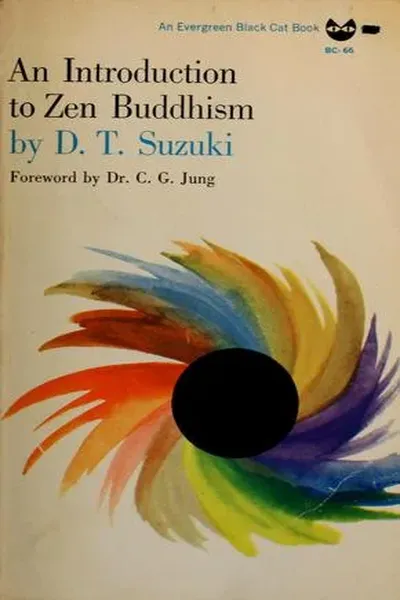





More Free Occult Philosophy Books
View all →