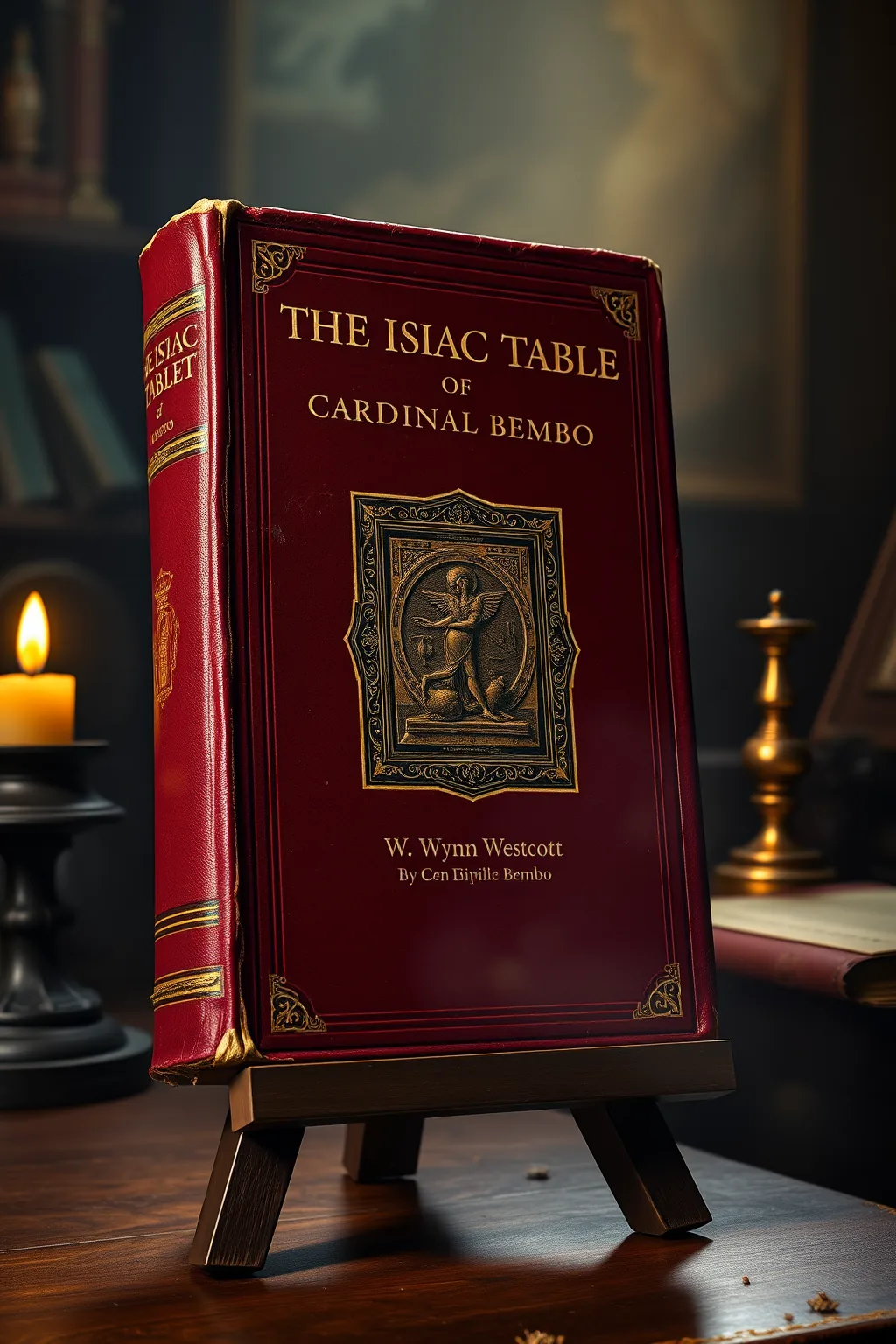
The Isiac Tablet of Cardinal Bembo
 74
74

The Isiac Tablet of Cardinal Bembo


Ophelia Vance, Mystical Literature Reviewer — W. Wynn Westcott's 'The Isiac Tablet of Cardinal Bembo' is an indispensable treatise for anyone seeking to unravel the deeper mysteries of the Tarot and ancient Hermetic thought. Westcott's scholarly yet accessible approach guides the reader through the labyrinthine symbolism of the Mensa Isiaca, revealing its profound connection to esoteric traditions. He deftly bridges the gap between historical artifact and occult doctrine, demonstrating the tablet's enduring significance. This work is a treasure for practitioners and scholars alike, offering clarity and profound insight into a cornerstone of Western esoteric philosophy. A truly illuminating read for the dedicated seeker.
📝 Description
74
W. Wynn Westcott published 'The Isiac Tablet of Cardinal Bembo' in 1897, analyzing a Roman artifact.
W. Wynn Westcott's 1897 book examines the Isiac Tablet of Cardinal Bembo, a 1st-century Roman bronze artifact inlaid with silver and enamel. While its iconography references Egyptian deities, Westcott argues the tablet originated in Rome, a center for various spiritual practices. He systematically breaks down the tablet's complex symbols, questioning prior interpretations. Westcott proposes the artifact is not simply decorative but acts as a cipher for hidden philosophical ideas. He connects it to the development of the Tarot's esoteric language. This work is for those studying Hermeticism, Alchemy, and Western esoteric traditions.
This book engages with the Hermetic tradition, particularly as it manifested in Renaissance thought and later occult revivalism. The Isiac Tablet itself represents a blend of Egyptian religious imagery with Roman interpretations, a common theme in esoteric studies that seek connections across cultures and time. Westcott's analysis places the artifact within a lineage of symbolic systems used to convey hidden knowledge, aligning with alchemical and Neoplatonic philosophies that influenced Western esotericism.
💡 Why Read This Book?
Uncover the hidden language of the Tarot through a legendary artifact. 'The Isiac Tablet of Cardinal Bembo' offers a direct link to ancient esoteric wisdom, revealing the philosophical underpinnings of occult practices. Ideal for Tarot enthusiasts, Hermetic scholars, and seekers of lost knowledge, this book provides a unique lens through which to view symbolic systems and the enduring power of ancient mysteries.
⭐ Reader Reviews
Honest opinions from readers who have explored this book.
❓ Frequently Asked Questions
What is the Isiac Tablet?
The Isiac Tablet, also known as the Mensa Isiaca, is a 1st-century Roman bronze artifact with intricate silver and enamel inlay. It depicts Egyptian deities and themes but is Roman in origin, serving as a rich source of esoteric symbolism.
Who was W. Wynn Westcott?
W. Wynn Westcott was a prominent English lawyer, occultist, and one of the founders of the Hermetic Order of the Golden Dawn. He was a prolific author and scholar of esoteric literature, known for his rigorous research and insightful interpretations.
What is the connection between the Isiac Tablet and the Tarot?
Esotericists like Westcott, Eliphas Levi, and Manly P. Hall believed the Isiac Tablet held a symbolic key to understanding the archetypes and meanings within the Tarot cards, viewing it as a foundational text for Tarot divination and philosophy.
Is this book suitable for beginners?
While rich in detail, the book is best appreciated by those with some familiarity with esoteric concepts. However, its clear explanations can serve as an excellent introduction to the deeper symbolic language of Hermeticism and the Tarot.
Where can I find the Isiac Tablet today?
The Isiac Tablet is a significant artifact displayed in the Capitoline Museums in Rome, Italy, allowing visitors to view the object of Westcott's profound study firsthand.
🔮 Key Themes & Symbolism
The Mensa Isiaca as an Esoteric Cipher
Westcott meticulously deconstructs the Isiac Tablet, arguing that its intricate imagery is not merely decorative but a sophisticated symbolic language. This theme explores how the tablet functions as a cipher, concealing profound philosophical and spiritual truths within its Roman-Egyptian fusion. It looks at the potential for the tablet to serve as a 'Rosetta Stone' for deciphering ancient occult doctrines and understanding the underlying principles that informed later esoteric systems, particularly the Tarot.
Hermeticism and the Synthesis of Cultures
This theme examines the Isiac Tablet as a product of Roman culture's assimilation of Egyptian religious and philosophical ideas. Westcott highlights how the tablet embodies the Hermetic principle of 'as above, so below,' reflecting a synthesis of diverse spiritual streams. It explores the syncretic nature of ancient thought, where Egyptian mysticism met Roman practicality and philosophical inquiry, creating a fertile ground for esoteric knowledge to flourish and be encoded in tangible artifacts.
The Isiac Tablet and the Foundations of Tarot
A central thesis of Westcott's work is the direct link between the Isiac Tablet and the esoteric development of the Tarot. This theme investigates how the tablet's symbolism, its archetypal figures, and its narrative structure are interpreted as a precursor or direct influence on the Major Arcana. It explores the idea that understanding the tablet is essential for a deeper comprehension of Tarot's divinatory and spiritual dimensions, positioning it as a crucial artifact for Tarot scholars and practitioners.
💬 Memorable Quotes
Direct passages from the work, attributed to the author.
“Egyptian themes, Roman execution, Hermetic essence.”
— This concise phrase highlights the tablet's hybrid nature – its Egyptian motifs, Roman craftsmanship, and the underlying universal spiritual principles of Hermeticism it is believed to represent.
“A bridge between the visible and the divine.”
— This suggests the tablet serves as an intermediary, connecting the mundane world of observation to the higher areas of spiritual understanding and divine revelation.
“The language of the ancients, whispered through metal.”
— This evocative quote emphasizes the tablet's role as a carrier of ancient wisdom, its symbols speaking to us across millennia through its physical form and intricate design.
“Within its patterns lie the seeds of future wisdom.”
— This implies that the tablet's symbolism is not static but contains foundational ideas that would influence and develop into later esoteric systems, such as the Tarot.
💡 Key Ideas
Editorial paraphrase of the work's core concepts — not direct quotes.
The Tablet is a key to unlock the hidden meaning.
This quote captures the core argument that the Isiac Tablet is not merely an artifact, but a symbolic tool designed to reveal profound, concealed knowledge within esoteric traditions.
🌙 Esoteric Significance
Tradition
The Isiac Tablet is deeply rooted in the Hermetic tradition, a philosophical and religious system that emphasizes esoteric knowledge, the divine nature of humanity, and the interconnectedness of the cosmos. It draws heavily on syncretic influences, blending Egyptian religious iconography with Roman philosophical thought, a hallmark of Hermeticism's ability to absorb and reinterpret diverse spiritual streams into a unified esoteric framework.
Symbolism
The tablet is replete with potent symbols, including representations of Isis, Osiris, and other Egyptian deities, alongside astrological and alchemical motifs. These symbols are interpreted as representing fundamental cosmic principles, the journey of the soul, and the processes of transformation and regeneration central to Hermetic and alchemical teachings. The figures and their interactions are seen as allegories for spiritual evolution and the attainment of divine knowledge.
Modern Relevance
In contemporary esoteric studies, the Isiac Tablet remains a vital subject. Its perceived connection to the Tarot continues to fascinate practitioners, offering a tangible historical link to the development of divinatory systems. Scholars and occultists alike still find value in Westcott's analysis for understanding the symbolic language of antiquity and its enduring influence on modern occultism, mysticism, and the ongoing human quest for spiritual understanding.
👥 Who Should Read This Book
This important work is essential for serious students of Western Esotericism, particularly those focused on Hermeticism, Alchemy, and the Tarot. Occult historians and researchers will find Westcott's meticulous scholarship important for understanding the historical context and symbolic interpretation of ancient artifacts. Tarot practitioners seeking a deeper, historical understanding of the Major Arcana's roots will be profoundly enriched. Beginners in esoteric studies may find it dense but rewarding if approached with patience, offering a solid foundation in symbolic interpretation and ancient wisdom traditions. It is a must-have for collectors of rare occult texts and anyone dedicated to unraveling the mysteries of the past.
📜 Historical Context
The 17th century, the era when Athanasius Kircher first attempted to decipher the Isiac Tablet, was a period of intense intellectual curiosity and burgeoning interest in ancient civilizations. While the Renaissance had rekindled a fascination with classical antiquity, the subsequent centuries saw a more systematic, albeit often speculative, approach to understanding lost knowledge. The Enlightenment was on the horizon, yet the lingering influence of Renaissance Neoplatonism and Hermeticism, coupled with a growing enthusiasm for Egyptology (often romanticized), created a fertile ground for figures like Kircher to seek hidden meanings in ancient artifacts. W. Wynn Westcott, writing in the late 19th and early 20th centuries, operated within a revived occult revival, where figures like Madame Blavatsky and the Hermetic Order of the Golden Dawn sought to synthesize ancient wisdom traditions. His work on the Isiac Tablet reflects this era's drive to find tangible proof and symbolic keys to esoteric philosophies, often linking them to foundational texts and artifacts.
📔 Journal Prompts
Reflect on the concept of a 'symbolic cipher' as applied to the Isiac Tablet. How might other artifacts from antiquity be interpreted through this lens?
Consider the Hermetic principle of 'as above, so below.' How does the Isiac Tablet visually represent this principle, and how can you apply it to your own life?
Westcott links the Isiac Tablet to the Tarot. What aspects of the tablet's imagery resonate with your understanding of the Major Arcana cards?
Imagine you are a 17th-century scholar attempting to decipher the tablet. What initial impressions or theories would you form based on its visual elements?
How does the fusion of Egyptian and Roman elements in the Isiac Tablet reflect broader patterns of cultural exchange and syncretism throughout history?
🗂️ Glossary
Mensa Isiaca
Latin for 'Isiac Table,' referring to the bronze tablet with inlaid silver and enamel, believed to be of 1st-century Roman origin, depicting Egyptian themes.
Hermeticism
A philosophical and spiritual tradition based on the purported teachings of Hermes Trismegistus, emphasizing esoteric knowledge, divine wisdom, and the interconnectedness of the universe.
Alchemy
An ancient practice combining chemistry, metallurgy, astrology, art, medicine, and mysticism, often associated with the transmutation of base metals into gold and the pursuit of immortality or spiritual enlightenment.
Esoteric
Intended for or likely to be understood by only a small number of people with a specialized knowledge or interest; relating to or concerned with the occult.
Syncretism
The amalgamation of different religions, cultures, or schools of thought, often by blending their beliefs and practices into a new or hybrid system.
This book appears in 2 collections
🔮 Readers Also Liked
Browse all →









From the “Hermeticism” Collection
View all →








More Free Alchemy & Hermeticism Books
View all →