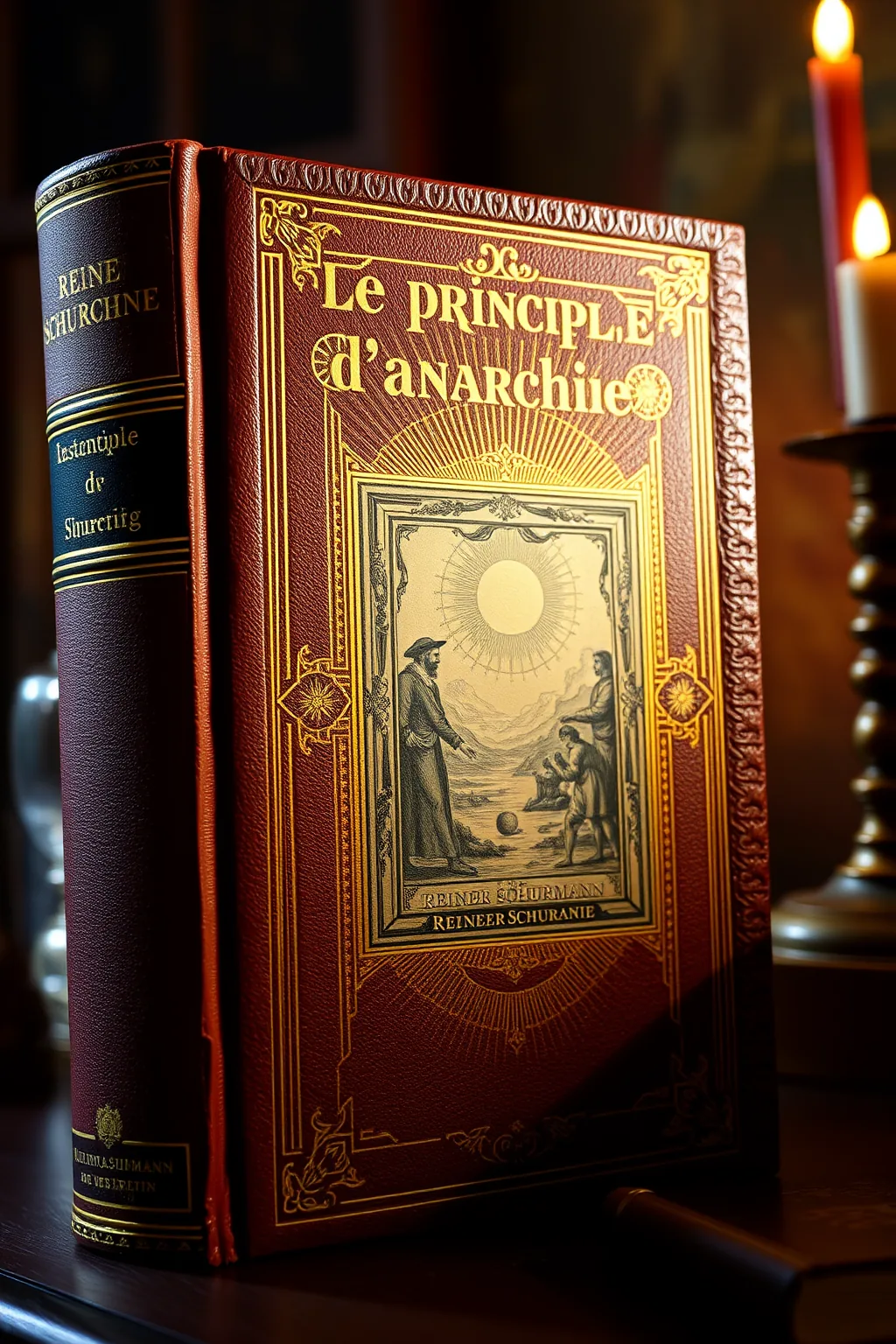
Le principe d’anarchie
 62
62

Le principe d’anarchie



Review by Isolde Whitaker (Sacred Texts Editor) — Reiner Schürmann's 'Le principe d’anarchie' is a tour de force in the realm of esoteric philosophy. Schürmann's deconstructionist analysis of Heidegger's thinking provides a fresh perspective on the end of metaphysical rationality. This book is a must-read for those interested in the occult and hermetic traditions, as it delves into the hidden knowledge that underpins our understanding of thought and action. Schürmann's work is particularly strong in its exploration of the relationship between theory and practice, making it an invaluable resource for both scholars and spiritual seekers.
📝 Description
62
Reiner Schürmann's 'Le principe d’anarchie' (1972) examines the breakdown of metaphysical certainties.
Published in 1972, Reiner Schürmann's 'Le principe d’anarchie' investigates the erosion of metaphysical structures and what that means for how we think and act. The book engages deeply with Martin Heidegger's philosophy, suggesting a departure from conventional rational thought towards an anarchic perspective. Schürmann employs a deconstructionist approach, urging readers to scrutinize their fundamental assumptions and beliefs.
The text fosters an environment of intellectual seriousness and introspective contemplation. It is aimed at individuals interested in the esoteric and hermetic traditions. Schürmann's contribution is his capacity to connect abstract theory with tangible practice. His ideas hold particular weight for those involved in spiritual practices and philosophical study.
This work engages with hermetic philosophy, a tradition that seeks hidden knowledge through symbolic interpretation and mystical experience. It approaches spiritual practice not as a separate domain but as intrinsically linked to philosophical inquiry. The book’s interest in questioning fundamental beliefs and seeking alternative understandings aligns with the hermetic pursuit of gnosis, or direct spiritual knowledge, often through challenging established doctrines.
💡 Why Read This Book?
Read 'Le principe d’anarchie' to explore the dissolution of traditional metaphysical foundations and their impact on contemporary thought and action. Ideal for seekers of hidden knowledge, philosophers, and practitioners of the occult and hermetic traditions, this book offers profound insights into the anarchic potential of human existence.
⭐ Reader Reviews
Honest opinions from readers who have explored this book.
❓ Frequently Asked Questions
What is the main theme of 'Le principe d’anarchie'?
The main theme is the dissolution of metaphysical foundations and the implications for thought and action in the absence of traditional rationalism.
Who is the intended audience for this book?
The book is intended for philosophers, spiritual seekers, and practitioners of the occult and hermetic traditions.
How does Schürmann's analysis differ from other philosophical works?
Schürmann's deconstructionist approach provides a unique perspective on Heidegger's thinking, focusing on the relationship between theory and practice in a post-metaphysical era.
What are the key insights offered by 'Le principe d’anarchie'?
The book offers insights into the anarchic potential of human existence and the hidden knowledge that underpins our understanding of thought and action.
Is this book suitable for beginners in philosophy?
While it is accessible to beginners, it is particularly valuable for those with some background in philosophy and the occult.
🔮 Key Themes & Symbolism
Anarchy and Metaphysics
Schürmann examines the dissolution of traditional metaphysical foundations, exploring the implications for thought and action in a post-rational world. This theme is central to understanding the anarchic potential of human existence.
Deconstructionist Analysis
The book offers a comprehensive deconstructionist interpretation of Heidegger's thinking, focusing on the relationship between theory and practice in the absence of metaphysical rationality.
Hidden Knowledge and Esoteric Insights
Schürmann's work is rich in esoteric insights, revealing hidden knowledge that underpins our understanding of thought and action. This theme appeals to those interested in the occult and hermetic traditions.
💬 Memorable Quotes
Direct passages from the work, attributed to the author.
“The relationship between theory and practice is crucial in a post-metaphysical era.”
— Schürmann emphasizes the importance of bridging the gap between abstract theory and practical application.
“Hidden knowledge reveals the true nature of our existence.”
— This insight appeals to those seeking esoteric and occult truths.
“Deconstructionist analysis offers a fresh perspective on Heidegger's thinking.”
— Schürmann's unique approach provides valuable insights into the philosopher's work.
“The anarchic potential of human existence is a profound revelation.”
— This theme is central to understanding the book's philosophical significance.
💡 Key Ideas
Editorial paraphrase of the work's core concepts — not direct quotes.
In the absence of metaphysical foundations, thought and action take on a new, anarchic potential.
This quote underscores the book's central theme of the dissolution of traditional rationalism.
🌙 Esoteric Significance
Tradition
This book belongs to the Hermetic tradition, focusing on the hidden knowledge and esoteric insights that underpin our understanding of thought and action. It appeals to those interested in the occult and hermetic philosophies.
Symbolism
Key symbols include the dissolution of metaphysical foundations and the anarchic potential of human existence. These symbols represent the hidden knowledge that Schürmann explores in his work.
Modern Relevance
Today, where traditional rationalism is increasingly questioned, 'Le principe d’anarchie' offers valuable insights into the post-metaphysical era. Modern practitioners and scholars use this book to understand the anarchic potential of human existence and the hidden knowledge that underpins our understanding of thought and action.
👥 Who Should Read This Book
Beginners in philosophy and the occult will find this book accessible and thought-provoking. Scholars of philosophy and hermeneutics will appreciate Schürmann's deconstructionist analysis. Spiritual seekers and practitioners of the occult and hermetic traditions will be drawn to the esoteric insights and hidden knowledge revealed in this work. Those interested in the dissolution of metaphysical foundations and the implications for thought and action will find this book particularly relevant.
📜 Historical Context
Published in an era where traditional metaphysical foundations were being questioned, 'Le principe d’anarchie' offers a timely exploration of the implications for thought and action. Schürmann's work has influenced contemporary philosophy and the occult community, providing a framework for understanding the dissolution of rationalism and the emergence of anarchic potential in human existence.
📔 Journal Prompts
How does the dissolution of metaphysical foundations impact your understanding of thought and action?
What are the implications of anarchic potential in human existence?
How does Schürmann's deconstructionist analysis influence your interpretation of Heidegger's thinking?
What hidden knowledge do you uncover in 'Le principe d’anarchie'?
How does this book challenge your existing beliefs and practices?
🗂️ Glossary
Deconstructionist Analysis
A method of critical examination that seeks to expose the underlying assumptions and contradictions in a text or philosophical system.
Metaphysical Foundations
The fundamental principles or beliefs that underpin our understanding of reality and existence.
Anarchic Potential
The capacity for thought and action to operate outside the constraints of traditional rationalism and metaphysical foundations.
Hermetic Tradition
A philosophical and spiritual tradition that focuses on hidden knowledge and esoteric insights, often associated with the occult.
Esoteric Insights
Deep, hidden knowledge that is revealed through mystical or philosophical inquiry, often associated with the occult and hermetic traditions.
This book appears in 3 collections
🔮 Readers Also Liked
Browse all →








From the “Hermeticism” Collection
View all →









More Free Alchemy & Hermeticism Books
View all →