The Easiest Way to Learn the Tarot - Ever!!
 71
71

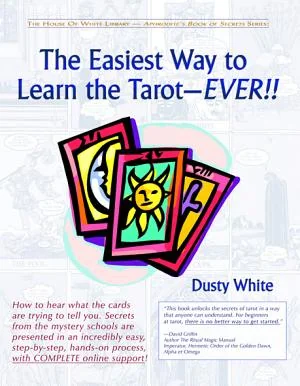
The Easiest Way to Learn the Tarot - Ever!!
Dusty White's "The Easiest Way to Learn the Tarot - Ever!!" tackles the perennial challenge of tarot acquisition with a refreshingly direct, hands-on ethos. The book’s strength lies in its immediate immersion. Rather than lengthy theoretical disquisitions, readers are prompted to pick up their decks and begin practicing from page one. This active engagement, as demonstrated in exercises like "card-talking," bypasses the often-daunting memorization phase that paralyzes so many beginners. However, this very focus on ease and speed might leave some users wishing for a deeper exploration of the tarot's historical and symbolic nuances. While the book promises mastery, the interpretation of complex multi-card spreads remains somewhat underdeveloped, leaning heavily on the foundational intuition built through its exercises. White’s insistence on a "fun" approach, while effective for accessibility, occasionally risks oversimplifying the profound archetypal energies at play. It’s a solid, if elementary, launchpad for the curious.
📝 Description
71
Dusty White's 2009 book argues that learning tarot hinges on intuition, not memorization.
This guide, first published in 2009, proposes a tarot learning method focused on intuitive connection. White emphasizes practical exercises to build a direct relationship between the reader and their deck. The book aims to make tarot symbolism understandable to anyone using a standard Rider-Waite-Smith deck. It is written for beginners who might find traditional tarot study intimidating or difficult. The approach assumes no prior knowledge, offering a simple entry point for those interested in personal insight or divination.
White's central idea is experiential learning. Instead of memorizing card meanings, readers are encouraged to "hear" the cards through simple spreads and prompts. This model suggests understanding develops naturally from repeated, playful engagement. The goal is a personal connection with the card imagery and archetypes, moving away from reliance on external guides or fixed interpretations. The exercises are designed to foster an organic comprehension of the tarot's symbolic language.
Published in 2009, 'The Easiest Way to Learn the Tarot - Ever!!' arrived during a resurgence of interest in divination. It connects to a tradition of tarot instruction that gained traction in the early 20th century, particularly with the 1909 Rider-Waite-Smith deck. White's book offers a contemporary take on learning this system, prioritizing a direct, personal interaction with the cards over academic study.
💡 Why Read This Book?
• You will learn to bypass the common beginner’s hurdle of memorizing card meanings by developing an intuitive connection through unique, playful exercises. This fosters a personal language with the cards that transcends rote learning. • You can expect to gain confidence in reading tarot quickly, as the book emphasizes immediate practical application rather than lengthy theoretical study, empowering you to perform basic readings almost immediately. • You will experience a sense of discovery by engaging with the tarot as a dialogue, learning to "hear" what the cards suggest through guided, interactive methods that make the learning process feel more like exploration than study.
⭐ Reader Reviews
Honest opinions from readers who have explored this book.
❓ Frequently Asked Questions
What makes Dusty White's tarot learning method different from traditional approaches?
White's method prioritizes intuitive engagement and practical exercises over memorizing vast lists of card meanings. It encourages a direct dialogue with the cards, aiming for understanding through experience rather than intellectual assimilation, a departure from more academic or rigidly structured learning systems.
Do I need any prior knowledge of tarot to use this book?
No, the book is specifically designed for absolute beginners. It assumes no prior knowledge and guides you through the process step-by-step, starting immediately with practical exercises using your tarot deck.
What kind of tarot deck is recommended for this book?
The book recommends using a standard Rider-Waite-Smith (RWS) style deck. These decks are widely available and their imagery forms the basis for the exercises and interpretations presented in the guide.
How quickly can I expect to learn tarot with this book?
The title suggests rapid learning, and the book's structure is designed for quick progress. By focusing on active practice, readers can anticipate being able to perform simple readings relatively quickly, often within hours of starting the exercises.
Does the book cover the historical origins of tarot?
While the book focuses on practical learning, it implicitly draws upon the legacy of the Rider-Waite-Smith deck, first published in 1909. The emphasis is on modern application rather than deep historical analysis.
Is this book suitable for someone who has tried learning tarot before and failed?
Yes, it is particularly suited for those who found traditional methods frustrating. Its emphasis on intuitive play and direct interaction aims to overcome common learning blocks associated with memorization and rigid interpretations.
🔮 Key Themes & Symbolism
Intuitive Card Connection
The book champions developing a personal, intuitive relationship with tarot cards. Instead of relying solely on memorized meanings, White guides readers to "hear" what the cards are communicating through their imagery and archetypes. This involves active engagement, such as looking at a card and describing what arises intuitively, fostering a dialogue that bypasses the intellectualization often associated with traditional tarot study. The goal is to make the cards speak directly to the reader's subconscious.
Experiential Learning Methodology
White’s approach is fundamentally experiential, moving away from passive learning. The core of the book consists of practical, fun exercises designed to be performed immediately with a tarot deck. Readers are encouraged to play with the cards, explore simple spreads, and discover meanings through direct interaction. This hands-on technique aims to build confidence and practical skill rapidly, making the learning process dynamic and engaging rather than purely academic.
Accessibility for Novices
Designed explicitly for beginners, the book removes barriers to entry for learning tarot. It explains the process by presenting it as accessible and enjoyable, requiring only a standard deck and the book itself. The language is straightforward, and the exercises are structured to build understanding incrementally. This focus ensures that individuals new to divination or esoteric studies can confidently begin their tarot journey without feeling overwhelmed.
The Rider-Waite-Smith Tradition
The book operates within the widely recognized framework of the Rider-Waite-Smith tarot system. It leverages the universally understood symbolism of the RWS deck, first published in 1909. By grounding its exercises in this popular and accessible deck, the book provides a practical entry point into a rich tradition of tarot reading, making its teachings relevant to a vast number of existing tarot practitioners.
💬 Memorable Quotes
Direct passages from the work, attributed to the author.
“You will spend your time playing with your cards, not memorizing rules.”
— This statement expresses the book's core philosophy: tarot learning should be an active, enjoyable process rooted in experience rather than a dry academic exercise. It promises a more engaging and effective path to understanding the cards.
“All you need to read the tarot is this book and a deck of cards.”
— This highlights the book's commitment to simplicity and accessibility. It reassures potential readers that no complex equipment or extensive background knowledge is required, making the practice of tarot reading seem attainable for everyone.
“This is the definitive guide to learning and mastering Tarot quickly and easily.”
— This claim, though marketing-oriented, sets a high expectation for the book's efficacy. It positions the work as a comprehensive and straightforward resource for anyone aspiring to gain proficiency in tarot reading with minimal difficulty.
💡 Key Ideas
Editorial paraphrase of the work's core concepts — not direct quotes.
Unique, fun, easy-to-learn exercises teach you how to hear what the cards are trying to tell you.
This paraphrased concept emphasizes the book's distinctive approach. It promises a method that cultivates intuitive perception, framing tarot reading as a form of communication rather than mere interpretation of symbols.
We start you immediately practicing our unique, easy and fun exercises with your cards.
This paraphrased concept underscores the book's immediate practical focus. It signals that readers will be actively engaged from the outset, applying learned concepts directly to their tarot deck, thereby accelerating the learning curve.
🌙 Esoteric Significance
Tradition
This work engages with the broad stream of Western esoteric traditions, specifically its modern manifestation through tarot. While not explicitly tied to a single lineage like Hermeticism or Kabbalah, it draws heavily on the symbolic language popularized by the Rider-Waite-Smith system, itself a synthesis influenced by earlier esoteric orders. Its significance lies in democratizing access to tarot, presenting it as an intuitive tool for personal development rather than solely a divinatory or ceremonial practice.
Symbolism
The book inherently works with the detailed symbolism of the Rider-Waite-Smith deck. Key motifs include the Fool's journey (representing new beginnings and leaps of faith), the archetypal figures of the Major Arcana (such as The Magician, The High Priestess, and The Emperor, embodying various powers and roles), and the elemental suits of the Minor Arcana (Wands, Cups, Swords, Pentacles), which represent different modes of action, emotion, thought, and material experience.
Modern Relevance
White's approach speaks to contemporary practices emphasizing mindfulness, self-discovery, and intuitive development. It aligns with modern psychological interpretations of tarot as a tool for introspection and archetypal exploration, rather than purely predictive divination. Its emphasis on ease and accessibility makes it relevant to a generation of practitioners exploring spirituality outside traditional religious or formal esoteric structures, often engaging through online platforms and self-study.
👥 Who Should Read This Book
• Absolute beginners curious about tarot who feel intimidated by complex systems or extensive memorization requirements. • Individuals seeking a practical, hands-on approach to learning divination that emphasizes intuition and personal connection over rigid rules. • Those who have previously attempted to learn tarot but found traditional methods frustrating or ineffective, looking for a more engaging and accessible learning style.
📜 Historical Context
Dusty White's "The Easiest Way to Learn the Tarot - Ever!!", published in 2009, arrived during a burgeoning era for esoteric and divination practices, significantly amplified by the internet. This period saw a surge in individuals seeking accessible spiritual tools and alternative wisdom traditions. The book taps into the enduring legacy of the Rider-Waite-Smith deck, a core part of modern tarot, first commissioned by Arthur Edward Waite and illustrated by Pamela Colman Smith in 1909. Unlike academic or deeply historical tarot texts, White's work reflects a contemporary trend towards practical, self-guided learning, often facilitated by user-friendly guides and online communities. It stands as an example of how foundational esoteric tools are being reinterpreted for a digitally connected, modern audience seeking personal insight and practical application, moving away from the more formalized esoteric societies of earlier decades.
📔 Journal Prompts
Reflect on a time you took a 'leap of faith' similar to The Fool.
Which card's imagery currently speaks most strongly to your inner state?
How does the 'playful' approach change your perception of learning tarot?
Describe a situation where you had to 'hear' unspoken messages.
What does the active engagement with your cards feel like compared to passive study?
🗂️ Glossary
Tarot Deck
A deck of 78 cards typically used for divination or self-exploration, consisting of 22 Major Arcana cards and 56 Minor Arcana cards divided into four suits.
Major Arcana
The 22 trump cards in a tarot deck, representing significant life lessons, archetypal energies, and major spiritual themes or events.
Minor Arcana
The 56 cards in a tarot deck divided into four suits (Wands, Cups, Swords, Pentacles), representing everyday events, actions, and challenges.
Rider-Waite-Smith Deck
A widely popular tarot deck first published in 1909, known for its clear imagery and symbolic richness, forming the basis for many modern tarot systems.
Spread
A specific arrangement of tarot cards laid out in a pattern to answer a particular question or explore a situation.
Intuition
The ability to understand something immediately, without the need for conscious reasoning; in tarot, it refers to the inner knowing that guides interpretation.
Archetype
A universal, symbolic pattern or image that recurs in the collective unconscious, often represented by the figures in the Major Arcana.
This book appears in 1 collection
🔮 Readers Also Liked
Browse all →









From the “Tarot” Collection
View all →






More Free Occult Philosophy Books
View all →