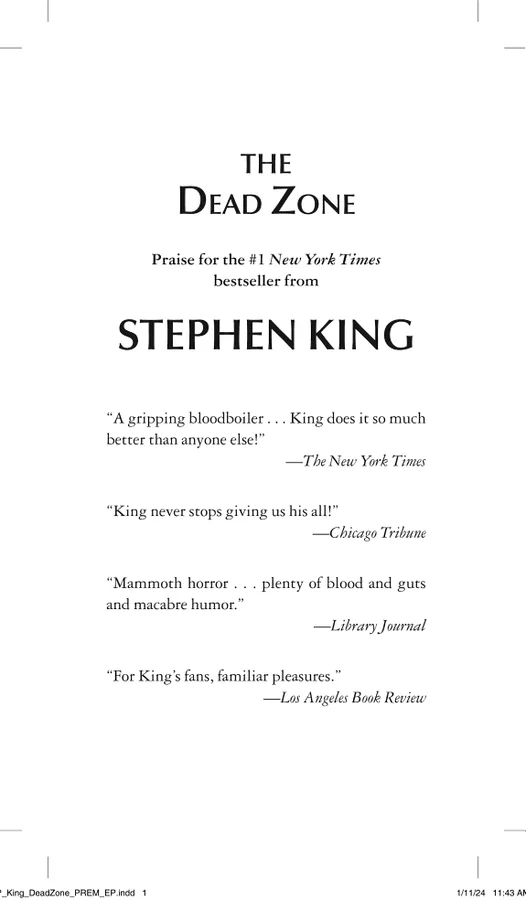
The Dead Zone
 72
72

The Dead Zone
Stephen King's The Dead Zone, while not his most overtly supernatural tale, offers a potent exploration of psychic precognition and its crushing weight. Johnny Smith's awakening in 1985 with an unwanted gift for seeing the future is rendered with King's characteristic blend of grounded characterization and escalating dread. The novel excels in portraying the personal cost of such abilities, particularly Smith's desperate attempts to forge a normal life against the tide of his visions. A particular strength lies in the depiction of his internal conflict; he doesn't seek out his powers but is tormented by their implications. However, the narrative's pacing occasionally falters in its middle sections, becoming somewhat bogged down in Smith's personal woes before the inevitable, climactic confrontation. The central thesis regarding the foreknowledge of a catastrophic future, specifically the potential rise of a dangerous political figure, remains chillingly effective. The Dead Zone is a solid, character-focused thriller that examines the ethical quandaries of knowing too much.
📝 Description
72
Johnny Smith awakens in 1985 with a psychic ability to see futures and pasts through touch.
Stephen King's 1979 novel, The Dead Zone, follows Johnny Smith after he wakes from a coma with precognitive powers. This "death zone" allows him to glimpse events through physical contact, a gift that becomes a heavy burden. He struggles to live a quiet life, but his visions often draw him into situations he feels compelled to address, despite the personal cost.
The narrative examines the moral weight of knowing future tragedies. Johnny grapples with the idea of destiny versus the possibility of changing outcomes, especially when he foresees a dangerous political figure. The book explores the isolation that such an extraordinary ability can bring, as Johnny finds himself apart from ordinary human experience. It is a story about the consequences of knowledge and the difficult choices it forces upon an individual.
Published in 1979, The Dead Zone taps into a cultural fascination with parapsychology and psychic phenomena prevalent during that era. Influences from Transcendental Meditation and the New Age movement were part of a broader societal interest in altered states and extrasensory perception. King's novel approached these ideas through a grounded, human lens, considering the psychological and ethical implications for an individual rather than focusing solely on the occult aspects.
💡 Why Read This Book?
• Gain insight into the psychological burden of precognition, as Johnny Smith grapples with visions of future calamities, particularly the threat posed by the political figure Greg Stillson. • Understand the concept of the "death zone" as a psychic locus, exploring how King presents this ability not as a superpower but as a source of profound personal anguish. • Examine the theme of free will versus determinism through Smith's struggle to alter or accept foreseen events, even when the consequences of his knowledge are devastating.
⭐ Reader Reviews
Honest opinions from readers who have explored this book.
❓ Frequently Asked Questions
When was Stephen King's The Dead Zone first published?
The Dead Zone by Stephen King was first published in 1979, a period when paranormal abilities and psychological thrillers were gaining significant traction in popular culture.
What is the "death zone" in Stephen King's The Dead Zone?
The "death zone" refers to the psychic space Johnny Smith enters when he touches someone or something, allowing him to see visions of their past or future.
What is the main conflict Johnny Smith faces in The Dead Zone?
Johnny Smith's primary conflict is wrestling with his unwanted psychic ability to see the future, particularly his vision of a dangerous political figure, Greg Stillson, who could lead to nuclear war.
Is The Dead Zone based on a true story?
While Stephen King draws inspiration from various sources, The Dead Zone is a work of fiction. However, it taps into widespread cultural fascination with psychic phenomena and precognition.
What are the key themes explored in The Dead Zone?
Key themes include the burden of knowledge, the nature of free will versus determinism, the ethics of using psychic abilities, and the isolation that comes with extraordinary gifts.
How does The Dead Zone differ from other Stephen King novels?
The Dead Zone focuses more on psychological suspense and the moral dilemmas of its protagonist's psychic abilities rather than overt horror or supernatural monsters, though it contains elements of dread.
🔮 Key Themes & Symbolism
The Burden of Precognition
Johnny Smith's ability to see the future, termed the "death zone," is not a gift but a profound burden. He is haunted by visions of impending disasters and personal tragedies, forcing him to confront the moral quandaries of intervention versus acceptance. The narrative emphasizes the psychological toll this takes, showing how knowledge of inevitable suffering can lead to isolation and despair, particularly his foreknowledge of Greg Stillson's rise to power.
Free Will vs. Determinism
A central tension in The Dead Zone lies in the debate between fate and free will. Johnny sees potential futures, leading to questions about whether these futures are fixed or if his actions can alter them. His attempts to avert foreseen calamities, especially the potential nuclear war instigated by Greg Stillson, highlight this struggle. The novel probes whether knowing the future empowers one to change it or merely traps them within a predetermined path.
The Ethics of Psychic Power
The novel is deeply concerned with the ethical implications of possessing extraordinary abilities. Johnny Smith is reluctant to use his powers, fearing the consequences and the violation of others' privacy. His journey explores the responsibility that comes with such insight and the difficult choices he must make when faced with knowledge of evil. This theme is starkly illustrated by his ultimate decision regarding Greg Stillson.
Isolation and Connection
Johnny Smith's psychic gift isolates him from normal human connection. The "death zone" experience prevents him from forming lasting relationships, as the past and future of those he encounters become overwhelmingly apparent. His struggle to find love and normalcy, particularly with Sarah Bracknell, underscores the theme of isolation. The novel portrays how his unique perception of reality alienates him from the world around him.
💬 Memorable Quotes
Direct passages from the work, attributed to the author.
“The death zone is a place of awful knowing.”
— This interpretation of the "death zone" concept highlights its dual nature: it grants knowledge, but this knowledge is often grim or overwhelming. It speaks to the psychic burden Johnny carries, where insights into life and death are constantly present.
“Can one man truly change the course of history?”
— This question reflects the core of Johnny's dilemma. He possesses knowledge of a future catastrophe, specifically involving Greg Stillson, and must decide if his actions can, or should, alter such a monumental path.
“He touched the boy and saw his death.”
— This represents a common occurrence for Johnny. A simple touch can unleash visions of profound, often tragic, events, illustrating the involuntary and often devastating nature of his psychic gift.
“He didn't want the power, but he couldn't escape it.”
— This statement expresses Johnny Smith's central conflict. He is not a hero seeking power but an ordinary man burdened by an extraordinary, unwanted ability that dictates his life and forces him into extraordinary circumstances.
💡 Key Ideas
Editorial paraphrase of the work's core concepts — not direct quotes.
He saw the future, and it was a terrible thing.
This paraphrase captures the essence of Johnny Smith's primary affliction. His visions aren't of pleasant outcomes but of potential disasters, making his psychic ability a source of dread and moral anguish, rather than a tool for personal gain.
🌙 Esoteric Significance
Tradition
While not explicitly tied to a single esoteric lineage, The Dead Zone engages with themes common in Western esotericism, particularly those concerning precognition, fate, and the burden of knowledge, which echo Gnostic concerns about hidden knowledge and its implications for the soul. The concept of Johnny's "death zone" can be seen as a form of heightened psychic perception, a concept explored across various mystical traditions that posit access to non-ordinary states of consciousness.
Symbolism
The "death zone" itself functions as a potent symbol, representing the liminal space between life and death, past and future, consciousness and oblivion. The recurring motif of the politician Greg Stillson symbolizes the potential for unchecked ambition and demagoguery to lead humanity toward destruction, serving as a modern manifestation of archetypal destructive forces. Johnny's isolation represents the alchemical idea of the solitary seeker, set apart from the mundane world by their unique insights.
Modern Relevance
The Dead Zone remains relevant in contemporary discussions surrounding the ethics of information and foresight. Thinkers and practitioners exploring consciousness studies, parapsychology, and even speculative fiction continue to draw upon its exploration of psychic phenomena. The novel's portrayal of how foreknowledge can lead to moral paralysis or desperate action speaks to modern anxieties about global threats and the individual's role in confronting them.
👥 Who Should Read This Book
• Readers interested in the psychological impact of psychic abilities, particularly those who appreciate narratives that explore the burden and ethical complexities of precognition. • Students of speculative fiction and horror who are drawn to Stephen King's mix of character study and suspense, focusing on the "what if" of extraordinary human potential. • Individuals exploring themes of free will versus determinism and the philosophical implications of knowing the future, particularly as depicted through Johnny Smith's struggle.
📜 Historical Context
Stephen King's The Dead Zone, published in 1979, arrived during a period of intense public fascination with parapsychology and the psychic. The late 1970s saw a rise in New Age philosophies and a general openness to exploring consciousness beyond conventional scientific understanding, partly influenced by figures like Uri Geller and earlier works on extrasensory perception. King's novel tapped into this zeitgeist, presenting a grounded, psychological thriller that explored psychic abilities through the lens of a relatable protagonist. It emerged in a literary landscape where authors like Dean Koontz were also exploring similar themes of extraordinary human capabilities. The book's critical and commercial success validated King's approach to blending the supernatural with deeply human concerns, solidifying his reputation beyond pure horror. Its reception highlighted a public appetite for narratives that questioned the boundaries of human potential and the nature of fate.
📔 Journal Prompts
Johnny Smith's "death zone" and its moral implications.
The burden of foreknowledge concerning Greg Stillson's potential actions.
Reflections on isolation stemming from unique abilities.
The choices Johnny makes when faced with foreseen tragedies.
The tension between fate and free will in Johnny's narrative arc.
🗂️ Glossary
Death Zone
A psychic field Johnny Smith enters upon physical contact with a person or object, revealing visions of their past or future. It is a source of intense mental strain and often portends negative events.
Precognition
The ability to perceive future events. In The Dead Zone, this ability is presented not as a controllable superpower but as an involuntary, often distressing, psychic phenomenon.
Greg Stillson
A charismatic but dangerous political figure whose future rise to power, culminating in potential nuclear war, is foreseen by Johnny Smith. He represents a tangible threat born from ambition.
Sarah Bracknell
A woman from Johnny Smith's past with whom he attempts to form a relationship after his coma. Their connection is strained by Johnny's psychic abilities and his awareness of her future.
The Castle Rock Strangler
A serial killer Johnny Smith identifies through his psychic abilities after waking from his coma, showcasing the practical, albeit dangerous, application of his "death zone" insight.
Frank Dodd
The Castle Rock Strangler, identified by Johnny Smith. His capture is one of the early instances where Johnny's precognition is used to prevent further tragedy.
Ace Merrill
A minor antagonist and associate of Greg Stillson, representing the petty criminality and opportunism that often surrounds political power.
This book appears in 1 collection
🔮 Readers Also Liked
Browse all →









From the “Extrasensory Perception” Collection
View all →






More Free Occult Philosophy Books
View all →