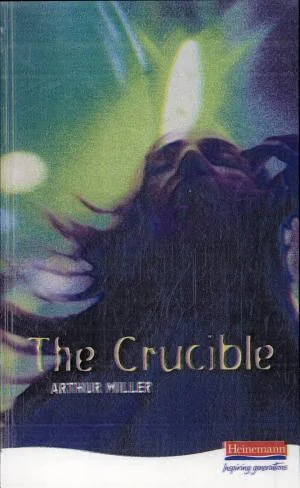
The Crucible
 82
82

The Crucible
Arthur Miller’s The Crucible, first staged in 1953, offers a stark portrayal of a community’s descent into paranoia. Its strength lies in its relentless depiction of how fear, amplified by authority, can dismantle reason and justice. The play’s structure masterfully builds the suffocating atmosphere of Salem, showcasing the terrifying ease with which accusations become fact. A notable limitation, however, is the occasional melodrama that, while heightening the stakes, can sometimes strain credulity for a modern reader less immersed in the period’s specific theological anxieties. The scene where Abigail Williams manipulates the court with feigned spectral visions, turning the accusers’ supposed torments into a collective performance, is particularly potent, illustrating the fragility of truth under duress. The Crucible serves as a potent, albeit at times overtly didactic, examination of collective delusion and the cost of dissent.
📝 Description
82
Arthur Miller wrote The Crucible in 1953 as an allegory for the McCarthy era.
Arthur Miller's 1953 play, The Crucible, is set during the 1692 Salem witch trials. It depicts a community succumbing to mass hysteria, where accusations of witchcraft escalate, resulting in fear, imprisonment, and executions. The drama meticulously illustrates how social order can collapse under the weight of fear and religious extremism.
The play connects to the Second Red Scare in the United States, a period marked by Senator Joseph McCarthy's investigations into alleged communist infiltration. This atmosphere of suspicion mirrored the events in Salem, though Miller initially presented the play as purely historical. Miller himself faced scrutiny from the House Un-American Activities Committee, making the allegorical link to contemporary events apparent to audiences at the time.
While not a text of esoteric doctrine, The Crucible functions as a powerful modern allegory for the dangers of collective delusion and the manipulation of social anxieties. Its depiction of a community consumed by unfounded accusations and the systematic persecution of individuals resonates with historical accounts of witch hunts and moral panics across various cultures and eras. The play examines how fear can override reason, leading to a collective descent into irrationality, a theme explored in various philosophical and psychological traditions concerned with group behavior and the fragility of societal norms.
💡 Why Read This Book?
• Gain insight into the mechanics of mass hysteria by examining the specific events of the 1692 Salem witch trials, understanding how fear can override reason. • Understand the political parallels to the 1950s McCarthy era, recognizing how similar patterns of accusation and persecution can emerge in different historical moments. • Explore the moral courage of characters like John Proctor, who confront societal pressure and the threat of death to uphold personal integrity in Act IV.
⭐ Reader Reviews
Honest opinions from readers who have explored this book.
❓ Frequently Asked Questions
When was Arthur Miller's The Crucible first performed?
Arthur Miller's The Crucible premiered on Broadway in January 1953, a period marked by significant political tension in the United States.
What historical event inspired Arthur Miller's The Crucible?
The play is inspired by the events of the 1692 Salem witch trials in colonial Massachusetts, where numerous individuals were accused of witchcraft.
What is the primary allegorical meaning of The Crucible?
The play is widely interpreted as an allegory for the anti-communist paranoia and the McCarthyism of the early 1950s in the United States.
Who is John Proctor in The Crucible?
John Proctor is a central character in the play, a farmer in Salem who struggles with his conscience and ultimately defies the court's authority.
What role do the girls play in The Crucible?
A group of young girls, led by Abigail Williams, are the primary accusers, their testimonies and accusations driving the hysteria and the trials.
What is the significance of the year 1692 in The Crucible?
The year 1692 marks the historical period of the Salem witch trials, the specific events and atmosphere of which Arthur Miller dramatizes in the play.
🔮 Key Themes & Symbolism
Moral Integrity vs. Societal Pressure
The play deeply examines the cost of maintaining one's moral compass when faced with overwhelming societal pressure and the threat of severe reprisal. John Proctor's struggle is central, as he grapples with confessing to lies to save his life or upholding truth and his good name, even unto death. This theme is amplified by the community's widespread conformity to the accusations, demonstrating how collective fear can compel individuals to abandon their principles.
The Corrupting Influence of Fear
Fear is presented as a potent catalyst for hysteria and injustice. The 1692 Salem environment, saturated with religious anxieties and the fear of witchcraft, becomes fertile ground for paranoia. This fear is weaponized by accusers like Abigail Williams, who exploit the court’s credulity to settle personal scores. The work illustrates how fear can erode rational thought and transform a community into an instrument of persecution.
The Nature of Truth and Accusation
The Crucible scrutinizes how easily subjective belief and manufactured evidence can supplant objective truth, particularly within a system predisposed to accept accusations as fact. The girls’ spectral visions, accepted as tangible proof, highlight the play’s critique of a justice system that fails to differentiate between genuine testimony and malicious fabrication. This thematic exploration questions the foundations of belief and the validity of evidence in times of crisis.
Religious Extremism and Authority
Miller critiques how rigid religious dogma and the abuse of religious authority can fuel persecution. The Puritanical society of Salem, with its strict moral code and fear of the Devil, provides the backdrop for the trials. Characters like Reverend Hale initially embody a belief in divine justice, but his arc shows the disillusionment that occurs when the established religious and legal structures become instruments of oppression rather than righteousness.
💬 Memorable Quotes
Direct passages from the work, attributed to the author.
“We are what we always were in Salem, but now that God damned witch hunt has laid bare our hypocrisy.”
— This interpretation reflects a sentiment that the hysteria of the trials did not create new evils but rather exposed the pre-existing flaws and moral failings within the community. It suggests the witch hunt acted as a revealing force, uncovering hidden truths about the villagers.
“There is either obedience or the office is vacant.”
— Attributed to Governor Danforth, this statement underscores the rigid, authoritarian mindset driving the trials. It prioritizes absolute compliance with the court's authority above all else, framing any questioning or dissent as rebellion and proof of guilt.
“I saw your face when it was you who told me to cry out on this man.”
— This represents a moment of defiance, likely from Mary Warren, challenging the fabricated reality presented by Abigail and the other girls. It hints at the manipulation behind the accusations and the potential for truth to emerge from within the accusers' ranks.
💡 Key Ideas
Editorial paraphrase of the work's core concepts — not direct quotes.
I have given you my soul; leave me my name!
This line, spoken by John Proctor, expresses his desperate plea for his reputation and integrity. It signifies the ultimate value he places on his personal honor, even when facing death, refusing to let his accusers destroy his legacy through a false confession.
Because it is my name! Because I cannot have another in my life! Because I lie and sign myself to lies!
Another expression of John Proctor's anguish over his reputation, this quote articulates the profound importance of his name and the unbearable burden of living a lie. It highlights the psychological toll of forced confessions and the deep-seated human need for authenticity.
🌙 Esoteric Significance
Tradition
While not explicitly rooted in a single esoteric lineage, The Crucible engages with themes resonant in Gnostic and Hermetic thought regarding the nature of truth, illusion, and the struggle against oppressive systems. The play’s depiction of a community ensnared by false doctrines and manipulated by deceitful forces echoes Gnostic narratives of spiritual ignorance and liberation. The emphasis on individual conscience and the search for authentic truth aligns with Hermetic principles of self-knowledge and discerning reality from falsehood.
Symbolism
The 'witch hunt' itself serves as a potent symbol for any widespread, irrational persecution driven by fear and misinformation. The courtroom becomes a symbolic arena where truth is distorted, reflecting the Hermetic concept of the 'shadow self' manifesting as societal delusion. John Proctor's internal conflict and eventual sacrifice symbolize the martyrdom of the enlightened individual who refuses to compromise their inner truth, a recurring motif in various mystical traditions.
Modern Relevance
The Crucible remains profoundly relevant in an era of 'fake news' and intensified political polarization. Contemporary thinkers and activists who analyze the spread of disinformation, the dynamics of online shaming, and the manipulation of public opinion often reference the play. Its exploration of how fear and groupthink can lead to the persecution of marginalized groups continues to inform discussions on social justice and the importance of critical thinking in contemporary spiritual and political discourse.
👥 Who Should Read This Book
• Students of American drama and political history seeking to understand the intersection of art and social commentary during the McCarthy era. • Readers interested in the psychological dynamics of mass hysteria and group conformity, drawn to historical case studies of societal breakdown. • Individuals exploring themes of moral courage, personal integrity, and the consequences of unchecked authority in literature and life.
📜 Historical Context
Arthur Miller's The Crucible, premiering in 1953, arrived at a key moment in American history, deeply shadowed by the Second Red Scare. The pervasive climate of suspicion, fueled by Senator Joseph McCarthy's investigations into alleged communist subversion, created an atmosphere eerily reminiscent of the 1692 Salem witch trials. Miller, who himself faced scrutiny from the House Un-American Activities Committee, used the historical events as a powerful allegory. While some critics, such as Brooks Atkinson of The New York Times, immediately recognized the parallels to McCarthyism, Miller initially downplayed the direct connection, framing it as a study of historical witch hunts. The play’s reception was strong, though its allegorical nature made some uncomfortable. It stands in contrast to the more overt political dramas of the era, offering a historical lens through which to critique contemporary political paranoia and the erosion of civil liberties.
📔 Journal Prompts
John Proctor's struggle to maintain his name.
The girls' accusations as a performance of hysteria.
Reverend Hale's evolving understanding of justice.
The role of the Puritanical worldview in Salem's downfall.
The concept of 'spectral evidence' and its validity.
🗂️ Glossary
Salem Witch Trials
A series of hearings and prosecutions of people accused of witchcraft in colonial Massachusetts between February 1692 and May 1693. It resulted in the executions of twenty people and the deaths of several others in prison.
McCarthyism
The practice of making accusations of subversion or treason, especially in public forums, without regard for evidence. It is associated with Senator Joseph McCarthy's anti-communist campaigns in the 1950s.
Spectral evidence
Testimony that the afflicted person was tormented or tormented by the apparition or specter of the accused. This was a controversial form of evidence admitted in the Salem trials.
Hysteria
Exaggerated or uncontrollable emotion or excitement, especially among a group of people. In the context of the play, it refers to the collective panic and fear surrounding witchcraft accusations.
Allegory
A story, poem, or picture that can be interpreted to reveal a hidden meaning, typically a moral or political one. The Crucible is widely seen as an allegory for McCarthyism.
Puritanism
A religious reform movement in the 16th and 17th centuries that sought to purify the Church of England of Roman Catholic practices. Their strict moral code influenced the society depicted in The Crucible.
House Un-American Activities Committee (HUAC)
An investigative committee of the United States House of Representatives that investigated allegations of communist activity in the U.S. during the early years of the Cold War.
🔮 Readers Also Liked
Browse all →




![Aloysii Charitini [pseud.] Discurs von trüglichen Kennzeichen der Zauberey, worinnen viel abergläubische Meinungen vernunfftmässig untersucht und verworffen; wie auch ... 1708: Iss 174](/img/thumb/aloysii-charitini-pseud-discurs-von-tr-glichen-kennzeichen-der-zauberey-worinnen-viel-abergl-ubische-meinungen-vernunfftm-ssig-untersucht-und-verworffen-wie-auch-1708-iss-174-brunneman-jacob-d-1735.webp)



More by Arthur Miller
All books →

More Free Witchcraft & Paganism Books
View all →