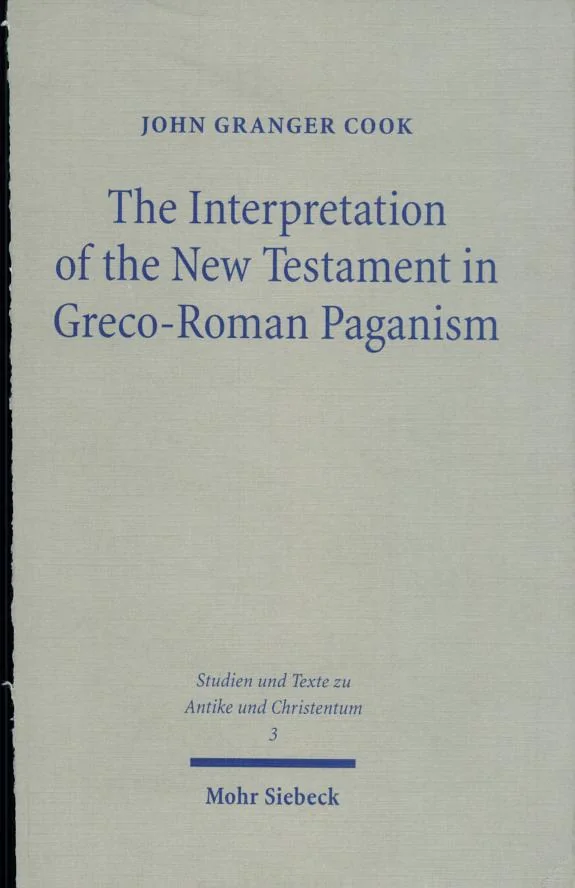
The Interpretation of the New Testament in Greco-Roman Paganism
 72
72

The Interpretation of the New Testament in Greco-Roman Paganism
Cook's analysis of pagan responses to the New Testament offers a valuable corrective to scholarship that sometimes overlooks the intellectual rigor of early Christian critics. His focus on figures like Celsus and Julian the Apostate demonstrates a sophisticated understanding of their philosophical underpinnings and rhetorical strategies. The work compellingly argues that these critics were not simply dismissing Christianity but actively engaging with its texts, attempting to place them within their own intellectual traditions. A notable strength is the detailed deconstruction of specific arguments, such as Porphyry's critique of the Gospels. However, the dense academic prose can, at times, obscure the narrative flow, requiring sustained attention from the reader. The section on Hierocles, while informative, feels somewhat less developed compared to the discussions of Celsus and Julian. Nevertheless, the book provides crucial insights into the intellectual friction between nascent Christianity and established Greco-Roman thought.
📝 Description
72
John Granger Cook's 2000 book analyzes pagan interpretations of early Christian scriptures.
In "The Interpretation of the New Testament in Greco-Roman Paganism," John Granger Cook examines the ways ancient pagan thinkers engaged with early Christian texts. Rather than focusing on outright rejection, Cook investigates the intellectual strategies pagan critics employed when confronting and interpreting the nascent New Testament canon. The study highlights figures who, while not adhering to Christian beliefs, felt compelled to analyze and critique its scriptures.
The work is relevant to scholars of early Christianity, comparative religion, and classical antiquity. It also speaks to readers interested in the history of textual criticism and the philosophical currents of the Roman Empire. Those wishing to grasp the intellectual environment that shaped Christianity's emergence and the reasoned opposition it encountered will find extensive material.
This book sits at the intersection of classical studies and the history of religious thought. It illuminates how philosophical traditions outside of early Christianity interpreted and responded to its core texts. By examining figures like Celsus and Porphyry, Cook shows how established Greco-Roman intellectual frameworks were applied to assess Christian scripture as a literary and philosophical artifact. This approach provides insight into the complex intellectual dialogues of the Roman world, where diverse belief systems and interpretive methods coexisted and interacted.
⭐ Reader Reviews
Honest opinions from readers who have explored this book.
❓ Frequently Asked Questions
Which specific pagan authors does John Granger Cook analyze in his study of New Testament interpretation?
The book focuses on the responses of Celsus, Porphyry, the anonymous philosopher of Macarius Magnes, Hierocles, and Julian the Apostate to the New Testament.
What is the primary argument of 'The Interpretation of the New Testament in Greco-Roman Paganism'?
The central argument is that ancient pagan intellectuals critically interpreted and engaged with the New Testament, rather than simply ignoring it, often using their own philosophical frameworks.
When was 'The Interpretation of the New Testament in Greco-Roman Paganism' first published?
The book was first published in 2000.
Does the book discuss how pagan readers understood the 'implied reader' of the New Testament?
Yes, the work explores how the New Testament might have affected ancient readers, including the concept of an 'implied reader,' from the perspective of those who rejected it.
What is the historical period covered by Cook's research?
The research primarily covers the period of the late Roman Empire, focusing on the 2nd through 4th centuries CE, when these pagan critiques were most prominent.
What academic field does this book contribute to?
The book makes a significant contribution to New Testament scholarship and the study of the relationship between early Christianity and Greco-Roman antiquity.
🔮 Key Themes & Symbolism
Pagan Hermeneutics
The work studies how Greco-Roman philosophers applied their own interpretive strategies to the New Testament. This involved analyzing Christian texts through the lens of Platonism, Stoicism, and other dominant philosophical schools. Cook demonstrates that these interpretations were not dismissive but serious attempts to integrate or critique Christian claims within existing intellectual paradigms. Understanding these pagan hermeneutic tools is crucial for grasping the reception of early Christianity.
Intellectual Opposition
This theme focuses on the structured opposition presented by pagan thinkers to Christian doctrines and scriptures. Figures like Celsus, writing in the 2nd century, and Porphyry, in the 3rd, developed systematic arguments against Christian theology, ethics, and the historicity of biblical accounts. Cook highlights their sophisticated engagement, revealing a complex intellectual battleground rather than a simple ideological divide.
Reception by Non-Believers
A core aspect is the study of how the New Testament was received and understood by those who did not accept its divine authority. This includes examining the concept of the 'implied reader'—how the text was constructed to address an audience—and how pagan readers perceived this. Cook investigates the reactions to the New Testament's narrative strategies, theological assertions, and social implications from an external, critical perspective.
Christianity's Place in Antiquity
The book situates early Christianity within the broader context of Greco-Roman religious and philosophical life. It illustrates how Christianity was perceived not as entirely alien but as a phenomenon that interacted with, borrowed from, and challenged existing traditions. By analyzing pagan responses, Cook illuminates the dynamic process by which Christianity asserted its identity and sought to gain adherents in a diverse spiritual landscape.
💬 Memorable Quotes
Direct passages from the work, attributed to the author.
“The New Testament affected ancient readers who rejected it.”
— This statement captures the book's premise: early Christian scriptures had an impact even on their staunchest critics, prompting significant intellectual engagement and debate within pagan philosophical circles.
“Response to the New Testament in the following authors: Celsus, Porphyry, the anonymous philosopher of Macarius Magnes, Hierocles, and Julian the Apostate.”
— This lists the key figures whose critical interpretations of Christian texts are analyzed, providing a roadmap to the specific pagan intellectual traditions examined in the study.
“Cook addresses the response to the New Testament in Greco-Roman antiquity.”
— This highlights the book's focus on how established philosophical and religious traditions of the Roman world grappled with the emergent claims and writings of early Christianity.
“Recent New Testament scholarship has raised the question of the effect of the New Testament on readers including an 'implied' reader.”
— This points to a significant scholarly debate about textual reception, which Cook extends by examining how non-Christian readers might have perceived the intended audience and message of the New Testament.
“How did the New Testament affect ancient readers who rejected it?”
— This question frames the core inquiry of the book, emphasizing the need to understand the intellectual and cultural impact of Christian texts on those outside the faith community.
🌙 Esoteric Significance
Tradition
While not strictly within a single esoteric lineage like Hermeticism or Kabbalah, this work speaks to Gnostic and Neoplatonic traditions that often engaged in allegorical or philosophical interpretations of religious texts. The focus on critical interpretation and the search for underlying philosophical truths aligns with esoteric methods of textual analysis that go beyond literal meaning. It speaks to a broader tradition of questioning established narratives and seeking deeper, often hidden, meanings within sacred or influential writings.
Symbolism
The New Testament itself, as a collection of narratives and teachings, becomes a symbolic field within this study. Pagan critics often viewed biblical stories allegorically or philosophically, seeking correspondences with their own cosmologies or ethical systems. The 'Christ figure' and the narrative of salvation, for instance, could be reinterpreted through lenses like the suffering God or the ascent of the soul, demonstrating how symbols are fluid and subject to interpretation across different belief systems.
Modern Relevance
Contemporary scholars of comparative religion and textual criticism continue to draw on the methods and findings presented here. Thinkers interested in the philosophy of religion, the history of exegesis, and the intercultural dynamics of belief systems find Cook's analysis of ancient intellectual engagement invaluable. It informs modern discussions about religious pluralism, the construction of religious identity, and the perennial tension between faith and reason in interpreting foundational texts.
👥 Who Should Read This Book
['• Scholars of Early Christianity: Those researching the historical development of Christian thought and its interaction with the Roman world will find detailed analysis of pagan counter-arguments.', '• Students of Classical Antiquity: Readers interested in the intellectual history of the Greco-Roman period will benefit from insights into pagan philosophy and its engagement with foreign religious ideas.', '• Comparative Religion Researchers: Individuals studying how different religious traditions interpret and critique one another will find this book a key resource on ancient inter-religious dialogue.']
📜 Historical Context
Published in 2000, John Granger Cook's work emerged during a period of sustained interest in the historical Jesus and the socio-religious dynamics of the Roman Empire. The late antique world, spanning roughly the 2nd to 4th centuries CE, was a crucible of competing philosophical schools and religious movements. Stoicism and Neoplatonism represented significant intellectual currents that provided frameworks for engaging with, and often critiquing, the novel claims of Christianity. Figures like Celsus, whose *True Discourse* (c. 170 CE) is a major focus, and Porphyry (c. 234–305 CE), a prominent Neoplatonist philosopher, represent the intellectual opposition Cook examines. These thinkers were not isolated critics; their writings engaged directly with Christian apologetics and scripture, influencing later pagan and even some Christian thinkers. The reception of their arguments, though often lost or preserved only in fragments within Christian refutations, was a vital part of the intellectual landscape.
📔 Journal Prompts
The philosophical frameworks used by Celsus to critique the New Testament.
Julian the Apostate's specific objections to Christian doctrine and scripture.
The concept of the 'implied reader' from a pagan perspective.
Porphyry's interpretive strategies applied to the Gospels.
How Macarius Magnes's anonymous work reflects pagan engagement with Christian texts.
🗂️ Glossary
Implied Reader
A concept in literary theory referring to the hypothetical reader envisioned by the author within the text itself. Cook examines how pagan critics might have perceived this implied audience and its intended effect.
Greco-Roman Antiquity
The historical period encompassing ancient Greece and Rome, characterized by their distinct philosophical, religious, and cultural traditions, which significantly influenced and interacted with early Christianity.
Hermeneutics
The theory and methodology of interpretation, especially the interpretation of biblical texts, literary works, or philosophical arguments. The book explores pagan hermeneutics applied to Christian scripture.
Neoplatonism
A philosophical system originating in the 3rd century CE, heavily influenced by Plato, emphasizing the transcendent nature of the One and the soul's journey towards it. Porphyry was a key figure.
Apologetics
The branch of Christian theology that aims to defend Christian beliefs through reasoned argument. Cook examines pagan critiques as a form of counter-apologetics.
Canon
The collection of texts recognized as genuine and authoritative scripture by a religious community. The study touches on how pagan critics viewed the emerging Christian canon.
Syncretism
The merging of different religions, cultures, or schools of thought. This was common in Greco-Roman antiquity and affected how Christianity was perceived and integrated or rejected.
This book appears in 1 collection
🔮 Readers Also Liked
Browse all →




![Cruels effets de la vengeance du Cardinal de Richelieu, ou Histoire des diables de Loudun, de la possession des religieuses ursulines, et de la condamnation et du suplice [sic] d'Urbain Grandier, curé de la même ville. 1716: Iss 53](/img/thumb/cruels-effets-de-la-vengeance-du-cardinal-de-richelieu-ou-histoire-des-diables-de-loudun-de-la-possession-des-religieuses-ursulines-et-de-la-condamnation-et-du-suplice-sic-d-urbain-grandier-cur-de-la-.webp)



From the “Paganism” Collection
View all →







More Free Witchcraft & Paganism Books
View all →