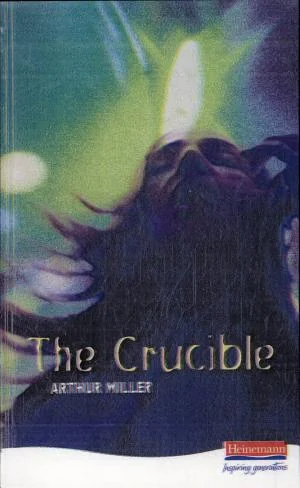
The Crucible
 75
75

The Crucible
Miller’s "The Crucible" is less a historical document and more a searing examination of human behavior under extreme pressure. Its enduring power lies not in its precise recreation of the 1692 Salem events, but in its stark portrayal of how fear and accusation can dismantle individuals and communities. The play’s structure, particularly its shift from the accused’s plight to the accusers’ motivations, reveals a profound understanding of the psychological dynamics at play. While the allegorical link to the McCarthy era is explicit and potent, the work’s true strength is its dissection of individual moral choices. The downfall of John Proctor, a man caught between his conscience and societal demands, offers a particularly poignant exploration of integrity. A limitation, however, is the occasionally didactic tone when drawing the McCarthy parallels, which can feel less organic than the Salem narrative. Nevertheless, "The Crucible" remains a vital study of the dangers of unchecked authority and collective panic. It is a stark reminder of the vigilance required to protect truth and individual liberty.
📝 Description
75
Arthur Miller's 1992 play, The Crucible, dramatizes the 1692 Salem witch trials.
Arthur Miller's 1992 drama, The Crucible, examines the 1692 Salem witch trials. The play dissects mass hysteria and the personal ruin of individuals caught in accusations. It functions as an allegory, linking the paranoia of 17th-century Massachusetts to the political climate of 1950s America during the McCarthy era.
The work confronts the Salem witch trials, a period of intense religious fervor and superstition. Miller, writing during the Cold War, intended the play as a critique of the McCarthy hearings. This parallel shows how accusations can snowball, leading to widespread suspicion and the erosion of individual liberties across different eras.
Central to The Crucible are themes of accusation, reputation, and the corrupting influence of unchecked power. The work shows how fear can silence dissent and maintain social control. It examines justice's fragility against mass delusion and the courage needed to uphold truth. The play also critiques public confession's performative nature and the consequences of groupthink.
While presented as historical drama, The Crucible engages with themes of collective delusion and the psychological mechanisms of persecution, which resonate within certain esoteric traditions concerned with societal consciousness. Its exploration of how fear and accusation can manifest as a powerful, almost supernatural force affecting a community aligns with studies of group psychology and the spread of belief systems. The play's depiction of individuals grappling with unseen forces and moral decay can be viewed through lenses that analyze societal pathology and the manipulation of collective narratives, common subjects in certain philosophical and psychological analyses.
💡 Why Read This Book?
• Understand the mechanics of mass hysteria through the specific events of the 1692 Salem witch trials, learning how fear can escalate accusations. • Analyze the parallels Miller draws between the Salem trials and the McCarthy era of the 1950s, recognizing how historical patterns of persecution repeat. • Examine the moral compromises individuals make under duress, exemplified by John Proctor's struggle between his principles and the pressures of his society.
⭐ Reader Reviews
Honest opinions from readers who have explored this book.
❓ Frequently Asked Questions
What is the primary historical event depicted in Arthur Miller's 'The Crucible'?
The primary historical event is the Salem witch trials that occurred in colonial Massachusetts in 1692. The play focuses on the accusations, trials, and executions that resulted from widespread panic and superstition.
How does 'The Crucible' relate to the McCarthy era?
Arthur Miller wrote 'The Crucible' as an allegory for the McCarthy era in the 1950s. It critiques the climate of suspicion and accusation fostered by Senator Joseph McCarthy, where individuals were persecuted for alleged communist ties.
Who is John Proctor in 'The Crucible'?
John Proctor is the central protagonist. He is a farmer in Salem who initially tries to remain aloof from the witchcraft accusations but becomes deeply involved when his wife, Elizabeth, is accused. His moral struggle is a core element of the play.
What are the main themes explored in 'The Crucible'?
The main themes include mass hysteria, the nature of truth and lies, reputation, individual conscience versus societal pressure, the corrupting influence of power, and the dangers of religious extremism.
When was Arthur Miller's 'The Crucible' first published?
Arthur Miller's 'The Crucible' was first published in 1992. It premiered on Broadway in 1953.
What is the significance of Abigail Williams in the play?
Abigail Williams is the primary instigator of the Salem witchcraft accusations. Her jealousy and desire for John Proctor fuel the hysteria, and her manipulative behavior highlights the destructive potential of unchecked adolescent anger and societal power dynamics.
🔮 Key Themes & Symbolism
The Nature of Accusation
The work meticulously details how accusations, once made, gain an almost unstoppable momentum, particularly within a climate of fear and religious fervor. It shows how the accusation itself becomes a form of power, capable of destroying reputations and lives irrespective of evidence. The play explores the psychological phenomenon where mass delusion takes hold, making individuals complicit in the persecution of their neighbors, a concept relevant to understanding societal scapegoating across different eras.
Integrity Under Duress
Central to the narrative is the struggle for personal integrity against overwhelming societal pressure. Characters like John Proctor face agonizing choices: confess falsely to save their lives, or maintain their truth and face death. This theme examines the cost of moral compromise and the profound courage required to stand firm in one's convictions when the entire community is aligned against them. The play highlights the internal battles individuals wage when their principles are tested.
The Weaponization of Fear
Miller illustrates how fear is not merely an emotional response but a tool that can be deliberately employed to manipulate and control populations. The Salem witch trials, and by extension the McCarthy hearings, are depicted as events where fear of the unknown, the 'other,' or perceived subversion is amplified to justify persecution. This theme underscores the fragility of social order when collective anxiety is exploited for political or personal gain.
Reputation and Social Standing
The play underscores the paramount importance of reputation in the rigid social structures of both 17th-century Salem and 1950s America. Characters are acutely aware of their standing within the community, and the threat of public accusation can shatter a lifetime's work and respectability. The fear of being branded 'witch' or 'communist' drives many characters' actions, revealing how deeply social acceptance is intertwined with survival and identity.
💬 Memorable Quotes
Direct passages from the work, attributed to the author.
“We are what we always were in Salem, but now that God is with the court, we are surely right.”
— This reflects the dangerous conviction that righteousness is determined by the prevailing authority, allowing individuals to justify their actions as divinely sanctioned, even when those actions are morally reprehensible.
“My name is my own name! However may I live without my name?”
— Spoken by John Proctor, this expresses the ultimate value he places on his personal integrity and reputation, which he sees as inseparable from his very self, even above life itself.
“The Devil is precise; the Devil is our constant company.”
— This highlights the paranoid mindset where the forces of evil are perceived as ever-present and meticulously orchestrating events, fueling the atmosphere of suspicion and the search for culprits.
“I will not give you false confession thus.”
— This signifies a character's ultimate refusal to compromise their truth or integrity, even in the face of extreme coercion and the promise of survival through a fabricated admission.
💡 Key Ideas
Editorial paraphrase of the work's core concepts — not direct quotes.
I cannot think the Devil may not reach our village any more than the village thatreportBody has already been devoured.
This line expresses the pervasive fear and the belief that evil, represented by the Devil, is an active and imminent threat that could strike anywhere, including their own seemingly protected community.
🌙 Esoteric Significance
Tradition
While not explicitly part of a formal esoteric lineage like Hermeticism or Gnosticism, "The Crucible" appeals to traditions that explore the darker aspects of human psychology and the manifestations of collective shadow. It aligns with concepts found in Jungian psychology, concerning the anima/animus, the shadow self, and the collective unconscious, particularly how societal fears and repressed desires can erupt into destructive forces. The play serves as a modern parable on the consequences of societal imbalance and the psychic price of repression.
Symbolism
The crucible itself is a potent symbol, representing a severe test or trial, and a vessel in which substances are heated to high temperatures. In the play, it symbolizes the intense pressure on individuals and the community, forcing their true nature to the surface, revealing their purity or impurity. The accusers, particularly Abigail Williams, embody the destructive force of uncontrolled psychic energy, fueled by personal grievance and societal anxieties, acting as agents of chaos and disruption within the community's established order.
Modern Relevance
Contemporary thinkers and practitioners in fields ranging from social psychology to critical theory continue to draw upon "The Crucible" to analyze modern phenomena. Its depiction of 'cancel culture,' the spread of misinformation online, and political polarization offers fertile ground for discussion. The play's examination of how fear and groupthink can override rational discourse remains highly relevant for understanding contemporary social dynamics and the persistent human susceptibility to mass delusion.
👥 Who Should Read This Book
• Students of American history and literature seeking to understand the interplay between historical events and dramatic interpretation. • Readers interested in social psychology and the dynamics of mass hysteria, fear, and group behavior. • Individuals drawn to philosophical examinations of morality, integrity, and the consequences of societal pressure.
📜 Historical Context
Arthur Miller's "The Crucible" emerged from the charged atmosphere of the early 1950s, a period defined by the Cold War and the intense anti-communist fervor led by Senator Joseph McCarthy. The play, first staged in 1953, directly paralleled the McCarthy hearings, where accusations of communist sympathies, often unsubstantiated, ruined careers and lives. Miller drew a stark parallel between the mass hysteria of the 1692 Salem witch trials and the contemporary climate of suspicion and political persecution. While the play’s allegorical nature was evident, it faced criticism and was seen by some as an attack on American institutions. It engaged with the intellectual currents of the time, which were deeply concerned with civil liberties and the potential for government overreach, particularly in response to perceived threats. Miller's work stood in contrast to more overtly patriotic or conformist narratives, instead challenging audiences to examine the dangers inherent in unchecked fear and accusation.
📔 Journal Prompts
The weight of reputation in Salem: how does it compare to modern social pressures?
Abigail Williams's motivations: explore the intersection of personal desire and communal fear.
John Proctor's confession: analyze the conflict between personal truth and public survival.
The concept of the 'witch' in 1692: what did this label represent beyond accusations?
The court's authority: examine how power dynamics enabled the hysteria of 1692.
🗂️ Glossary
Witchcraft
In the context of the play, witchcraft refers to the belief that individuals, typically women, could make pacts with the Devil to gain supernatural powers to harm others, often through unseen means.
Mass Hysteria
A phenomenon characterized by the spontaneous spread of fear, anxiety, and irrational beliefs within a group or community, often leading to collective delusions and unfounded accusations.
Theocracy
A form of government in which a deity is recognized as the supreme civil ruler, or in which religious leaders rule in the name of God or a god. Salem was a Puritan society with strong religious governance.
McCarthyism
A period of intense anti-communist suspicion and persecution in the United States during the early 1950s, characterized by widespread accusations, loyalty oaths, and blacklisting.
Reputation
The beliefs or opinions that are generally held about someone or something. In the play, reputation is a crucial social currency, and its destruction can lead to ostracization and ruin.
Allegory
A story, poem, or picture that can be interpreted to reveal a hidden meaning, typically a moral or political one. 'The Crucible' functions as an allegory for the McCarthy era.
Confession
An admission of guilt or wrongdoing. In the play, false confessions are coerced to satisfy the court's agenda, highlighting the corruption of justice.
This book appears in 1 collection
🔮 Readers Also Liked
Browse all →









From the “Witchcraft” Collection
View all →



More Free Occult Philosophy Books
View all →