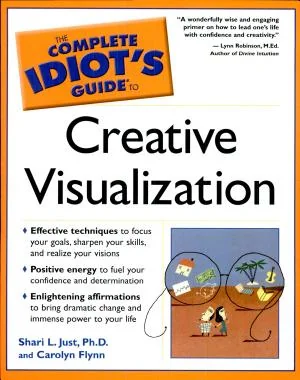
The Complete Idiot's Guide to Creative Visualization
 77
77

The Complete Idiot's Guide to Creative Visualization
Shari L. Just and Carolyn Flynn’s *The Complete Idiot's Guide to Creative Visualization* offers a practical, step-by-step introduction to a potent psychological and spiritual tool. Unlike many esoteric texts that assume prior knowledge, this work meticulously breaks down the process of mental imagery, making it accessible even to the complete novice. A notable strength is its detailed guidance on constructing vivid sensory experiences within the mind, moving beyond mere abstract desires to concrete mental constructs. For instance, the section on 'scripting' provides a tangible method for rehearsing desired future outcomes. However, the book occasionally leans towards overly simplistic explanations, which might frustrate those with a deeper background in psychology or comparative mysticism seeking nuanced theoretical frameworks. The sheer volume of exercises, while comprehensive, can sometimes feel repetitive. Ultimately, for its intended audience, it serves as a clear and actionable manual for applying visualization techniques to everyday life.
📝 Description
77
Published in 2005, this guide explains creative visualization for tangible results.
This book details how to use mental imagery to achieve desired outcomes, moving beyond simple affirmations. It focuses on building vivid mental scenes and connecting them with emotional states. The authors present visualization as a practical method for personal growth, spiritual development, and overcoming obstacles.
It is designed for anyone wanting to unlock their inner capabilities for real-world success. The book suits those new to visualization or those who have tried it without consistent results. It also appeals to individuals interested in boosting creativity, deepening their spiritual understanding, or finding solutions to personal and professional challenges.
The book emerged in 2005, a time of broad interest in self-help and New Age ideas. It draws from established mental imagery practices, influenced by figures like Napoleon Hill and incorporated into wellness movements. The core idea is that directed thought and emotion can shape one's reality.
💡 Why Read This Book?
• Learn to construct detailed mental scripts for future events, as detailed in the 'scripting' exercises, enabling you to rehearse success and prime your subconscious for achievement. • Gain practical strategies for enhancing spiritual growth and creativity through consistent practice of guided imagery techniques, as presented in the early chapters. • Develop actionable plans to resolve everyday problems by applying the principles of focused intention and emotional alignment discussed throughout the book.
⭐ Reader Reviews
Honest opinions from readers who have explored this book.
❓ Frequently Asked Questions
When was The Complete Idiot's Guide to Creative Visualization first published?
The book was first published in 2005, offering a comprehensive introduction to visualization techniques during a period of growing interest in self-improvement and metaphysical practices.
What are the main techniques covered in the book?
The guide covers fundamental techniques such as guided imagery, scripting, affirmations, and sensory anchoring, all designed to help readers manifest their goals.
Is this book suitable for beginners in visualization?
Yes, it is specifically designed for beginners, presenting concepts and exercises in a clear, step-by-step manner suitable for those with no prior experience.
Who are the authors of The Complete Idiot's Guide to Creative Visualization?
The authors are Shari L. Just and Carolyn Flynn, who collaborated to create this accessible guide.
Does the book address spiritual growth as well as practical goals?
Yes, the book explicitly aims to provide advice on strategies for enhancing spiritual growth and creativity alongside achieving practical life goals.
What is the core philosophy behind the visualization methods presented?
The core philosophy is that focused mental imagery, combined with emotional conviction, can influence reality and help individuals achieve their desired outcomes.
🔮 Key Themes & Symbolism
Intentional Manifestation
The book posits that the universe responds to focused intention, amplified by vivid mental imagery and emotional conviction. It guides readers to clearly define their desires and then construct detailed mental scenarios where these desires are already fulfilled. This isn't mere wishful thinking; the work emphasizes the active, deliberate process of 'seeing' and 'feeling' the outcome into existence, aligning one's energy with the desired reality. Specific exercises, like scripting future events, are designed to build this energetic momentum.
Inner Resource Cultivation
Beyond external goals, creative visualization is presented as a powerful method for developing internal strengths, creativity, and spiritual resilience. The techniques aim to build confidence, overcome self-doubt, and foster a more positive self-image by regularly rehearsing successful outcomes and desired states of being. This internal cultivation then serves as a foundation for addressing external challenges with greater equanimity and resourcefulness.
Practical Application Strategies
The guide moves beyond abstract theory to offer concrete strategies for applying visualization to real-world problems in home, work, and leisure. It provides frameworks for using mental imagery to enhance problem-solving skills, improve relationships, and achieve professional success. The emphasis is on making visualization an integrated part of daily life, rather than an isolated spiritual practice, thereby fostering tangible improvements across all life domains.
The Role of Emotion and Belief
A central tenet is that visualization without emotional engagement is less effective. The book teaches readers to imbue their mental images with genuine feelings of joy, gratitude, and conviction. Furthermore, it addresses the importance of belief systems, guiding readers to identify and reframe limiting beliefs that might sabotage their visualization efforts. This emotional and psychological alignment is presented as crucial for the manifestation process.
💬 Memorable Quotes
Direct passages from the work, attributed to the author.
“Your mind is a powerful tool that can be trained to create the reality you desire.”
— This statement highlights the book's core premise: that mental discipline and focused imagination are not passive states but active forces capable of shaping external circumstances.
“Visualize not just the outcome, but the feeling of having achieved it.”
— This emphasizes the crucial role of emotional resonance in the visualization process, suggesting that embodying the feeling of success is as important as mentally picturing the goal itself.
“Scripting involves writing about your desired future as if it has already happened.”
— This explains the 'scripting' technique, a practical method for solidifying intentions by narrating them in the past tense, thereby reinforcing their reality in the mind.
“Consistency in practice is key to unlocking the full potential of creative visualization.”
— This interpretation underscores the book's practical advice, stressing that regular, dedicated application of visualization techniques is necessary for achieving significant results.
“Identify and release limiting beliefs that hinder your ability to manifest your goals.”
— This points to the book's focus on addressing internal obstacles, such as negative thought patterns, which can impede the effectiveness of visualization practices.
🌙 Esoteric Significance
Tradition
While not strictly aligned with a single esoteric lineage, this work draws heavily from principles found in New Thought, the Law of Attraction, and general Western esotericism concerning the power of focused consciousness. It simplifies and operationalizes concepts related to mind-over-matter and the holographic nature of reality, making them accessible outside of traditional occult studies. It departs from more complex systems by focusing on practical, goal-oriented application rather than elaborate ritual or complex cosmology.
Symbolism
The book primarily utilizes the 'symbolism' of the desired outcome itself as the central motif. The mental image of success, wealth, or well-being acts as a potent symbol. Techniques like scripting encourage the creation of a symbolic narrative. While not relying on traditional esoteric symbols like the Ouroboros or the Caduceus, it teaches the reader to imbue their *personal* desired outcomes with symbolic power, making them tangible representations of inner potential.
Modern Relevance
The principles discussed in *The Complete Idiot's Guide to Creative Visualization* remain highly relevant. Contemporary practices in positive psychology, mindfulness, and even certain coaching methodologies echo its emphasis on intentionality and mental framing. Thinkers and practitioners focusing on manifestation, abundance mindset, and goal achievement, such as those found in online communities dedicated to the Law of Attraction, continue to draw upon the accessible techniques popularized by books like this one.
👥 Who Should Read This Book
• Aspiring individuals seeking practical techniques to achieve personal and professional goals, who will benefit from the clear, actionable exercises provided. • Beginners to metaphysical concepts and self-development, who will appreciate the accessible language and step-by-step approach to visualization. • Anyone feeling stuck or facing challenges, looking for a structured method to harness their mental energy for positive change and increased creativity.
📜 Historical Context
Published in 2005, *The Complete Idiot's Guide to Creative Visualization* arrived during a period where self-help literature flourished, building on the New Thought movement's legacy. This era saw authors like Rhonda Byrne popularizing concepts of manifestation with works such as *The Secret* (released in 2006). The 'Idiot's Guide' series itself was known for clarifying complex subjects for a mainstream audience, a contrast to more academic or strictly esoteric texts. While not directly engaging with academic debates, the book implicitly drew from psychological principles explored by figures like Maxwell Maltz in the mid-20th century regarding self-image and its impact. The reception was generally positive within the self-help sphere, though some critics within more traditional spiritual circles might have found its approach too simplified or lacking in deeper philosophical grounding compared to older traditions.
📔 Journal Prompts
Reflect on the core concept of 'scripting' and its potential application to a current challenge.
Analyze the role of emotional engagement in your past attempts at visualization.
Consider how the principle of 'inner resource cultivation' could impact your daily interactions.
Identify one limiting belief that might be hindering your visualization practice.
Map out a simple visualization sequence for a small, achievable goal.
🗂️ Glossary
Creative Visualization
The practice of using focused mental imagery and emotion to manifest desired outcomes in one's life, essentially 'creating' reality through directed thought.
Guided Imagery
A technique involving listening to or creating detailed mental scenarios, often with sensory elements, to induce relaxation, achieve goals, or promote healing.
Scripting
A method of writing about desired future events as if they have already occurred, using present or past tense to solidify the intention and emotional connection.
Affirmations
Positive statements or declarations, usually in the present tense, designed to challenge and reframe negative or limiting thoughts and beliefs.
Limiting Beliefs
Subconscious or conscious assumptions and convictions that restrict one's potential or ability to achieve goals, often stemming from past experiences.
Emotional Resonance
The quality of imbuing mental images or affirmations with genuine feelings, making the visualization experience more potent and believable to the subconscious mind.
Manifestation
The process by which thoughts, beliefs, and intentions are externalized into physical reality, often considered the outcome of effective creative visualization.
This book appears in 2 collections
🔮 Readers Also Liked
Browse all →









From the “Affirmations” Collection
View all →








More Free Occult Philosophy Books
View all →