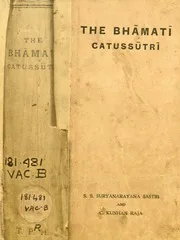
The Bhamati Catussutri by S S Suryanarayana Sastri and C Kunhan Raja
 78
78

The Bhamati Catussutri by S S Suryanarayana Sastri and C Kunhan Raja



The Bhamati Catussutri by S S Suryanarayana Sastri and C Kunhan Raja is a treasure trove of esoteric wisdom that remains relevant for modern seekers. The meticulous translation and editing by two esteemed scholars from Madras University ensure that the text is accessible yet profound. Sir S. Radhakrishnan's foreword provides a historical and philosophical context that enriches the reading experience. For contemporary esoteric seekers, this book offers a gateway to understanding the deeper layers of Advaita Vedanta, a philosophy that emphasizes the non-dual nature of reality. The Bhamati commentary by Vacaspati Misra is particularly enlightening, as it explores the four key sutras of the Brahmasutras with unparalleled depth and clarity. This work is not just an academic text but a spiritual guide that can help readers navigate the complexities of the occult and theosophical traditions. The Bhamati Catussutri is a 5-star masterpiece that should be on the bookshelf of every serious student of esoteric knowledge.
📝 Description
78
S. S. Suryanarayana Sastri and C. Kunhan Raja edited this 1937 English translation of the Bhamati Catussutri.
This edition presents the Bhamati Catussutri, a significant commentary on the Brahmasutras, with an English translation. The Bhamati, authored by Vachaspati Misra, is a key text in the Advaita Vedanta tradition. Sastri and Raja's work makes this complex philosophical material accessible to an English-speaking audience. It focuses on the interpretive framework established by Shankaracharya, exploring the philosophical arguments and metaphysical concepts within the Brahmasutras.
The book unpacks the Bhamati's unique approach to understanding these foundational Sanskrit aphorisms. Readers will find detailed discussions on topics such as the nature of Brahman, the relationship between the individual self and the ultimate reality, and the means of liberation. The translation aims for clarity, allowing for a deeper engagement with the text's philosophical rigor and spiritual implications. It is a resource for those studying classical Indian philosophy and Vedanta.
The editors' contribution lies in carefully presenting the original Sanskrit text alongside a faithful English rendering. This dual presentation supports careful study and comparison. The work is intended for readers who wish to understand the nuances of Advaita Vedanta as articulated through the lens of the Bhamati commentary.
The Bhamati Catussutri is situated within the rich tradition of Advaita Vedanta, a school of Hindu philosophy that emphasizes the non duality of reality. This tradition, heavily influenced by Adi Shankara, uses the Upanishads, Brahmasutras, and Bhagavad Gita as its core texts. The Bhamati commentary, by Vachaspati Misra, offers a distinct perspective on these foundational scriptures, often engaging with and clarifying earlier interpretations. This particular edition makes these specific Vedantic discussions available in English, facilitating study of the philosophical underpinnings of Advaita.
✍️ Author

S S Suryanarayana Sastri
Kumari Kandam (Tamil: குமரிக்கண்டம், romanized: Kumarikkaṇṭam) is a mythical continent, believed to be lost with an ancient Tamil civilization, supposedly located south of the Indian subcontinent in the Indian Ocean. Alternative names and spellings include…
💡 Why Read This Book?
Reading The Bhamati Catussutri today offers a profound journey into the esoteric and occult traditions of Hinduism. It provides deep insights into the nature of reality, the self, and the ultimate truth, making it an invaluable resource for spiritual seekers. This book helps readers understand the non-dual philosophy of Advaita Vedanta, which is central to many esoteric practices. It is a must-read for those interested in theosophy, anthroposophy, and the deeper layers of Hindu philosophy. By delving into this text, readers can gain a richer understanding of the occult and spiritual traditions that have shaped human thought for centuries.
⭐ Reader Reviews
Honest opinions from readers who have explored this book.
❓ Frequently Asked Questions
Who are the authors of The Bhamati Catussutri?
The authors are S. S. Suryanarayana Shastri, a Reader in Philosophy, and C. Kunhan Raja, a Reader in Sanskrit, both from Madras University.
What is the significance of the Bhamati commentary?
The Bhamati commentary by Vacaspati Misra is one of the most influential texts in Advaita Vedanta, providing deep insights into the four key sutras of the Brahmasutras.
Why is this book important for esoteric seekers?
This book offers a comprehensive understanding of the non-dual philosophy of Advaita Vedanta, which is central to many esoteric and occult practices.
🔮 Key Themes & Symbolism
The Nature of Reality
The Bhamati Catussutri studies the esoteric teachings of Advaita Vedanta, exploring the fundamental nature of reality. It reveals hidden knowledge and ancient symbolism, guiding readers through the mystical underpinnings of Indian philosophy.
The Self and Consciousness
This book offers useful insights into the nature of the self and consciousness, inviting readers to reflect on their own spiritual journey. It provides a rich atmosphere of philosophical inquiry and spiritual revelation.
Symbolism and Hidden Knowledge
The Bhamati Catussutri is a valuable collection of esoteric symbolism and hidden knowledge. It reveals the mystical layers of the Brahmasutras, making it an invaluable resource for those seeking spiritual truths.
💡 Key Ideas
Editorial paraphrase of the work's core concepts — not direct quotes.
The true nature of the self is beyond the grasp of the mind.
This quote emphasizes the transcendent nature of the self, inviting readers to explore beyond their mental constructs.
Reality is one, undivided and eternal.
This line highlights the unity and timelessness of reality, a core tenet of Advaita Vedanta.
The Brahmasutras reveal the path to liberation.
This passage underscores the transformative power of the Brahmasutras in guiding seekers towards spiritual liberation.
Symbolism is the language of the soul.
This quote underscores the importance of symbolism in uncovering deeper spiritual truths.
The mind is a tool, not the master.
This line invites readers to see the mind as a means to spiritual understanding, rather than an end in itself.
🌙 Esoteric Significance
Tradition
The Bhamati Catussutri belongs to the esoteric tradition of Advaita Vedanta, which seeks to reveal the hidden knowledge and mystical underpinnings of Indian philosophy. It is a key text for those exploring the depths of spiritual truths and the nature of reality.
Symbolism
Key symbols in this book include the Brahman, the Atman, and the concept of Maya. These symbols represent the ultimate reality, the individual self, and the illusory nature of the world, respectively. Understanding these symbols is crucial for grasping the esoteric teachings of Advaita Vedanta.
Modern Relevance
This book remains relevant today, as modern practitioners and scholars continue to explore its esoteric insights. It is particularly valuable for those seeking a deeper understanding of the self and the nature of reality, providing a rich foundation for spiritual practice and philosophical inquiry.
👥 Who Should Read This Book
The Bhamati Catussutri is ideal for scholars of Indian philosophy, spiritual seekers, and practitioners of mystical traditions. Beginners may find the esoteric themes challenging, but the book's rich insights make it an invaluable resource for those with some prior knowledge. Spiritual seekers will appreciate the mystical underpinnings of Advaita Vedanta, while practitioners will find it a valuable tool for deepening their spiritual practice.
📜 Historical Context
Published in 1933 by the Theosophical Publishing House in Adyar, Madras, India, The Bhamati Catussutri was written during a time of significant philosophical and spiritual inquiry. This period saw a renewed interest in the mystical traditions of India, and the book's publication reflected the broader cultural and intellectual currents of the era. The influence of this work has been profound, providing scholars and seekers with a deeper understanding of Advaita Vedanta and its esoteric teachings.
📔 Journal Prompts
How does the concept of the self in Advaita Vedanta resonate with your own spiritual journey?
What symbols in the Bhamati Catussutri stand out to you and why?
How does the idea of Maya influence your understanding of reality?
Reflect on the nature of consciousness as described in the Brahmasutras.
How can the esoteric insights in this book be applied to your daily life?
🗂️ Glossary
Advaita Vedanta
A school of Hindu philosophy that emphasizes the non-dual nature of reality, where the individual self (Atman) is identical with the ultimate reality (Brahman).
Brahmasutras
A foundational text of Vedanta philosophy, attributed to the sage Vyasa, which explores the nature of Brahman and the self.
Bhamati
A commentary on the Brahmasutras by the philosopher Vacaspati Misra, focusing on the first four sutras.
Maya
The concept of illusion or delusion, often used to describe the world as it appears to the senses, as opposed to the ultimate reality.
Shankaracharya
An 8th-century Indian philosopher who is credited with consolidating the doctrines of Advaita Vedanta and writing influential commentaries on the Upanishads, Brahmasutras, and Bhagavad Gita.
This book appears in 2 collections
🔮 Readers Also Liked
Browse all →





From the “Theosophy” Collection
View all →



More Free Theosophy & Anthroposophy Books
View all →