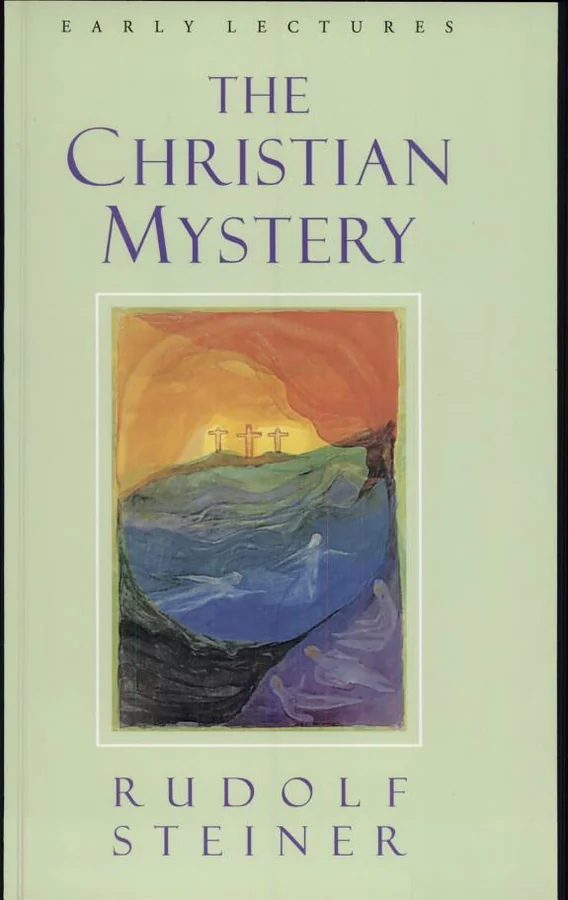
The Christian Mystery
 74
74

The Christian Mystery
Rudolf Steiner's "The Christian Mystery" is less a book and more a transcription of lectures, which presents both its strength and its challenge. The sheer density of esoteric interpretation applied to Christian doctrine is remarkable, offering a unique lens through which to view the Christ impulse. Steiner's assertion of the spiritual reality of Golgotha and the cosmic significance of Christ's sacrifice is powerfully articulated, particularly in his discussions of the Luciferic influence. However, the work's abstract nature and its reliance on a specific spiritual-scientific framework can be a significant hurdle for those unfamiliar with Anthroposophy. A particular strength lies in his exploration of the Rosicrucian path as a precursor and parallel to Christian initiation. The limitation, for the uninitiated, is the lack of accessible entry points into his complex cosmology. Ultimately, "The Christian Mystery" functions as a vital, if demanding, exposition of Steiner's esoteric Christology.
📝 Description
74
Rudolf Steiner delivered lectures on the esoteric dimensions of Christianity between 1902 and 1914.
Rudolf Steiner's "The Christian Mystery" comprises lectures from the early 20th century that examine Christianity from an esoteric perspective. Rather than a standard historical or theological account, Steiner seeks to illuminate the spiritual realities behind Christian narratives and doctrines. He particularly focuses on the Christ event at Golgotha, suggesting that a deeper understanding of Christ's incarnation, crucifixion, and resurrection is possible through inner perception and spiritual science.
This book is for individuals interested in a non-traditional view of Christian cosmology and Christology. It will resonate with those drawn to esoteric traditions, spiritual science, and the historical development of Christian Gnosticism and Rosicrucianism. Readers should be prepared to engage with abstract spiritual concepts and seek an understanding of the Christ impulse beyond conventional religious interpretations. It is especially relevant for students of Steiner's work who are studying his lectures on Christianity.
These lectures were delivered during a period of significant interest in spiritualism and esoteric movements across Europe, reacting against prevailing materialism. Steiner's work engaged with Western esotericism and Eastern philosophies, aiming to articulate a spiritual path distinct from contemporary movements. He presented his ideas within the context of Anthroposophy, a spiritual philosophy he founded, often speaking under the auspices of the Theosophical Society before establishing his own movement.
💡 Why Read This Book?
• Gain an esoteric understanding of the Christ event at Golgotha, moving beyond conventional theology to explore its cosmic significance as presented in Steiner's early lectures. • Comprehend Steiner's unique interpretation of the relationship between Christ and Lucifer, understanding them not as simple good and evil but as fundamental cosmic forces influencing human evolution. • Explore the specific paths of initiation discussed, such as the Christian-Gnostic and Rosicrucian Paths, offering concrete models for spiritual development within a Christian esoteric framework.
⭐ Reader Reviews
Honest opinions from readers who have explored this book.
❓ Frequently Asked Questions
What is the primary focus of Rudolf Steiner's "The Christian Mystery"?
The book focuses on Rudolf Steiner's esoteric interpretation of Christianity, particularly the spiritual significance of the Mystery of Golgotha and the Christ event, aiming to reveal its hidden spiritual teachings.
When were the lectures that form "The Christian Mystery" originally delivered?
The lectures compiled in "The Christian Mystery" were primarily delivered by Rudolf Steiner between 1902 and 1914, forming part of his early esoteric teachings on Christianity.
What is the concept of the Luciferic influence as discussed by Steiner in this book?
Steiner presents Lucifer as a spiritual being representing forces of intellect and freedom, whose influence is contrasted with that of Christ, and explores their complex relationship in human evolution.
Does "The Christian Mystery" offer practical spiritual exercises?
While the book discusses paths of initiation and spiritual development, it primarily focuses on theoretical and conceptual understanding rather than providing step-by-step practical exercises for the reader.
How does Steiner's view of Christianity differ from traditional theology?
Steiner's view emphasizes the spiritual, cosmic, and evolutionary dimensions of Christian events and figures, accessible through spiritual perception, which differs from historical, dogmatic, or purely faith-based theological approaches.
What is "spiritual science" in the context of Rudolf Steiner's work?
Spiritual science, as developed by Steiner, is a proposed method for investigating the spiritual world with the same rigor as natural science investigates the physical world, aiming for verifiable spiritual knowledge.
🔮 Key Themes & Symbolism
The Golgotha Mystery
This theme centers on the profound cosmic event of Christ's crucifixion and resurrection. Steiner argues that Golgotha was not merely a historical event but a key moment in the evolution of the cosmos and humanity. The lectures explore the spiritual significance of the Blood shed on the Cross, positing it as a substance that imbues the Earth with new life forces and enables humanity's spiritual development. This is presented as a central mystery of esoteric Christianity, requiring inner perception to grasp its full import.
Christ and Lucifer
Steiner addresses the complex relationship between Christ and Lucifer, presenting them not as simple adversaries of good and evil but as fundamental spiritual forces. Lucifer is associated with the development of individual consciousness, intellect, and freedom, while Christ represents a unifying, spiritualizing impulse. The lectures examine how these forces interact within the cosmos and human evolution, and how understanding this dynamic is crucial for navigating spiritual development and resisting negative influences.
Paths of Initiation
The work outlines various historical and potential future paths of spiritual initiation, with a particular focus on Christian-Gnostic and Rosicrucian traditions. Steiner suggests that these paths offer methods for individuals to develop their inner capacities and achieve direct spiritual experience. He connects these traditions to the broader Christian mystery, showing how they prepare the soul for a deeper apprehension of Christ's significance and the spiritual realities of the universe.
Esoteric Biblical Interpretation
Steiner offers his early interpretations of key biblical passages, including the Gospel of John and the Sermon on the Mount. These are not literal or historical readings but rather attempts to uncover the underlying spiritual truths and cosmic events they symbolize. He seeks to reveal the hidden meaning behind the narratives, aligning them with his broader vision of spiritual science and the evolution of consciousness, emphasizing the Christ impulse as central to these texts.
💬 Memorable Quotes
Direct passages from the work, attributed to the author.
“The Blood that flowed on the Cross is the Blood of a God, and this Blood is the spiritual substance of the Earth.”
— This statement highlights Steiner's view of the crucifixion's cosmic impact. The Blood is not merely physical but a divine, spiritual element that fundamentally transforms the Earth and provides a new foundation for human spiritual evolution.
“Lucifer represents the principle of the ego, of the self-assertion of the individual.”
— Here, Lucifer is characterized not solely as a negative force but as an embodiment of the developing human ego and the drive for individual consciousness and freedom, which must be understood and integrated.
“Gnosis is the knowledge of the spiritual world.”
— This definition clarifies Steiner's use of the term 'Gnosis,' linking it directly to the experiential knowledge of spiritual realities, which he believed was essential for understanding the deeper Christian mysteries.
“Christ is the Spirit of the Earth, who underwent Golgotha for the sake of earthly evolution.”
— This interpretation underscores Steiner's unique Christology, portraying Christ as a cosmic being intrinsically linked to the Earth's development, whose sacrifice at Golgotha was essential for humanity's spiritual progress.
💡 Key Ideas
Editorial paraphrase of the work's core concepts — not direct quotes.
The Sermon on the Mount is a teaching for the inner transformation of man.
This paraphrased concept emphasizes that Steiner viewed the Sermon on the Mount not just as ethical instruction but as a guide for developing inner spiritual faculties and transforming one's consciousness.
🌙 Esoteric Significance
Tradition
This work is foundational to Anthroposophy, Rudolf Steiner's system of spiritual science. It reinterprets core Christian doctrines and events through an esoteric lens, drawing parallels with Gnostic and Rosicrucian traditions while presenting a unique evolutionary cosmology. Steiner positions Christ not just as a historical figure but as a cosmic being whose sacrifice is central to Earth's development, offering a distinct path of spiritual understanding within the broader Western esoteric lineage.
Symbolism
Key symbols include the Blood of Golgotha, representing a divine, life-giving spiritual substance that imbues the Earth and facilitates human spiritual evolution. The figure of Lucifer is employed to represent the forces of intellect, individualization, and potential separation, contrasted with the unifying, spiritualizing impulse of Christ. The Cross itself is seen as a cosmic symbol of the meeting of spiritual and material realms, essential for transformation.
Modern Relevance
Steiner's esoteric Christology continues to influence contemporary spiritual seekers and practitioners of Anthroposophy. His ideas on the cosmic significance of Christ and the inner paths of development are explored in various modern spiritual education initiatives, biodynamic agriculture, and alternative healing practices. Thinkers in consciousness studies and comparative religion sometimes reference Steiner's unique interpretations of Christian symbolism and the evolution of human awareness.
👥 Who Should Read This Book
• Students of Rudolf Steiner's Anthroposophy seeking to understand his core teachings on Christianity and Christology. • Esoteric practitioners interested in exploring Christian Gnosticism and Rosicrucianism from a unique spiritual-scientific perspective. • Comparative religion scholars and spiritual seekers looking for non-traditional interpretations of the Christ event and its cosmic significance.
📜 Historical Context
Rudolf Steiner's lectures collected in "The Christian Mystery" were delivered in the nascent years of the 20th century, a period marked by intense spiritual searching across Europe. This era saw the rise of various esoteric movements, including Theosophy, Spiritualism, and early Anthroposophy, as many sought alternatives to prevailing materialism and orthodox religion. Steiner himself was initially active within the Theosophical Society, delivering many of these foundational talks between 1902 and 1914 before his eventual separation from it. His work offered a distinct spiritual scientific approach, often engaging critically with contemporary esoteric currents and seeking to establish a unique understanding of Christianity's cosmic role. While figures like Annie Besant were prominent in Theosophy, Steiner developed his own distinct path, emphasizing Christology and human spiritual evolution. His ideas were part of a broader intellectual milieu that included thinkers like Carl Jung, who also explored the psychological and symbolic dimensions of religion.
📔 Journal Prompts
The spiritual significance of the Blood shed at Golgotha: initial thoughts.
The dual role of Lucifer in human consciousness as presented by Steiner.
Reflecting on the Sermon on the Mount as a guide for inner transformation.
Potential correspondences between Christian-Gnostic and Rosicrucian initiation paths.
The Christ impulse as a force for Earth's spiritual evolution.
🗂️ Glossary
Golgotha
The site of Christ's crucifixion. In Steiner's work, it represents a cosmic event of immense spiritual significance for the Earth and humanity, not just a historical occurrence.
Lucifer
A spiritual being representing forces of intellect, individuality, and freedom, often in dynamic tension with the Christ impulse. Steiner views Lucifer's influence as necessary but requiring conscious integration.
Spiritual Science
Rudolf Steiner's term for a methodology aiming to investigate the spiritual world with the same rigor as natural science investigates the physical world, leading to verifiable knowledge.
Initiation
A process of spiritual development and awakening, leading to direct experience of higher spiritual realities. Steiner discusses various paths, including Christian-Gnostic and Rosicrucian.
Christ Impulse
The unique spiritual force brought to Earth by Christ, which Steiner believed is essential for human evolution, consciousness development, and the spiritualization of the Earth.
Rosicrucianism
An esoteric tradition Steiner often referenced. He saw early Rosicrucianism as a precursor to Christian esoteric development, emphasizing inner wisdom and spiritual transformation.
Gnosis
In this context, refers to direct spiritual knowledge or insight, particularly concerning the mysteries of Christianity, as attainable through esoteric development.
This book appears in 1 collection
🔮 Readers Also Liked
Browse all →





From the “Anthroposophy” Collection
View all →







More Free Theosophy & Anthroposophy Books
View all →