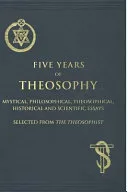
Five Years of Theosophy
 84
84

Five Years of Theosophy
The 1885 compilation 'Five Years of Theosophy' offers a direct window into the nascent discourse of the Theosophical Society. Babu Mohini M. Chatterji’s selection from 'The Theosophist' magazine, spanning its first five volumes, presents a substantial collection of essays and communications. A notable strength lies in its unvarnished presentation of early Theosophical thought, allowing readers to engage with the foundational ideas as they were being articulated and debated. The inclusion of a glossary for Oriental terms, a crucial aid for Western audiences of the era, is commendable. However, the sheer volume and the sometimes dense prose, characteristic of the period's academic and spiritual writing, can present a barrier to casual readers. A particularly illuminating section, for instance, discusses the nature of 'devachan,' the post-mortem state, reflecting the detailed cosmological frameworks being developed. While lacking the polished narrative of later works, its historical authenticity is undeniable. This compilation is essential for understanding the bedrock of Theosophy, despite its demanding nature.
📝 Description
84
Published in 1885, 'Five Years of Theosophy' compiles articles from the initial issues of 'The Theosophist' magazine.
'Five Years of Theosophy' collects writings from the first five volumes of 'The Theosophist' magazine. Babu Mohini M. Chatterji compiled and organized this material, intending it for Western audiences curious about the developing Theosophical movement. The articles cover a wide range of subjects important to the early Society for Psychical Research and its Theosophical interests.
This book is for serious students of esoteric history and comparative religion, especially those interested in the primary texts of the Theosophical Society. Readers who prefer original sources over later interpretations will find it valuable for understanding the intellectual climate that fostered modern esoteric movements. It also helps trace the origins of ideas that would later influence New Age thought.
Originally released in 1885, the book appeared during a time of significant spiritual and intellectual change in the West. The late 19th century saw growing interest in Eastern religions, spiritualism, and occult topics, partly as a response to materialism and the limits of contemporary science and religion. The Theosophical Society, established in 1875, sought to unify Eastern and Western esoteric traditions. This compilation reflects the early discussions within that movement.
This compilation emerged from the early days of the Theosophical Society, a movement that sought to bridge Eastern spiritual philosophies with Western occultism and scientific inquiry. Founded in 1875, the Society aimed to understand universal truths and promote spiritual development. The articles within 'Five Years of Theosophy' represent a direct engagement with these aims, articulating core concepts like karma, reincarnation, and the existence of unseen spiritual forces that shape human destiny. It reflects a period when Western thinkers were actively reexamining ancient wisdom traditions and integrating them into a modern spiritual framework.
💡 Why Read This Book?
• Gain direct access to the foundational discussions of karma and reincarnation as presented by early Theosophists, offering a clearer understanding of these concepts before later interpretations. • Explore the Theosophical Society's early engagement with Eastern philosophies, as documented in 'The Theosophist' magazine from 1879-1884, providing historical context for the global spread of these ideas. • Benefit from Babu Mohini M. Chatterji's 1885 compilation, which specifically aimed to make complex Oriental terms and concepts accessible to a Western readership through its organized selections and glossary.
⭐ Reader Reviews
Honest opinions from readers who have explored this book.
❓ Frequently Asked Questions
What is the original publication date of 'Five Years of Theosophy'?
'Five Years of Theosophy' was first published in 1885. This compilation draws material from the initial five volumes of 'The Theosophist' magazine, which began publication in 1879.
Who compiled 'Five Years of Theosophy' and why?
Babu Mohini M. Chatterji compiled the book in 1885. His stated aim was to gather significant articles from the early years of 'The Theosophist' for the convenience of Western readers unfamiliar with the Oriental terms and concepts discussed.
What kind of subjects are covered in 'Five Years of Theosophy'?
The book covers a wide spectrum of early Theosophical interests, including karma, reincarnation, spiritual evolution, comparative mythology, Eastern philosophies, and the nature of consciousness and spiritual planes.
Is 'Five Years of Theosophy' a primary source for Theosophical teachings?
Yes, it is considered a primary source. It consists of articles and communications originally published in 'The Theosophist' magazine between 1879 and 1884, reflecting the direct discourse of the movement's early proponents.
What makes this book valuable for understanding Theosophy?
Its value lies in presenting the foundational ideas of Theosophy directly from its early proponents, offering insight into the intellectual currents and concepts that shaped the movement before later elaborations or schisms occurred.
Does the book include explanations for Sanskrit or other Eastern terms?
Yes, the original publication included a glossary of Oriental terms specifically to aid Western readers in understanding the specialized vocabulary used throughout the text.
🔮 Key Themes & Symbolism
Karma and Reincarnation
The compilation dedicates significant space to exploring the principles of karma and reincarnation, fundamental to Theosophical doctrine. Early discussions in 'Five Years of Theosophy' attempt to define these concepts not merely as abstract philosophical ideas but as operative laws within the universe, governing the cyclical nature of existence and individual spiritual progression. The work presents these doctrines as universal mechanisms for spiritual evolution, explaining how actions in one life influence future existences and the soul's journey through various states of being.
The Nature of the Soul and Higher Consciousness
Central to the texts are inquiries into the human constitution, particularly the nature of the soul, spirit, and the various planes of consciousness. 'Five Years of Theosophy' features early attempts to delineate the subtle bodies and the process by which the spiritual self interacts with the material world and post-mortem states. Discussions often revolve around the concept of the 'higher self' or 'Buddhi' and its potential for awakening, moving beyond the limitations of personal ego and intellect towards a more universal awareness.
Comparative Mythology and Ancient Wisdom
This collection reflects the Theosophical Society's interest in finding a universal spiritual tradition underlying diverse global mythologies and religions. Articles within 'Five Years of Theosophy' often draw parallels between Eastern scriptures, ancient Greek philosophy, and other esoteric traditions. The aim was to demonstrate that beneath the surface variations, a single 'Ancient Wisdom' or 'Perennial Philosophy' existed, providing a spiritual framework for understanding existence that predates current civilizations.
Spiritual Hierarchies and Guides
The early writings compiled here also introduce the concept of spiritual hierarchies or 'Masters' who, according to Theosophy, guide human evolution. 'Five Years of Theosophy' contains discussions on the existence of advanced beings who have attained a higher level of consciousness and who work behind the scenes to assist humanity's spiritual progress. These entities are presented as intermediaries between the divine and humanity, embodying the principles of compassion and wisdom.
💬 Memorable Quotes
Direct passages from the work, attributed to the author.
“The Theosophist magazine has been the organ through which the Society has communicated its ideas.”
— This statement highlights the foundational role of 'The Theosophist' magazine in disseminating the early doctrines and communications of the Theosophical Society, making this compilation a direct record of that exchange.
“The book contains selections from the first five volumes of The Theosophist.”
— This fact emphasizes the historical depth of the material, indicating that the content represents the movement's initial phase, offering a glimpse into the very genesis of Theosophical thought as presented to the public.
“Babu Mohini M. Chatterji compiled this work for the convenience of Western readers.”
— This clarifies the compiler's intention: to bridge a cultural and intellectual gap by making complex Eastern philosophical and spiritual concepts more accessible to a Western audience unfamiliar with the terminology and frameworks.
“The work has been done with judgment.”
— This refers to the careful selection process employed by Babu Mohini M. Chatterji, suggesting that the articles included in the compilation were chosen for their relevance, importance, and contribution to the foundational understanding of Theosophy.
💡 Key Ideas
Editorial paraphrase of the work's core concepts — not direct quotes.
The selections cover a wide portion of the field of research with which our Society concerns itself.
This quote from a contemporary review points to the broad scope and ambitious agenda of the early Theosophical Society, showcasing its engagement with diverse areas of esoteric inquiry and spiritual philosophy.
🌙 Esoteric Significance
Tradition
This work is a central to early Theosophical literature, belonging squarely within the Western Esoteric Tradition's modern revival. It represents the Theosophical Society's attempt to synthesize Eastern (particularly Hindu and Buddhist) philosophies with Western mystical concepts, creating a distinct lineage. It departs from purely Hermetic or Gnostic traditions by emphasizing reincarnation and a specific cosmology of spiritual evolution guided by 'Masters,' while integrating universalist themes found across esoteric schools.
Symbolism
Key symbols explored include the 'Lotus,' often representing spiritual unfoldment and the connection between the human and divine, and the 'Serpent,' frequently symbolizing wisdom, cyclic existence, and primal energy. The 'Seven Planes' of existence, a recurring motif, represent a structured, hierarchical understanding of consciousness and reality, moving from the densest material to the most rarefied spiritual states, a common feature in esoteric cosmologies.
Modern Relevance
Contemporary esoteric thinkers and practitioners in New Age movements, modern Theosophy, and Anthroposophy often reference the foundational concepts laid out in this early period. The work's exploration of karma, subtle bodies, and spiritual evolution continues to inform discussions on consciousness, personal development, and the interconnectedness of all life. It remains a key text for understanding the lineage of ideas that underpin many contemporary spiritual practices and philosophies.
👥 Who Should Read This Book
• Students of Western Esotericism: Those seeking to understand the origins and foundational texts of the Theosophical movement, a significant force in 19th and 20th-century esoteric thought. • Comparative Religion Scholars: Researchers interested in the historical intersection of Eastern and Western spiritual ideas, particularly how concepts like karma and reincarnation were introduced and interpreted in the West. • Early Theosophists: Individuals wishing to engage directly with primary source material from the first five years of 'The Theosophist' magazine, providing unfiltered insight into the movement's initial phase.
📜 Historical Context
Emerging in 1885, 'Five Years of Theosophy' is deeply embedded in the late Victorian era's fascination with the occult and Eastern spirituality. This period saw movements like Spiritualism gaining traction, while scholars began engaging more seriously with comparative religion and ancient texts. The Theosophical Society, established in 1875 by Helena Blavatsky and others, sought to create a universal brotherhood and study ancient religions and philosophies. This compilation captured the Society's early discourse, positioning it against a backdrop of burgeoning scientific materialism and traditional religious dogma. Its reception was significant within esoteric circles, providing a substantial text for those drawn to Blavatsky's vision. Contemporaries like Madame Blavatsky herself, though not a direct compiler here, was the central figure whose writings and ideas were being disseminated through 'The Theosophist' magazine, the source of these selections. The intellectual currents of the time, including Orientalism and the search for hidden spiritual knowledge, provided fertile ground for such a work.
📔 Journal Prompts
The concept of the 'Ancient Wisdom' as presented in these early Theosophical texts.
Babu Mohini M. Chatterji's role in bridging Eastern and Western esoteric thought.
The depiction of karma and reincarnation in relation to individual spiritual progression.
Early Theosophical explanations of the human constitution and subtle bodies.
Parallels drawn between Eastern philosophies and Western esoteric traditions within the compilation.
🗂️ Glossary
Theosophy
A system of mystical philosophy and esoteric teachings that seeks to understand the divine nature and the universe, often through the study of ancient religions, philosophies, and sciences. Founded in its modern form by Helena Blavatsky in 1875.
Karma
The principle of cause and effect governing the universe, where actions (karma) inevitably lead to consequences, shaping an individual's present and future existences and spiritual development.
Reincarnation
The belief that the soul or spirit, after biological death, begins a new life in a new body. It is seen as a process through which the soul evolves over many lifetimes.
Devachan
A Sanskrit term in Theosophy referring to a state of spiritual bliss or 'heaven-world' experienced by the soul after death, between physical incarnations, where it assimilates the experiences of the past life.
Manas
In Theosophical anthropology, Manas (Sanskrit for 'mind') refers to the thinking principle or intellect in humans, often distinguished between the lower, personal mind and the higher, spiritual mind (Higher Manas).
Buddhi
The intuitive or spiritual discernment principle in the human constitution according to Theosophy. It is considered the vehicle of the divine or higher self, enabling spiritual wisdom and understanding.
Chela
A Sanskrit term for a disciple or pupil, especially one undergoing spiritual training under a guru or 'Master' in the Theosophical tradition.