The advantage and necessity of the Christian revelation

 83
83

The advantage and necessity of the Christian revelation
John Leland's "The Advantage and Necessity of the Christian Revelation" is a sober, if somewhat dense, defense of faith presented in the reasoned style of the mid-18th century. Leland meticulously builds his case, not with fiery rhetoric, but with logical progression, demonstrating how revealed truth, as embodied in Christianity, addresses limitations inherent in purely human reason. A notable strength is its systematic approach to countering deistic and skeptical arguments prevalent during its time. However, for a contemporary reader, the extensive scriptural exegesis and the detailed refutation of specific philosophical points can feel protracted. The section examining the moral law's divine origin offers a particularly clear articulation of Leland's core argument. Ultimately, it stands as a significant artifact of theological debate, valuable for its historical perspective.
📝 Description
83
John Leland argued in 1764 that Christian revelation was both necessary and advantageous.
Published in 1764, John Leland's "The advantage and necessity of the Christian revelation" makes a case for the importance of divine communication. Leland examines how Christian revelation contributes to human knowledge and spiritual understanding. He systematically analyzes arguments supporting divine communication and its effects on morality, society, and individual salvation.
The book addresses scholars of theological history, students of Enlightenment religious thought, and those interested in historical apologetics. It speaks to readers who want to grasp the intellectual arguments that shaped religious discussions during a significant period in Western thought. Leland constructs a detailed defense for the necessity of revealed truth.
Leland's work emerged during the 18th century, an era of strong religious belief and emerging Enlightenment critiques. He engaged with philosophical ideas that questioned or reshaped traditional religious doctrines. Leland offered a strong defense, using reason and historical evidence, amidst debates on natural versus revealed theology.
While not strictly esoteric in the modern sense, Leland's work engages with the tradition of reasoned defense of revealed religion that often underpins esoteric interpretations. His focus on the specific mechanisms and necessity of divine communication, as opposed to purely philosophical or naturalistic explanations, aligns with a broader current of thought that seeks deeper, often divinely mediated, understanding of existence. This tradition emphasizes the unique authority and efficacy of sacred texts and divine pronouncements for spiritual and moral guidance, setting it apart from secular philosophies.
💡 Why Read This Book?
• Understand the 18th-century debate between revealed religion and deism, learning how thinkers like John Leland countered Enlightenment skepticism by examining specific arguments presented in the book. • Grasp Leland's concept of 'divine revelation' as a necessary supplement to human reason, recognizing how this historical viewpoint contrasts with modern philosophical approaches to ethics and spirituality. • Appreciate the historical apologetics of the period by analyzing Leland's defense of Christianity's unique claims, as detailed in his arguments regarding salvation and moral law.
⭐ Reader Reviews
Honest opinions from readers who have explored this book.
❓ Frequently Asked Questions
When was "The Advantage and Necessity of the Christian Revelation" first published?
John Leland's significant work, "The Advantage and Necessity of the Christian Revelation," was first published in 1764, placing it firmly within the intellectual landscape of the Enlightenment era.
What was the main philosophical context for John Leland's writing?
Leland wrote during the height of the Enlightenment, a period characterized by a rise in deism and skepticism. His work served as a direct response to these intellectual currents, defending the necessity and superiority of Christian revelation.
Who was John Leland and what was his background?
John Leland (1706-1766) was an influential English Dissenter minister and theologian. He was a prolific writer known for his theological treatises and defenses of orthodox Christianity against deistical attacks.
Does the book engage with specific Enlightenment thinkers?
Yes, while not always naming them directly, Leland's arguments implicitly or explicitly address the core tenets of deism and rationalism promoted by Enlightenment figures who sought to explain the world without recourse to supernatural revelation.
What is the central thesis of "The Advantage and Necessity of the Christian Revelation"?
The central thesis is that Christian revelation is not merely beneficial but absolutely necessary for human beings to achieve true moral understanding and spiritual salvation, a necessity that human reason alone cannot fulfill.
Is this book available online?
As a work published in 1764, "The Advantage and Necessity of the Christian Revelation" is in the public domain and is widely available through various online archives and digital libraries.
🔮 Key Themes & Symbolism
Revelation vs. Reason
Leland meticulously contrasts the insights gained through divine revelation with those accessible through human reason alone. He argues that while reason has its place, it is insufficient to grasp the complexities of morality, the nature of God, and the path to salvation. The Christian revelation, in his view, provides essential truths that reason cannot discover, thereby highlighting its unique advantage and indispensable necessity for spiritual enlightenment and ethical guidance.
The Moral Imperative
A significant portion of the work is dedicated to the moral dimension. Leland posits that the Christian revelation provides a clearer, more authoritative, and ultimately more effective framework for moral conduct than any secular philosophical system. He examines the divine origin of moral law and the transformative power of Christian principles in shaping individual character and societal order, asserting its superiority in fostering genuine virtue.
Apologetics of Christian Truths
The book functions as a robust apologetic, defending the veracity and importance of core Christian doctrines. Leland systematically addresses potential objections and presents reasoned arguments for the historical claims and theological tenets of Christianity. This theme underscores his commitment to demonstrating that the Christian message is not merely a matter of faith but is grounded in evidence and possesses a unique capacity to fulfill humanity's deepest needs.
💬 Memorable Quotes
Direct passages from the work, attributed to the author.
“The light of nature, or reason, is sufficient to lead us to the knowledge of the being, perfections, and will of God, so far as is necessary to our acceptance with him.”
— This statement, often attributed to the deistic viewpoint Leland critiques, sets up his core argument. He contends that while reason can reveal basic divine attributes, it falls short in providing the comprehensive understanding and salvation offered by Christian revelation.
“Revelation supplies deficiencies of reason.”
— This concise interpretation captures Leland's central thesis: that human reason, while valuable, has inherent limitations in understanding divine matters and moral imperatives, which are then addressed by the truths communicated through divine revelation.
“What is not revealed, cannot be known.”
— This assertive statement emphasizes Leland's conviction that certain spiritual truths, crucial for salvation and understanding God's will, are exclusively accessible through divine communication and are beyond the reach of empirical observation or philosophical deduction.
💡 Key Ideas
Editorial paraphrase of the work's core concepts — not direct quotes.
The Gospel is the perfection of the moral law.
This paraphrased concept highlights Leland's view that the teachings of Christianity do not abolish or contradict natural moral law but rather perfect and fulfill it, offering a higher standard and a means to achieve it.
The necessity of the Christian revelation arises from the corruption of human nature.
This paraphrased concept points to Leland's theological anthropology. He believed that humanity's fallen state requires divine intervention and guidance, which only the Christian revelation can adequately provide to overcome inherent sinfulness.
🌙 Esoteric Significance
Tradition
While primarily a work of Christian apologetics and theological philosophy, Leland's emphasis on revealed knowledge as a superior and necessary source of truth places him within a lineage that values direct divine communication. This speaks to certain Gnostic traditions that prioritize revealed gnosis over philosophical speculation, though Leland grounds his revelation firmly in historical scripture and divine incarnation rather than esoteric inner experience.
Symbolism
Leland's work does not heavily feature overt symbolic language in the manner of alchemical or Hermetic texts. However, the central 'symbol' or concept is 'Revelation' itself, representing divine light breaking into the darkness of human ignorance and fallen nature. The 'Christian Revelation' specifically symbolizes the ultimate divine condescension and the pathway to spiritual restoration and true understanding, acting as a key that unlocks spiritual truths.
Modern Relevance
Contemporary thinkers in philosophical theology and the philosophy of religion continue to engage with Leland's arguments regarding the relationship between faith and reason, and the nature of religious epistemology. His defense of revelation remains a touchstone for those seeking to articulate the unique epistemic status of religious claims against secularizing philosophical trends.
👥 Who Should Read This Book
• Students of Enlightenment intellectual history: To understand the theological debates of the 18th century and how figures like Leland defended traditional faith against rising skepticism. • Apologetics enthusiasts: To study historical methods of defending Christian doctrines and to analyze arguments for the necessity of divine revelation. • Comparative religion scholars: To examine a foundational text that articulates the perceived distinctiveness and superiority of Christian revelation in contrast to other systems of thought.
📜 Historical Context
Published in 1764, John Leland's "The Advantage and Necessity of the Christian Revelation" emerged during a period of intense intellectual ferment in the Age of Enlightenment. This era witnessed a rise in deism and rationalism, championed by thinkers like Voltaire and David Hume, who questioned the necessity and validity of supernatural revelation, often favoring a 'religion of nature'. Leland's work was a direct counter-argument, a defense of orthodox Christianity against these skeptical challenges. He engaged with the prevailing philosophical currents, meticulously presenting a case for the unique efficacy of Christian revelation in providing moral guidance and salvation, which he argued reason alone could not achieve. His detailed refutations of deistic arguments placed him in dialogue with a significant intellectual movement of his time, solidifying his reputation as a key apologist.
📔 Journal Prompts
The necessity of Christian revelation as argued by Leland.
Leland's comparison of natural light (reason) versus revealed truth.
The role of divine revelation in moral law according to the text.
Critique of deistic arguments as presented by Leland.
The concept of 'acceptance with God' through revelation.
🗂️ Glossary
Christian Revelation
The divine communication of truths, doctrines, and commands from God to humanity, as specifically understood and presented in the Christian tradition, particularly through the Bible and the person of Jesus Christ.
Light of Nature
A philosophical concept, prominent in the Enlightenment, referring to the capacity of human reason and observation to understand the natural world and infer certain truths about God and morality without supernatural intervention.
Deism
A philosophical belief system that posits the existence of a creator God based on reason and observation of the natural world, but rejects supernatural revelation, miracles, and the divine intervention characteristic of organized religions.
Apologetics
The branch of theology and philosophy concerned with the defense of the doctrines and tenets of a religion, often in response to criticism or perceived intellectual challenges.
Moral Law
In Leland's context, this refers to the principles of right and wrong conduct, which he argues are ultimately divinely ordained and best understood and practiced through the guidance of Christian revelation.
Natural Theology
A branch of theology and philosophy that attempts to establish the existence and attributes of God through reason and the observation of the natural world, independent of supernatural revelation.
Gospel
The Christian message of salvation through Jesus Christ, as recorded in the Gospels of the New Testament, considered by Leland to be the ultimate expression and fulfillment of divine will and moral teaching.
🔮 Readers Also Liked
Browse all →









More by John Leland
All books →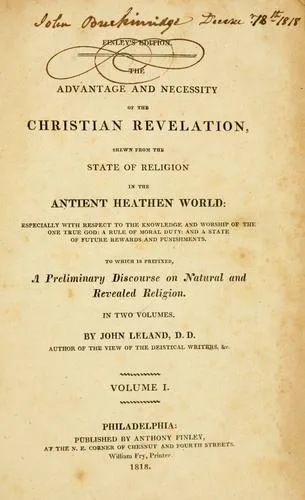
More Free Occult Philosophy Books
View all →

![BHAGAVAD GITA AS IT IS [NEPALI LANGUAGE].](/img/thumb/bhagavad-gita-as-it-is-nepali-language-ac-bhaktivedanta-swami-prabhupada-883290.webp)