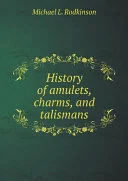
History of amulets, charms, and talismans
 80
80

History of amulets, charms, and talismans
Rodkinson's "History of Amulets, Charms, and Talismans" is a commendable, if somewhat dry, academic survey. Its strength lies in its thoroughness; the author meticulously compiles examples from disparate historical periods and geographical locations, offering a broad panorama of these objects. A notable passage details the use of scarab amulets in ancient Egypt, linking their form to rebirth and protection. However, the book's limitation is its dispassionate tone, which occasionally leaves the reader wanting more exploration of the *experience* of belief. The initial publication in 1983 means some archaeological or anthropological perspectives may be dated. Nevertheless, it serves as a valuable reference for understanding the historical trajectory of talismanic practices.
📝 Description
80
M.L. Rodkinson's 1983 History of Amulets, Charms, and Talismans traces the global lineage of protective objects.
Published in 1983, M.L. Rodkinson's work examines the history and origins of protective and luck-bringing objects. The book systematically traces the evolution of these artifacts through various cultures and time periods, from ancient civilizations to more recent eras. Rodkinson aims to provide a thorough overview of the beliefs and practices associated with these items, detailing their perceived effectiveness and cultural importance.
This book is for scholars of comparative religion, cultural historians, folklorists, and serious practitioners of occult studies. It appeals to those interested in the historical development of magical objects, the psychology behind belief in their power, and their role in human societies over millennia. Readers will find detailed historical accounts and an academic approach to the subject.
The text differentiates between amulets, charms, and talismans, categorizing their functions and symbolic meanings. It discusses the materials employed, the inscription of specific symbols or texts, and the rituals for their consecration and activation.
This study emerged from a late 20th-century academic and esoteric interest in the history of magic and popular belief. It aligns with scholarship that sought to demystify and document pre-modern and non-Western belief systems, often drawing on archaeological findings and historical texts. Unlike works that broadly examine magic's decline, Rodkinson's book focuses directly on the objects themselves and their worldwide historical presence.
💡 Why Read This Book?
• Understand the foundational differences between amulets, charms, and talismans, as detailed in Rodkinson's historical classifications, to better engage with specific magical traditions. • Gain insight into the ancient Egyptian significance of scarab amulets, as discussed in the text, to appreciate the deep historical roots of symbolism in protective magic. • Explore the concept of sympathetic magic, a core principle examined by Rodkinson, to grasp how efficacy was attributed to these objects across cultures.
⭐ Reader Reviews
Honest opinions from readers who have explored this book.
❓ Frequently Asked Questions
What is the primary difference between an amulet and a talisman according to M.L. Rodkinson?
Rodkinson distinguishes amulets primarily by their protective function against evil or harm, while talismans are often seen as instruments for attracting or channeling specific energies or influences.
Does the book discuss the materials used in creating historical amulets and talismans?
Yes, the work investigates various materials, including metals, stones, and organic substances, examining the symbolic and energetic properties attributed to each in different cultures and historical periods.
What historical periods does "History of Amulets, Charms, and Talismans" cover?
The book spans a wide historical range, referencing examples from ancient civilizations like Egypt and Rome, through medieval periods, and into more recent historical eras, illustrating the enduring nature of these practices.
Are specific examples of charms discussed in the book?
Indeed, the text provides numerous examples of charms, often focusing on their folkloric origins and their role in everyday life for purposes such as luck, love, or warding off minor afflictions.
Is M.L. Rodkinson's work considered an academic or a practitioner's text?
Rodkinson's book leans towards an academic survey, offering historical context and analysis rather than practical instruction, though it is valuable for practitioners seeking historical grounding.
When was "History of Amulets, Charms, and Talismans" first published?
The work by M.L. Rodkinson was first published in 1983, making it a product of late 20th-century scholarship on esoteric history and folklore.
🔮 Key Themes & Symbolism
The Nature of Protective Objects
This theme centers on the fundamental distinction between amulets, charms, and talismans as presented by Rodkinson. The work explores how these objects were historically conceived as conduits of specific energies, designed either to repel negative forces (amulets) or attract positive influences (talismans). It studies the cultural and psychological underpinnings of this belief, examining how societies have consistently sought tangible means to engage with the unseen forces believed to govern their well-being and fortune.
Cultural Evolution of Talismans
Rodkinson traces the lineage of talismanic practices across diverse civilizations, highlighting how the form, function, and symbolism of these objects adapted to different cultural contexts. From ancient Mesopotamian cylinder seals acting as protective charms to medieval European enchiridions, the book illustrates a continuous thread of human engagement with portable magical devices. This theme underscores the universality of the desire for protection and empowerment through material objects.
Symbolism and Material Efficacy
A core focus is the symbolic language and material properties attributed to amulets, charms, and talismans. The work examines how specific shapes, inscriptions (like sigils or divine names), and materials (gemstones, metals, herbs) were believed to imbue objects with power. Rodkinson investigates the principle of contagion and sympathetic magic, where an object's form or origin dictated its perceived ability to influence events or individuals, offering a glimpse into pre-scientific causal reasoning.
Belief Systems and Social Function
This theme addresses the socio-religious context in which these artifacts were created and utilized. Rodkinson explores how amulets and talismans functioned within broader belief systems, often intertwined with religious practices, folk magic, and cosmology. The book touches upon their role in personal devotion, social status, and the management of existential anxieties, revealing their deep integration into the fabric of historical societies.
💬 Memorable Quotes
Direct passages from the work, attributed to the author.
“The history of amulets, charms, and talismans is a history of human attempts to control or influence the unseen.”
— This highlights the core thesis: these objects are not merely decorative but represent a deep-seated human drive to interact with and shape perceived spiritual or cosmic forces.
“Ancient cultures widely employed scarab amulets for their association with rebirth and protection.”
— This points to specific cultural practices, using the Egyptian scarab as an example to illustrate the symbolic power and intended function of certain talismanic forms.
“The efficacy of a charm was often believed to derive from its material composition and inscribed symbols.”
— This emphasizes the tangible aspects of magical belief, suggesting that the physical properties and visual language of an object were considered crucial for its magical operations.
“Sympathetic magic played a significant role in the creation and use of many talismans.”
— This identifies a key theoretical principle underpinning talismanic magic, where resemblance or connection was thought to facilitate influence over distant objects or events.
“From ancient times, talismans have served as bridges between the material world and the spiritual.”
— This expresses the mediating function attributed to talismans, positioning them as essential tools for accessing or interacting with non-physical realities.
🌙 Esoteric Significance
Tradition
This work aligns broadly with the study of Western Esotericism, particularly its interest in magical objects and historical practices. While not strictly tied to a single lineage like Hermeticism or Kabbalah, it provides historical context for objects frequently discussed within those traditions. It functions as a historical survey that informs practitioners by detailing the origins and cultural significance of items they might encounter or utilize.
Symbolism
The book explores symbols such as the scarab beetle, representing rebirth in ancient Egypt, and various geometric patterns or divine names inscribed on talismans, believed to channel specific cosmic energies. It also touches upon the symbolism of materials like specific gemstones or metals, understood to possess inherent magical properties or planetary associations within occult frameworks.
Modern Relevance
Contemporary practitioners of folk magic, ceremonial magic, and even those interested in the psychology of belief can draw upon Rodkinson's research. Modern occult authors and practitioners often reference historical examples of amulets and talismans when developing their own magical systems or exploring the enduring power of symbolic objects in personal practice.
👥 Who Should Read This Book
• Students of comparative religion and folklore seeking historical documentation of apotropaic and talismanic practices across diverse cultures. • Occult practitioners interested in the historical origins and conceptual frameworks behind the creation and use of magical objects. • Cultural historians and anthropologists examining the role of material culture and belief in shaping societal interactions with the perceived supernatural.
📜 Historical Context
M.L. Rodkinson's "History of Amulets, Charms, and Talismans," first published in 1983, emerged during a period of renewed academic and public interest in the history of magic, folklore, and esotericism. Works like Carlo Ginzburg's "The Night Battles" (1983, English translation) were exploring shamanistic traditions and folk beliefs, while others continued to analyze the impact of figures like Eliphas Lévi on modern occultism. Rodkinson's contribution offered a more focused, object-centric survey, drawing on a wide array of historical examples. While not engaging directly with specific contemporary scholars in its text, the book implicitly contextualized itself within the broader anthropological and historical study of material culture and belief systems that was gaining momentum. Its detailed compilation of practices across cultures served as a valuable resource for those seeking to understand the deep roots of apotropaic and talismanic traditions, distinct from purely theoretical or philosophical treatises on magic.
📔 Journal Prompts
The historical human attempt to influence the unseen, as described in the book's scope.
The symbolic meaning of the scarab amulet and its connection to rebirth.
The principle of sympathetic magic in the context of talismanic efficacy.
Distinguishing the functions of amulets versus talismans in historical practice.
The role of inscribed symbols and material composition in object-based magic.
🗂️ Glossary
Amulet
An object worn or carried, primarily intended to provide protection against evil, harm, or misfortune. Its function is typically seen as defensive or repelling.
Talisman
An object consecrated or inscribed with symbols, believed to attract or channel specific energies, influences, or powers for the benefit of the bearer, often for luck or success.
Charm
A smaller object, often associated with folk magic, believed to possess minor magical properties to bring good luck, love, or ward off minor annoyances or ailments.
Sympathetic Magic
A principle of magic based on the belief that like affects like (law of similarity) and that objects once in contact continue to be connected (law of contagion), allowing for influence at a distance.
Apotropaic
Having the power to ward off evil or bad luck; a term often applied to amulets and other protective devices.
Sigil
A symbol or sign, often magical, created for a specific purpose, such as to represent a concept, entity, or to invoke a particular influence or power.
Consecration
The act of formally dedicating or setting apart an object, place, or person for sacred purposes, often involving ritualistic practices to imbue it with spiritual power.
This book appears in 1 collection
🔮 Readers Also Liked
Browse all →








From the “Talismans” Collection
View all →



More Free Occult Philosophy Books
View all →