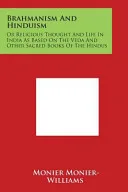
Brahmanism and Hinduism
 79
79

Brahmanism and Hinduism
Monier-Williams' "Brahmanism and Hinduism" offers a formidable survey, meticulously cataloging the vast theological and philosophical landscape of India as understood in the late 19th century. Its strength lies in its encyclopedic breadth and the author's deep engagement with textual sources, providing a valuable historical snapshot. However, the work occasionally betrays its era, with certain interpretations reflecting the biases and limited understanding of non-Western religions prevalent at the time of its original publication. The detailed exploration of the concept of Samsara, for instance, is rendered with considerable academic rigor, illuminating the cyclical view of existence central to these traditions. A notable limitation is the sometimes-dense prose, which can present a challenge to readers unfamiliar with the subject matter. For scholars of Indology and comparative religion, this 1891 edition remains a foundational, if sometimes dated, resource.
📝 Description
79
Monier Monier-Williams' 1891 study examines Indian religious and philosophical traditions from Vedic roots to 19th-century practices.
Published in 1891, Monier Monier-Williams' study offers a detailed account of Brahmanism and Hinduism. The author, an orientalist, traces the development of these belief systems from their Vedic origins to the religious landscape of the late 1800s. This scholarly compilation explains key deities, rituals, ethical principles, and metaphysical doctrines central to these faiths. The text is suited for serious students of comparative religion and Indian history, particularly those interested in a historical perspective on foundational philosophical texts. Readers exploring the origins of yoga, Vedanta, and devotional practices will find it a valuable reference.
The book originated during a period of significant European academic engagement with Eastern thought, often called the Oriental Renaissance. This era focused on translating and analyzing Sanskrit literature. Monier-Williams' work is situated within this scholarly context, responding to earlier analyses and adding to the growing field of Indology. It uses the classification and analytical methods typical of Victorian scholarship on religious and philosophical subjects.
This work falls within the tradition of comparative religion and Indology, particularly as it developed in the 19th century. It represents a scholarly attempt to codify and understand the complex religious and philosophical systems of India for a Western audience. While not strictly an esoteric text in itself, it analyzes traditions that are deeply concerned with liberation (Moksha) and ultimate reality (Brahman), concepts central to many esoteric philosophies.
💡 Why Read This Book?
• Gain a comprehensive historical overview of Brahmanism and Hinduism, understanding their development from the Vedic period, as detailed in the text's examination of ancient scriptures and practices. • Grasp the intricate philosophical doctrines of Brahman and Atman, learning how these concepts underpin the spiritual goals of liberation (Moksha) as presented in Monier-Williams' analysis. • Appreciate the scholarly context of late 19th-century Indology through this 1891 edition, understanding how contemporary academic thought shaped the study of Indian religions.
⭐ Reader Reviews
Honest opinions from readers who have explored this book.
❓ Frequently Asked Questions
What is the original publication date of Monier Monier-Williams' "Brahmanism and Hinduism"?
The original edition of "Brahmanism and Hinduism" by Monier Monier-Williams was first published in 1891, reflecting late 19th-century scholarship on Indian religions.
Who was Monier Monier-Williams and what was his background?
Monier Monier-Williams was a prominent British orientalist and scholar of Sanskrit. He served as the Boden Professor of Sanskrit at the University of Oxford, dedicating much of his career to the study and translation of Indian texts.
What are the primary religious traditions covered in this book?
The book primarily covers Brahmanism, the older Vedic tradition, and Hinduism, exploring its diverse practices, philosophies, and deities as they evolved over centuries.
Does the book discuss the concept of Karma?
Yes, the work extensively discusses the concept of Karma, detailing its role in the cycle of rebirth (Samsara) and its influence on ethical frameworks within Brahmanism and Hinduism.
Is this book suitable for beginners interested in Hinduism?
While comprehensive, the book's scholarly depth and the nature of the 1891 edition might be challenging for absolute beginners. It is best suited for those with some background or a serious academic interest in the subject.
What historical period does the book primarily focus on?
The book traces the development of Brahmanism and Hinduism from their ancient Vedic origins through to the practices and philosophies prevalent in the 19th century, when it was originally written.
🔮 Key Themes & Symbolism
The Vedic Foundations
The work meticulously details the foundational texts and rituals of Brahmanism, particularly the Vedas and the early hymns. Monier-Williams examines the cosmic order, the role of sacrifices (yajnas), and the nature of the early pantheon. This section is crucial for understanding the deep historical layers from which later Hindu traditions emerged, highlighting the continuity and transformation of religious thought from ancient India.
Philosophical Doctrines
Central to the book is an exposition of core metaphysical concepts like Brahman (ultimate reality), Atman (the soul), and the interconnectedness of all existence. The text explains the philosophical inquiries found in the Upanishads, laying the groundwork for schools of thought such as Vedanta. It explores the pursuit of Moksha, or liberation, as the ultimate spiritual aim.
The Evolution of Deities and Worship
Monier-Williams charts the development of the Hindu pantheon, from the Vedic deities to the Puranic age's prominent figures like Vishnu, Shiva, and Devi. The book differentiates between the philosophical Brahmanism and the devotional practices (Bhakti) that became widespread. It analyzes the forms of worship, temple rituals, and the significance of avatars.
Karma and Samsara
A significant portion of the work is dedicated to explaining the concepts of Karma and Samsara. The book clarifies how the principle of cause and effect (Karma) governs the soul's transmigration (Samsara) through countless lifetimes. This doctrine provides the ethical and existential framework for understanding suffering and the path to spiritual release.
💬 Memorable Quotes
Direct passages from the work, attributed to the author.
“Brahmanism may be said to be the religion of the Brahmans, and Hinduism to be the religion of the people of India.”
— This statement, representing a core distinction drawn by Monier-Williams, highlights his analytical approach. It posits Brahmanism as the priestly, scriptural tradition and Hinduism as the broader, more popular manifestation, a categorization crucial for understanding the book's structure.
“The great aim of the Hindu is to obtain release from the cycle of births and deaths.”
— This succinctly captures the ultimate spiritual objective within the traditions discussed. It frames the entire religious and philosophical endeavor as a quest for liberation (Moksha) from the perpetual cycle of Samsara.
“The sacred books of India are not only the foundation of Brahmanism and Hinduism, but are also the source from which Buddhism and Jainism have sprung.”
— This highlights the foundational role of Vedic and Upanishadic literature, suggesting a common origin for various Indian religious and philosophical movements and underscoring the seminal importance of these early texts.
“The Hindu doctrine of Karma is the doctrine of causation applied to morality.”
— This offers a concise explanation of Karma, framing it not just as fate, but as a moral law of action and reaction. It emphasizes the ethical dimension and the principle that one's actions directly influence future experiences and rebirths.
“The Atman is the eternal, unchanging self, identical with Brahman.”
— This expresses a key tenet of Advaita Vedanta and related philosophies discussed. It points to the concept of an ultimate, immanent reality within the individual, often seen as the highest spiritual truth to be realized.
🌙 Esoteric Significance
Tradition
While not strictly belonging to a single Western esoteric lineage, Monier-Williams' work is foundational for modern Theosophy and subsequent movements seeking to synthesize Eastern and Western spiritual philosophies. Theosophists like Helena Blavatsky drew heavily on scholarly interpretations of Indian thought, including works like this, to formulate their own doctrines regarding karma, reincarnation, and universal spiritual evolution. It provides the scholarly framework that later esotericists would reinterpret and adapt.
Symbolism
The book details numerous symbols central to Brahmanism and Hinduism. The Om (Aum) symbol, representing the primordial sound and the totality of existence, is explored in its sonic and visual significance. The lotus flower often symbolizes purity, spiritual enlightenment, and creation, emerging unstained from muddy waters. The concept of the chakras, though more prominent in Tantric traditions, is also touched upon as energetic centers within the subtle body, crucial for spiritual development.
Modern Relevance
Contemporary scholars of religion, comparative mythology, and Indology continue to reference Monier-Williams' extensive research as a historical marker. Modern practitioners of yoga and Vedanta often engage with his interpretations to understand the historical development of concepts they now practice. His work remains a significant source for tracing the academic reception and understanding of these traditions in the West during a formative period.
👥 Who Should Read This Book
• Students of Comparative Religion: Individuals seeking to understand the historical development and core tenets of major world religions will find this text provides a detailed, scholarly foundation. • Scholars of Indology: Researchers focusing on the history of Sanskrit literature, Indian philosophy, and religious studies will benefit from Monier-Williams' extensive textual analysis and historical context. • Those exploring the origins of Yoga and Vedanta: Readers interested in the philosophical roots and historical evolution of practices like yoga and the teachings of Vedanta will find detailed explanations of key concepts.
📜 Historical Context
Monier Monier-Williams' "Brahmanism and Hinduism" was published in 1891, a period marked by significant European engagement with Eastern philosophies and religions. The late 19th century saw the rise of Indology as a formal academic discipline, fueled by increased colonial presence and scholarly expeditions. This era was characterized by efforts to categorize, translate, and interpret Indian texts, often through a Western lens. Monier-Williams himself was a prominent figure, holding the Boden Professorship of Sanskrit at Oxford. His work emerged amidst a scholarly landscape that included figures like Max Müller, whose translations of the Vedas were influential. While aiming for scholarly objectivity, the text reflects the prevailing intellectual currents of Victorian England, including a focus on comparative religion and, at times, an implicit comparison with Christian doctrines. There was considerable academic debate regarding the origins and nature of these traditions, with Monier-Williams contributing his extensive textual analysis to this ongoing discourse.
📔 Journal Prompts
The concept of Brahman as ultimate reality and its relationship to Atman.
The cyclical nature of Samsara and the role of Karma in human experience.
The evolution of deities from the Vedic pantheon to the Puranic era.
The significance of the Vedas as foundational scriptures.
The ultimate goal of Moksha and the paths described for its attainment.
🗂️ Glossary
Brahman
In Hindu philosophy, the supreme, unchanging, ultimate reality that is the source and substance of all existence. It is often described as infinite, eternal, and beyond all attributes.
Atman
The individual soul or self. In many Hindu schools, particularly Advaita Vedanta, the Atman is considered identical with Brahman, representing the true, eternal essence of a being.
Samsara
The cycle of death and rebirth, or reincarnation, to which all beings are subject in Hindu, Buddhist, Jain, and Sikh traditions. It is seen as a state of suffering driven by karma.
Karma
The principle of cause and effect in Hindu and Buddhist traditions, where actions (karma) have consequences that influence an individual's present life and future rebirths.
Moksha
Liberation or release from the cycle of Samsara. It is the ultimate spiritual goal in many Hindu traditions, achieved through various paths such as knowledge, devotion, or action.
Vedas
The oldest and most sacred scriptures of Hinduism, comprising hymns, rituals, and philosophical insights. They are considered Shruti ('what is heard') and form the basis of Brahmanism.
Upanishads
A collection of philosophical texts forming the theoretical basis of Hinduism. They explore concepts such as Brahman, Atman, and the nature of reality, and are considered part of the Vedas.

![[The English physician] Culpeper's English physician; and complete herbal. To which are now first added, upwards of one hundred additional herbs, with a display of their medicinal and occult properties, physically applied to the cure of all disorders incident to banking. To which are annexed, rules for compounding medicine. 1789](/img/thumb/the-english-physician-culpeper-s-english-physician-and-complete-herbal-to-which-are-now-first-added-upwards-of-one-hundred-additional-herbs-with-a-display-of-their-medicinal-and-occult-properties-phys.webp)