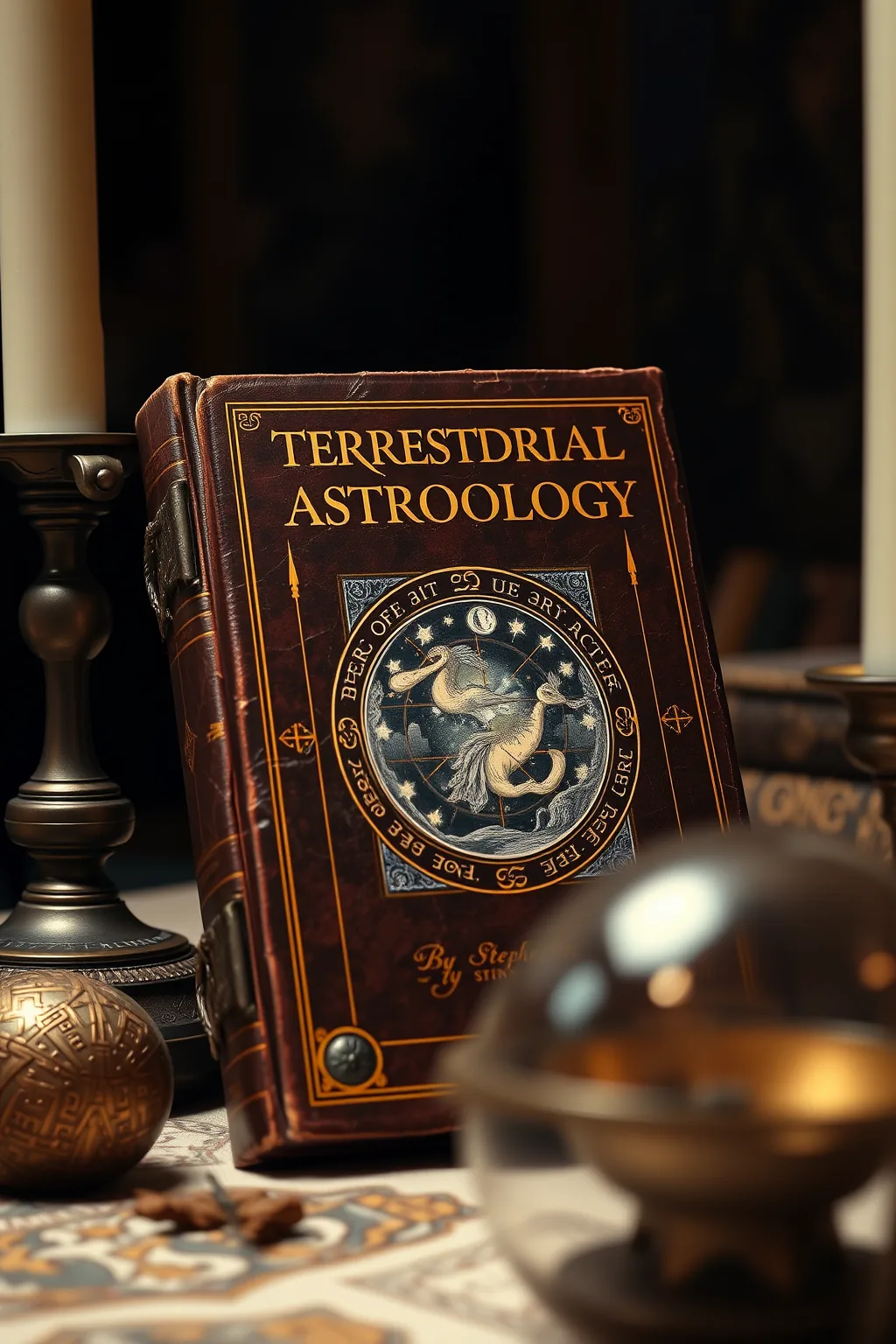
Terrestrial astrology
 71
71

Terrestrial astrology
Stephen Skinner's Terrestrial Astrology offers a compelling counterpoint to the deeply personal focus prevalent in modern Western astrology. By shifting the lens from individual birth charts to the planet as a whole, Skinner challenges readers to consider the Earth as an organism influenced by cosmic rhythms. The strength of the work lies in its meticulous tracing of historical precedents for this type of astrological inquiry, moving beyond the confines of purely human-centric interpretation. However, a limitation for some readers might be the inherent difficulty in empirically verifying the direct correlations proposed; the work operates within the speculative framework of esoteric philosophy. A particularly engaging section explores the astrological significance of geological fault lines, suggesting a direct celestial imprint on Earth's physical structure. Ultimately, Terrestrial Astrology serves as a vital exploration for those seeking a more holistic, cosmically-aware perspective on our planet.
📝 Description
71
Stephen Skinner's 2021 book examines celestial influences on Earth's geology and weather.
Terrestrial astrology, a less common area of astrological study, investigates the connections between planetary movements and earthly occurrences beyond individual horoscopes. This perspective proposes that planetary forces influence geological events, weather patterns, and the planet's physical makeup. It shifts focus from the personal natal chart to view the Earth as a dynamic entity shaped by cosmic cycles.
This book is for dedicated occult researchers and astrologers who wish to broaden their practice beyond personal readings. It appeals to those interested in the larger cosmic forces that shape the physical world, including students of geophysics, meteorology, and earth sciences from an esoteric viewpoint. Readers curious about historical astrological uses beyond the personal will also find it relevant.
Central to terrestrial astrology is the concept of sympathetic resonance between the heavens and the Earth. This involves understanding how planetary configurations may correlate with seismic activity, volcanic eruptions, or significant weather events. The field of mundane astrology, which deals with nations and world events, is a significant precursor and related area that terrestrial astrology extends by concentrating on the physical planet itself.
Astrological thought has historically included branches that considered terrestrial events. While much attention went to human destiny, traditions also looked at celestial influences on kingdoms, harvests, and natural disasters. The early 20th century saw a renewed interest in broader astrological applications, moving away from purely psychological interpretations that became popular mid-century. Skinner's work connects to this historical lineage, examining how the cosmos affects the physical planet.
💡 Why Read This Book?
• Gain an understanding of mundane astrology's historical roots, specifically how celestial events were historically linked to global occurrences rather than individual lives, as explored in the early sections. • Learn about the astrological correlation between planetary positions and geophysical events, moving beyond personal horoscopes to consider the Earth's cycles as described by Skinner. • Discover a framework for viewing the planet as a living entity influenced by cosmic forces, offering a unique esoteric perspective on Earth sciences and natural phenomena.
⭐ Reader Reviews
Honest opinions from readers who have explored this book.
❓ Frequently Asked Questions
What is the primary focus of terrestrial astrology compared to natal astrology?
Terrestrial astrology shifts focus from individual birth charts to the Earth as a whole. It examines celestial influences on global events, climate, and geological phenomena, rather than personal destinies or psychological traits.
When was Stephen Skinner's Terrestrial Astrology first published?
Stephen Skinner's work on Terrestrial Astrology was first published in 1980, making it a significant contribution to the esoteric literature of the late 20th century.
Does terrestrial astrology predict specific natural disasters?
While the work explores potential correlations between celestial alignments and geophysical events, it generally posits broader patterns and influences rather than precise predictions of specific disasters.
What historical precedents does Skinner draw upon for terrestrial astrology?
Skinner references ancient astrological traditions that considered the cosmos's influence on kingdoms, agriculture, and weather patterns, often referred to as mundane astrology, predating the modern focus on natal charts.
Is terrestrial astrology a recognized scientific field?
No, terrestrial astrology is an esoteric or occult philosophy, not a scientifically validated discipline. Its methods and conclusions are based on symbolic correlations within mystical traditions.
What kind of reader would benefit most from this book?
Readers interested in esoteric cosmology, the history of astrology beyond personal charts, or those seeking a symbolic understanding of Earth's relationship with the cosmos would find this book particularly valuable.
🔮 Key Themes & Symbolism
Geocosmic Harmonics
This theme explores the intricate, often overlooked, connections between celestial bodies and the physical Earth. It moves beyond the familiar concept of the personal horoscope to investigate how planetary cycles might influence geological formations, seismic activities, and atmospheric patterns. The work posits a fundamental sympathetic resonance, suggesting that Earth itself is subject to cosmic rhythms in ways analogous to how individuals are influenced by their birth charts. This perspective invites a re-evaluation of our planet not merely as a physical entity but as a dynamic system intertwined with the greater cosmos.
Mundane Astrology's Scope
Terrestrial Astrology expands upon the principles of mundane astrology, which traditionally concerned itself with the fate of nations, rulers, and collective events. Skinner's approach refines this by focusing specifically on the Earth's physical environment. It examines historical astrological applications that sought to understand the celestial underpinnings of agricultural cycles, weather phenomena, and even the locations of significant geographical features. This theme highlights how astrological inquiry, throughout history, has encompassed macrocosmic forces affecting collective human existence and the planet itself.
Planetary Sympathy
Fundamentally, terrestrial astrology is built on the principle of planetary sympathy – the idea that the celestial spheres and the terrestrial realm are interconnected through unseen forces and correspondences. This theme examines how specific planetary configurations and movements are believed to mirror or trigger events on Earth. It encourages a holistic view where the Earth is seen as a living organism, responsive to the grand celestial dance, a concept that bridges esoteric philosophy with a symbolic understanding of natural processes.
Historical Astrological Applications
This theme traces the historical lineage of astrological practices that extended beyond individual horoscopes. It examines how ancient and medieval practitioners utilized celestial observation to understand and potentially predict terrestrial events, from famines and plagues to climatic shifts. Skinner's work situates terrestrial astrology within this broader historical context, demonstrating that the focus on the Earth as an astrological entity has deep roots, offering a counter-narrative to the modern overemphasis on personal natal charts.
💬 Memorable Quotes
Direct passages from the work, attributed to the author.
“The Earth is as much a creature of the heavens as any man born under the stars.”
— This statement expresses the core thesis of terrestrial astrology: that our planet is not an independent entity but is fundamentally subject to celestial influences, mirroring the astrological principle that human lives are governed by planetary positions.
“Geological fault lines may possess their own celestial signatures.”
— This concept suggests a direct, symbolic mapping between planetary alignments and the physical structure of the Earth, implying that the very stresses and tensions within the planet's crust could be astrologically significant.
“Celestial configurations provide a framework for understanding terrestrial cycles.”
— This highlights the predictive or correlative power attributed to astrology in this context. It implies that by studying the heavens, one can gain insight into the natural cycles and events occurring on Earth.
“The patterns in the sky are reflected in the patterns of the Earth.”
— This succinctly expresses the principle of celestial-terrestrial correspondence, suggesting a holographic or sympathetic relationship where macrocosmic order (heavens) directly relates to microcosmic order (Earth).
💡 Key Ideas
Editorial paraphrase of the work's core concepts — not direct quotes.
Mundane astrology's focus on kingdoms can be extended to the kingdom of the Earth itself.
This paraphrased idea positions terrestrial astrology as an evolution or expansion of traditional mundane astrology, broadening its scope from human political entities to the planet as a singular, grand entity influenced by cosmic forces.
🌙 Esoteric Significance
Tradition
Terrestrial Astrology aligns with the broader Hermetic and Neoplatonic traditions that view the cosmos as a unified, interconnected whole, where the macrocosm directly influences the microcosm. It echoes ancient Babylonian and Hellenistic astrological practices that considered celestial influences on weather, agriculture, and kingdoms (mundane astrology). This work departs from later Kabbalistic or Gnostic interpretations by focusing on the physical, geophysical manifestation of celestial forces rather than purely spiritual or psychological realms.
Symbolism
A key symbol is the **Earth as a living entity**, akin to a human body with its own celestial 'natal chart'. Another motif is the **celestial equator and ecliptic**, not just as markers for seasons but as direct influences on tectonic plates and atmospheric phenomena. The **planets themselves** are viewed not merely as archetypes but as active energetic forces with tangible effects on Earth's geology and climate, embodying principles of sympathy and correspondence.
Modern Relevance
Contemporary thinkers in fields like archaeoastronomy and certain branches of eco-spirituality draw upon the underlying principles of geocosmic correlation explored by Skinner. Astrologers seeking to broaden their practice beyond natal interpretation, particularly those interested in mundane astrology or the astrological influence on climate and natural events, find value in this perspective. The work also appeals to modern systems thinking and ecological philosophies that emphasize interconnectedness.
👥 Who Should Read This Book
• **Occult scholars and historians of astrology:** Those researching the evolution of astrological thought beyond personal horoscopes will find a detailed exploration of mundane and terrestrial applications. • **Esoteric practitioners interested in Earth sciences:** Individuals seeking to integrate a spiritual or symbolic understanding of planetary influences with geophysical phenomena will discover a unique framework. • **Advanced astrologers seeking new perspectives:** Practitioners looking to expand their interpretive toolkit beyond natal charts to encompass global and environmental influences will benefit from this specialized branch.
📜 Historical Context
Stephen Skinner's *Terrestrial Astrology*, first published in 1980, emerged during a period of renewed interest in esoteric traditions and a diversification of astrological practice beyond the dominant psychological models of the mid-20th century. The era saw figures like Dane Rudhyar popularizing a more humanistic astrology, while others, like Skinner, sought to reclaim older, more cosmically-oriented branches. This work engaged with the long history of mundane astrology, which had traditionally concerned itself with the affairs of nations and collective events, dating back to Ptolemy's *Tetrabiblos*. Skinner's contribution was to refine this focus specifically onto the Earth's physical phenomena. While not a widely debated topic in mainstream academic circles, Skinner’s work contributed to a more scholarly exploration within esoteric communities, drawing from historical texts and challenging the purely anthropocentric view of astrology prevalent at the time.
📔 Journal Prompts
The Earth's sympathetic resonance with celestial bodies: explore potential terrestrial events that might correlate with specific planetary alignments.
Analyze the historical interpretations of mundane astrology and how they differ from Skinner's terrestrial focus.
Reflect on the concept of planetary sympathy and its implications for understanding Earth's natural cycles.
Consider the symbolic relationship between specific constellations or planets and geological formations.
Map a significant terrestrial event (e.g., a volcanic eruption, a major storm) to its potential astrological correlations as outlined in terrestrial astrology.
🗂️ Glossary
Terrestrial Astrology
A branch of astrology that examines the correlation between celestial movements and phenomena occurring on the Earth's surface, such as geological events, weather patterns, and climate, as distinct from personal natal astrology.
Mundane Astrology
The branch of astrology concerned with the prediction and interpretation of events affecting nations, communities, and the world at large, historically including politics, economics, and collective happenings.
Geocosmic Correlation
The principle suggesting a relationship or correspondence between celestial positions and events or patterns occurring on the Earth.
Planetary Sympathy
The esoteric concept that celestial bodies exert influences on terrestrial matters through a form of sympathetic or resonant connection, binding the macrocosm and microcosm.
Natal Chart
A map of the heavens at the precise moment and location of an individual's birth, used in natal astrology to interpret personality, life path, and potential events.
Celestial Equator
The imaginary circle in the sky directly above the Earth's equator, used as a reference line in astronomical and astrological calculations.
Ecliptic
The apparent path of the Sun across the celestial sphere throughout the year, representing the plane of Earth's orbit around the Sun and a fundamental reference in astrology.
🔮 Readers Also Liked
Browse all →








More by Stephen Skinner
All books →




More Free Occult Philosophy Books
View all →