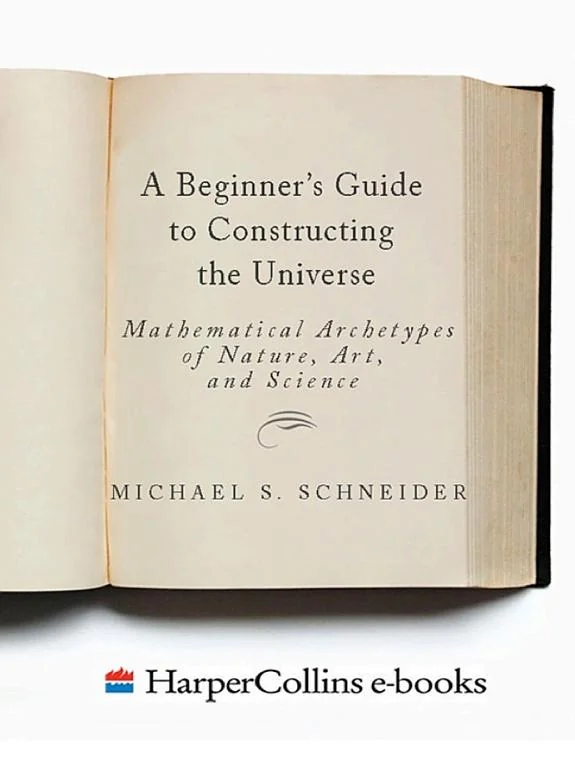
A Beginner's Guide to Constructing the Universe
 77
77

A Beginner's Guide to Constructing the Universe
Michael S. Schneider's 'A Beginner's Guide to Constructing the Universe' approaches the subject of natural order with a refreshing directness. The author avoids overly academic jargon, making complex ideas accessible through clear prose and illustrative diagrams. A particular strength lies in its ability to connect seemingly disparate observations – for instance, the spiral of a seashell to the arrangement of seeds in a sunflower – through the lens of geometric principles. However, the book's ambition to cover such a vast array of phenomena occasionally leads to a breadth that might sacrifice depth for some readers. The section on the "musical scale of the cosmos" offers a compelling, albeit brief, glimpse into harmonic relationships. Ultimately, Schneider provides a compelling argument for an inherent, quantifiable beauty in the universe, offering a valuable perspective for those seeking order beyond conventional scientific frameworks.
📝 Description
77
Michael S. Schneider's 2014 guide reveals the geometric principles shaping the natural world.
This book introduces the fundamental geometric principles that structure the natural world. It shows how essential shapes and ratios appear consistently across phenomena, from the smallest particles to the largest cosmic structures. The author seeks to uncover a hidden order, a mathematical blueprint connecting different aspects of existence. Individuals curious about nature's patterns, regardless of their scientific or mathematical background, will find this accessible. It is for those wanting to grasp the symbolic language of geometry as it appears in everyday observations and vast cosmic formations. The book acts as a starting point for a deeper study of how form influences function and meaning.
Schneider's work contrasts with modern scientific reductionism that often ignores emergent patterns. It offers an alternative to purely mechanistic viewpoints by drawing on historical traditions that viewed geometry as central to cosmic understanding. The text engages with ideas from Pythagorean thought and Renaissance natural philosophy, which proposed a universe governed by numerical and geometric harmony. It presents these mathematical and geometric forms not as abstract ideas but as active components of reality.
Published in 2014, this guide connects with ancient traditions that saw geometry and number as the underlying language of the cosmos. It revisits ideas found in Pythagoreanism and Neoplatonism, where the study of form and proportion was a path to understanding divine order. The book offers a perspective on the universe as a coherent, harmonious whole, built from discernible mathematical relationships, a concept explored throughout esoteric philosophy.
💡 Why Read This Book?
• Understand the fundamental geometric patterns like the Golden Ratio and Platonic solids that structure the natural world, as detailed in Schneider's explanations. • Gain a new perspective on everyday observations, seeing the mathematical relationships in things like plant growth and crystal formation, as presented in the book's examples. • Explore connections between geometry, nature, and ancient wisdom traditions, as Schneider links geometric forms to historical philosophical concepts.
⭐ Reader Reviews
Honest opinions from readers who have explored this book.
❓ Frequently Asked Questions
What is the main idea behind 'A Beginner's Guide to Constructing the Universe'?
The book's central thesis is that the universe is constructed according to a geometric code. Michael S. Schneider illustrates how fundamental shapes, ratios, and patterns are observable across all scales of existence, from subatomic particles to galactic formations.
Who is Michael S. Schneider?
Michael S. Schneider is an education writer who has dedicated himself to exploring and explaining the geometric principles underlying the natural world. His work aims to make these complex ideas accessible to a general audience.
When was 'A Beginner's Guide to Constructing the Universe' first published?
The book was first published on April 1, 2014. This edition serves as a modern introduction to concepts of natural geometry.
Does this book require advanced mathematical knowledge?
No, the book is designed for beginners and specifically states that one need not be a mathematician to appreciate the geometric order of the world. Schneider focuses on conceptual understanding and visual illustration.
What kind of examples does the book use to illustrate geometric principles?
Schneider uses examples from biology (plant growth, shells), geology (crystal structures), astronomy (planetary orbits), and even art and music, showing how geometric ratios and forms manifest universally.
What is John Michell's role in this book?
John Michell, a noted author on sacred geometry and earth mysteries, wrote the preface for 'A Beginner's Guide to Constructing the Universe,' endorsing Schneider's work as a perceptive investigation into nature's geometric code.
🔮 Key Themes & Symbolism
Geometric Blueprint of Reality
The core idea is that reality operates on a foundational geometric framework. Schneider argues that shapes like spheres, spirals, and the Golden Ratio are not mere coincidences but are inherent organizing principles. He demonstrates this by showing how these forms appear in everything from the arrangement of petals on a flower to the structure of galaxies, suggesting a unified mathematical language underlies all existence.
Sacred Geometry in Nature
This theme explores the concept of sacred geometry, positing that certain geometric forms hold intrinsic meaning and sacred significance. The book examines how these forms, often found in ancient temples and religious art, are also prevalent in natural phenomena. Schneider connects these ancient understandings with modern scientific observations, bridging historical spiritual insights with empirical evidence of universal patterns.
The Golden Ratio and Fibonacci
Schneider extensively discusses the Golden Ratio (phi) and its close relation to the Fibonacci sequence. He illustrates their ubiquitous presence in nature, such as in the growth patterns of plants, the branching of trees, and the proportions of animal bodies. This section highlights how these mathematical sequences create aesthetically pleasing and efficient structures, revealing a fundamental principle of natural design.
Cosmic Harmony and Proportion
The book extends its geometric analysis to celestial bodies and cosmic phenomena. It explores how principles of proportion and harmony, derived from geometry, may govern the distances between planets, the orbits of moons, and the overall structure of the universe. This theme connects the micro and macrocosm, suggesting that the same geometric laws apply across all scales.
💬 Memorable Quotes
Direct passages from the work, attributed to the author.
“The geometric code of nature.”
— This phrase expresses the book's central thesis: that the universe is organized according to underlying mathematical and geometric principles, akin to a hidden language or blueprint.
“Is there some sort of order, a pattern, to the things that we see in the sky, on the ground, at the beach?”
— This rhetorical question frames the reader's curiosity and guides them toward the book's exploration of the hidden geometric structures that connect diverse natural phenomena.
“Written and illustrated by the most perceptive of its modern investigators.”
— This description, from John Michell's preface, praises the author's insight and skill in revealing the geometric principles of nature through both writing and visual representation.
“A complete introduction to the geometric code of nature.”
— This concise summary highlights the book's purpose: to serve as a comprehensive yet accessible guide for understanding the fundamental geometric patterns that define the natural world.
💡 Key Ideas
Editorial paraphrase of the work's core concepts — not direct quotes.
You need not be a philosopher or a botanist, and certainly not a mathematician, to enjoy the bounty of the world around us.
This quote emphasizes the book's accessibility, suggesting that an appreciation for nature's order and beauty is available to everyone, regardless of their academic background.
🌙 Esoteric Significance
Tradition
This work aligns with the Hermetic and Pythagorean traditions, which emphasize the power of number and geometry as fundamental aspects of divine creation. It carries the Hermetic principle of "As Above, So Below," illustrating how cosmic laws manifest in terrestrial forms. Schneider's approach fits within the broader esoteric interest in finding a unifying, intelligible order in the universe, moving beyond mere physical description to explore underlying symbolic meaning.
Symbolism
Key symbols include the Platonic solids, representing the elements and fundamental forms of creation; the Golden Ratio (phi), symbolizing divine proportion and natural growth; and the spiral, embodying cosmic evolution and dynamic balance. These symbols are presented not just as abstract mathematical concepts but as active principles shaping the physical world, connecting the microcosm of life to the macrocosm of the cosmos.
Modern Relevance
Schneider's work continues to influence contemporary discussions in fields like ecopsychology, permaculture design, and consciousness studies, where an appreciation for natural patterns and inherent order is valued. Thinkers and practitioners in fields that integrate art, science, and spirituality, such as those exploring fractal geometry or bio-architecture, often draw inspiration from his clear exposition of geometric principles.
👥 Who Should Read This Book
• Aspiring students of natural philosophy and cosmology seeking to understand the mathematical underpinnings of the universe. • Creatives and designers interested in the principles of proportion, harmony, and pattern found in nature. • Individuals curious about sacred geometry and its applications, looking for an accessible introduction to core concepts and examples.
📜 Historical Context
Published in 2014, Michael S. Schneider's "A Beginner's Guide to Constructing the Universe" arrived during a period of resurgent interest in perennial philosophy and holistic science, offering a counter-narrative to purely reductionist paradigms. It taps into a lineage stretching back to Pythagorean mathematics and Plato's theory of Forms, which posited a universe governed by numerical and geometric harmony. While scientific materialism dominated academic discourse, works exploring sacred geometry found an audience among those seeking deeper meaning and interconnectedness. Schneider's book can be seen in dialogue with earlier proponents of geometric symbolism in nature, such as the works of Rudolf Steiner or modern interpretations of ancient cosmological models. Its reception was generally positive within esoteric and New Age circles, appreciated for its clarity and breadth in connecting diverse natural phenomena through geometric principles.
📔 Journal Prompts
The Platonic solids and their elemental associations.
The ubiquity of the spiral in natural forms.
Personal observations of the Golden Ratio in everyday life.
Connecting geometric patterns to personal experiences of harmony.
The concept of a universal geometric code.
🗂️ Glossary
Platonic Solids
Five unique three-dimensional shapes (tetrahedron, cube, octahedron, dodecahedron, icosahedron) where each face is a congruent regular polygon and the same number of faces meet at each vertex. Traditionally associated with the classical elements.
Golden Ratio (Phi)
An irrational number, approximately 1.618, found when a line is divided into two parts such that the ratio of the whole length to the longer part is equal to the ratio of the longer part to the shorter part. Often found in aesthetically pleasing proportions.
Fibonacci Sequence
A sequence of numbers where each number is the sum of the two preceding ones, usually starting with 0 and 1 (e.g., 0, 1, 1, 2, 3, 5, 8...). The ratio of consecutive numbers approaches the Golden Ratio.
Sacred Geometry
The study of geometric forms, patterns, and ratios that are considered fundamental to the structure of the universe and are often seen as having symbolic or spiritual significance.
Vesica Piscis
A shape formed by the intersection of two circles of the same radius, intersecting at their centers. It is a fundamental symbol in sacred geometry, representing union and creation.
Fractal
A complex geometric pattern that exhibits self-similarity at different scales. This means that as you zoom in or out, you see the same or similar patterns repeated.
Tetrahedron
A Platonic solid with four triangular faces, often associated with the element of fire. It is the simplest of the Platonic solids.
This book appears in 1 collection
🔮 Readers Also Liked
Browse all →









From the “Sacred Geometry” Collection
View all →







More Free Occult Philosophy Books
View all →