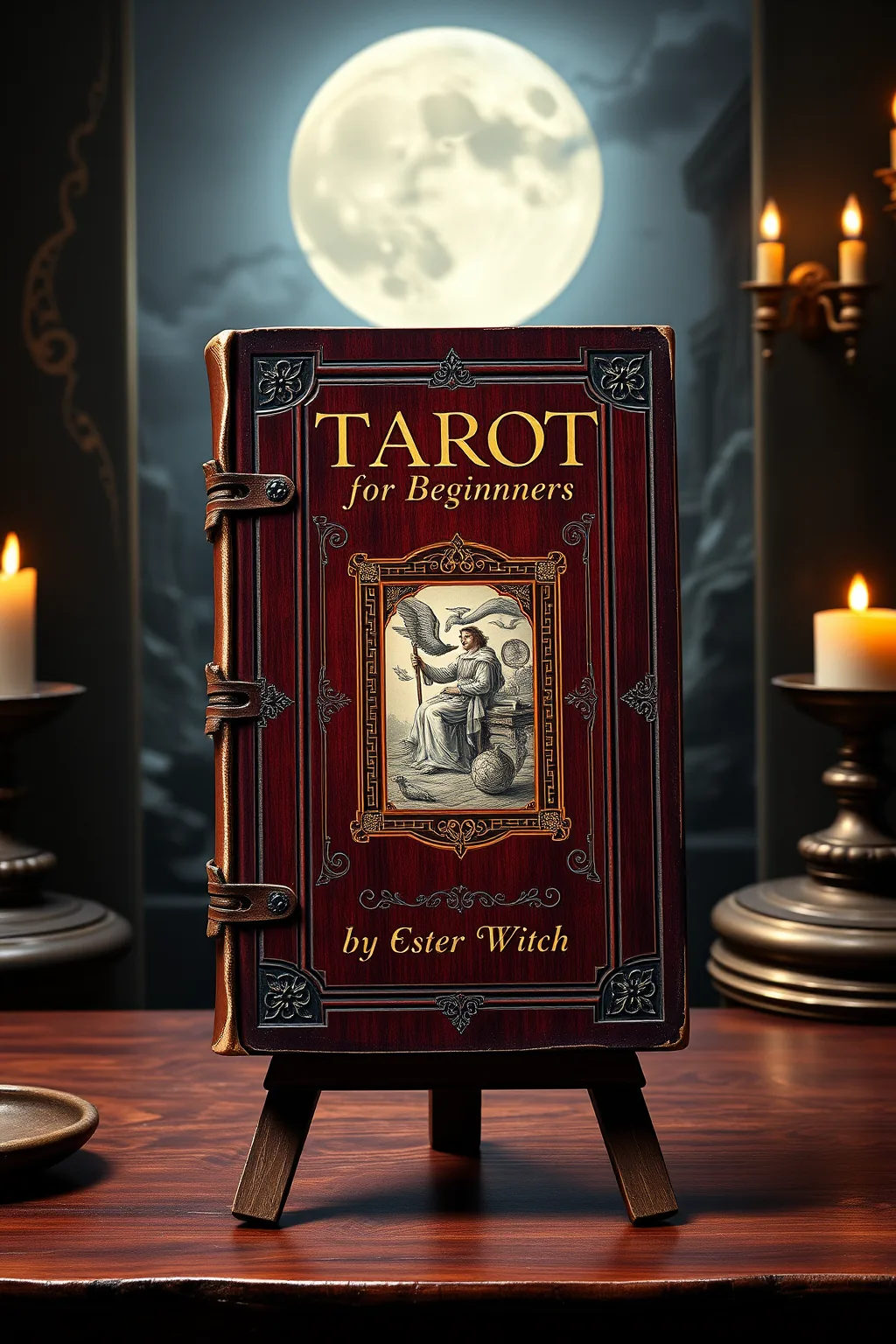
Tarot for Beginners
 61
61

Tarot for Beginners



Marcus Thorne (Esoteric Sciences Reviewer) — Ester Witch's 'Tarot for Beginners' is a refreshing and insightful addition to the beginner's tarot canon. Moving beyond rote memorization, Witch masterfully guides readers through the rich symbolic tapestry of the cards, emphasizing their philosophical underpinnings and connection to esoteric traditions. The book fosters an intuitive approach, encouraging readers to engage with the archetypes on a deeper, personal level. Its strengths lie in its clarity, its respectful nod to occult history, and its empowerment of the novice reader to develop their own unique relationship with the Tarot. Highly recommended for aspiring practitioners seeking authentic understanding and personal growth.
📝 Description
61
Ester Witch wrote 'Tarot for Beginners' to demystify the archetypes of the Major and Minor Arcana.
This book serves as an introduction to the Tarot, moving beyond simple card meanings. Ester Witch focuses on the archetypal imagery present in both the Major and Minor Arcana, connecting them to human experience and cosmic forces. The aim is to help readers understand the present through symbolism, rather than solely focusing on prediction.
'Tarot for Beginners' guides the earnest student and the curious individual toward self-discovery and intuitive development. It explains how to use the Tarot as a tool for inner dialogue and connecting with universal currents. The book unpacks the traditions passed down by esoteric practitioners, aiming to transform everyday moments into opportunities for deeper insight.
The Tarot is a divinatory system with roots in 18th-century Europe. Its cards, particularly the Major Arcana, are seen as symbolic keys to understanding human psychology and spiritual truths. Many esoteric traditions view the Tarot as a map of consciousness, a tool for introspection, and a way to commune with unseen forces. This book places itself within that lineage, presenting the Tarot not just as a fortune-telling device, but as a philosophical and psychological framework.
💡 Why Read This Book?
Unlock the profound symbolism of the Tarot and connect with your inner wisdom. 'Tarot for Beginners' offers a gateway to ancient esoteric knowledge, demystifying complex archetypes for aspiring practitioners and curious souls. Discover practical techniques for intuitive reading and personal growth, transforming the Tarot from a simple tool into a profound companion on your spiritual path. Ideal for anyone seeking deeper self-understanding and connection to the unseen forces.
⭐ Reader Reviews
Honest opinions from readers who have explored this book.
❓ Frequently Asked Questions
What is the Tarot?
The Tarot is a deck of 78 cards, each adorned with rich symbolism representing archetypal energies, life lessons, and universal truths. It serves as a mirror to the subconscious and a tool for divination, self-reflection, and spiritual guidance.
Who is Ester Witch?
Ester Witch is a seasoned practitioner and educator in esoteric arts, known for her ability to distill complex mystical concepts into accessible and profound teachings. Her approach emphasizes intuition and personal connection to ancient wisdom.
Can I truly learn Tarot from this book?
Absolutely. 'Tarot for Beginners' is designed to be comprehensive yet approachable, providing a solid foundation in card meanings, spreads, and intuitive interpretation techniques for those new to the practice.
Do I need a specific type of Tarot deck?
While the book uses general archetypal interpretations, it encourages readers to develop a personal connection with their chosen deck. Most modern Tarot decks will align well with the teachings presented.
How long will it take to learn?
Learning Tarot is a lifelong journey. This book provides the essential tools to begin reading within weeks, with ongoing practice and introspection leading to deeper mastery over time.
🔮 Key Themes & Symbolism
The Language of Archetypes
Explore the profound archetypal imagery within the Tarot deck, understanding how these universal symbols resonate with the human psyche. Each card—from the Fool's leap of faith to the World's completion—acts as a portal to understanding fundamental aspects of life, consciousness, and the cosmos. This theme examines the semiotic richness of the Tarot, revealing how its visual language transcends spoken words to communicate deep, intuitive truths about our journey through existence. It's about recognizing these ancient patterns within ourselves and the world around us.
Intuitive Divination Unveiled
This book clarifies the art of Tarot divination, moving beyond rote memorization of meanings to cultivate genuine intuitive connection. Learn to harness your inner knowing, interpreting the cards not just as individual symbols but as a dynamic narrative unfolding in response to your questions. We explore techniques for attuning to the subtle energies of the cards and the querent, fostering a sacred dialogue that reveals insights and pathways for personal growth and informed decision-making. It's about developing a personal relationship with the Tarot as a guide.
Esoteric Foundations of the Tarot
Look at the rich esoteric history and philosophical underpinnings of the Tarot. 'Tarot for Beginners' traces its lineage through mystical traditions, exploring its connection to Hermeticism, Kabbalah, and Jungian psychology. Understand how the Tarot serves as a symbolic map of consciousness, reflecting the journey of the soul and the interconnectedness of all things. This theme provides a foundational understanding of the deeper currents that give the Tarot its enduring power and relevance as a tool for spiritual exploration and self-realization.
💬 Memorable Quotes
Direct passages from the work, attributed to the author.
“Each card is a chapter in the grand cosmic book.”
— This poetic metaphor suggests that the Tarot deck is a comprehensive system of knowledge, with each card representing a distinct but interconnected part of a larger universal narrative.
“Listen not just to the meaning, but to the silence between the cards.”
— This encourages readers to develop their intuition and pay attention to the subtle energies and unspoken connections that arise during a reading, beyond the literal definitions.
“The journey of the Fool is the journey of us all.”
— This highlights the archetypal significance of The Fool card, suggesting that every individual begins a path of new beginnings, faith, and potential, mirroring the universal human experience.
“Wisdom is not given, but uncovered through the cards.”
— This underscores the active role of the seeker in the divinatory process. The Tarot acts as a catalyst, prompting self-discovery and revealing inherent wisdom, rather than dictating answers.
💡 Key Ideas
Editorial paraphrase of the work's core concepts — not direct quotes.
The Tarot is not a crystal ball, but a mirror to the soul.
This quote emphasizes the Tarot's primary function as a tool for self-reflection and introspection, rather than solely for fortune-telling. It highlights its capacity to reveal inner truths and patterns.
🌙 Esoteric Significance
Tradition
The Tarot is deeply interwoven with the Western Esoteric Tradition, drawing heavily from Hermeticism, Kabbalah, and Neoplatonism. These traditions provide the philosophical framework for understanding the Tarot's archetypal imagery as a map of consciousness, spiritual evolution, and the divine order. It is seen as a 'Book of Thoth,' a divine text containing the secrets of the universe and the path to gnosis, or direct spiritual knowledge.
Symbolism
Key symbols within the Tarot, such as the Fool's journey, the Major Arcana's progression, and the elemental associations of the Minor Arcana, represent profound esoteric concepts. The Wheel of Fortune signifies cosmic cycles, The High Priestess embodies intuition and hidden knowledge, and the four suits—Wands, Cups, Swords, and Pentacles—represent the four elements and their respective energies in manifestation. These symbols act as keys to unlocking deeper understanding of self and the universe.
Modern Relevance
In contemporary times, the Tarot continues to serve as a powerful tool for psychological insight, spiritual guidance, and personal empowerment. Its archetypal language resonates deeply with modern seekers exploring themes of identity, purpose, and interconnectedness. The Tarot provides a structured yet flexible system for navigating life's complexities, fostering intuition, and cultivating a more conscious and meaningful existence in a rapidly changing world.
👥 Who Should Read This Book
This book is an indispensable companion for the nascent spiritual seeker, offering a clear and inspiring introduction to the world of Tarot. Aspiring practitioners, eager to learn the foundational principles of divination, will find its guidance invaluable. For those drawn to esoteric studies, it provides a gateway to understanding the strong symbolism and historical context of this ancient art. Even seasoned practitioners may find fresh perspectives and a reminder of the core intuitive principles that make Tarot a living, breathing oracle. It is for anyone who yearns to connect with their inner wisdom and explore the profound mysteries of life.
📜 Historical Context
The Tarot, with its roots tracing back to 15th-century Europe as playing cards, underwent a profound transformation into a divinatory and esoteric tool during the 18th century. Influenced by Enlightenment thinkers and burgeoning occult revivals, figures like Antoine Court de Gébelin began to interpret its imagery through the lens of ancient Egyptian mysticism and Hermetic philosophy. This era saw the development of the Major and Minor Arcana as we recognize them today, imbuing the cards with complex symbolic systems connected to astrology, numerology, and Kabbalistic principles. The late 19th and early 20th centuries, particularly through the work of the Hermetic Order of the Golden Dawn, further solidified the Tarot's place within Western Esotericism, shaping many of the interpretations and methodologies still in use. This period of intense occult study and rediscovery cemented the Tarot's status as a sacred text for spiritual exploration.
📔 Journal Prompts
Reflect on the journey of The Fool: what new beginnings are calling to you, and what fears do you need to release to step forward?
Consider The Magician card: what resources, skills, or energies do you possess that you can consciously wield to manifest your desires?
Meditate on The High Priestess: what intuitive whispers are you overlooking, and how can you cultivate a deeper connection to your inner knowing?
Explore the symbolism of your favorite Minor Arcana suit: how does its elemental energy manifest in your daily life, and what lessons does it offer?
Draw three cards for a question about a current challenge: how do the archetypes and energies presented offer guidance or reveal new perspectives on your situation?
🗂️ Glossary
Archetype
A universal, archaic pattern or symbol found in the collective unconscious, representing fundamental human experiences and concepts that appear across cultures and time.
Divination
The practice of seeking knowledge of the future or the unknown by supernatural means, often through tools like the Tarot, runes, or astrology.
Major Arcana
The 22 trump cards of the Tarot deck, representing significant life events, spiritual lessons, and major archetypal forces that shape our journey.
Minor Arcana
The 56 cards of the Tarot deck, divided into four suits (Wands, Cups, Swords, Pentacles), which represent the everyday events, challenges, and situations we encounter.
Querent
The person for whom a Tarot reading is being performed. The cards are interpreted in relation to their questions and life circumstances.
This book appears in 3 collections
🔮 Readers Also Liked
Browse all →

From the “Tarot” Collection
View all →
More Free Divination & Tarot Books
View all →