Taoism
 84
84

Taoism
Russell Kirkland's "Taoism" provides a clear, if somewhat academically detached, overview of this complex tradition. Its strength lies in its structured approach, meticulously detailing the historical trajectory of Taoism from its ancient roots to its contemporary status. The section on the restoration of religious freedom in China is particularly informative, situating the faith within modern political realities. However, the book occasionally feels more like a textbook summary than an engaging exploration. While it covers essential concepts like the Tao and Yin-Yang, it sometimes lacks the evocative quality one might associate with the subject matter. A passage detailing the rituals associated with Mount Tai, a significant sacred site, feels clinical rather than spiritual. For a balanced introduction, Kirkland's work is competent, but it doesn't quite capture the mystique of its subject.
📝 Description
84
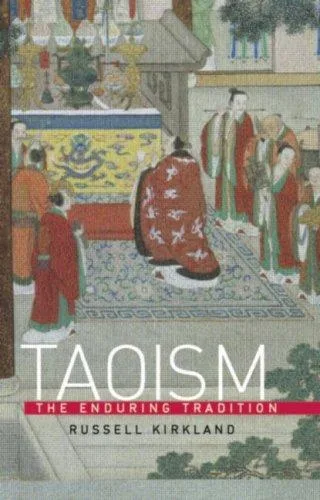
Russell Kirkland's 2004 book traces the development of Taoism from ancient China to its modern resurgence.
Published in 2004 as part of a world religions series, Russell Kirkland's study examines Taoism's origins and evolution. The book charts the tradition's course from ancient Chinese cosmology through its eventual revival and recognition under contemporary religious policies. It situates Taoist thought within its historical and cultural context, detailing philosophical underpinnings and practices.
Kirkland outlines core principles such as the Tao, Yin and Yang, and the pursuit of harmony with nature. The work provides a structured overview of the philosophical foundations that shape Taoist rituals, ethics, and cosmology. It is intended for students of world religions, comparative philosophy, and anyone seeking an introduction to Eastern spiritual practices interested in the historical and cultural background of Taoism.
Taoism represents a significant current within the broader spectrum of contemplative and mystical traditions originating in East Asia. It emphasizes a direct, experiential understanding of the fundamental principle of the universe, known as the Tao. Rather than relying solely on scripture or dogma, Taoist practice often involves cultivating an intuitive connection with the natural order. Kirkland's work details how this pursuit of harmony and alignment with the Tao has manifested through distinct philosophical schools and religious practices across centuries of Chinese history.
💡 Why Read This Book?
• Gain an understanding of the Tao, the ineffable principle central to Taoist philosophy, as presented in Kirkland's analysis of its origins. • Learn about the significance of Mount Tai as a sacred site for Taoist pilgrimage and ritual, a concept detailed within the book's exploration of physical locations. • Understand the impact of China's religious freedom clause on Taoism's restoration, a historical fact Kirkland addresses concerning the tradition's modern resurgence.
⭐ Reader Reviews
Honest opinions from readers who have explored this book.
❓ Frequently Asked Questions
When was Russell Kirkland's book on Taoism first published?
Russell Kirkland's "Taoism" was first published on May 7, 2004, as part of a larger series on World Religions.
What are the central beliefs of Taoism as explored in the book?
The book explores core Taoist beliefs such as the concept of the Tao, the balance of Yin and Yang, and the pursuit of harmony with the natural world.
Does the book discuss Taoist rituals?
Yes, the volume presents an overview of Taoist rituals, examining their origins and practices within the broader context of the tradition.
What historical period does Kirkland's Taoism cover?
Kirkland's work spans from the ancient origins of Taoism in China through to its modern restoration and practice.
Is Taoism presented as a philosophy or a religion in this book?
The book explores Taoism as both a philosophical system and a religious tradition, examining its multifaceted nature and development.
What is the role of sacred sites in Taoism according to the book?
The book discusses the importance of sacred sites in Taoism, detailing their significance for rituals and spiritual practice.
🔮 Key Themes & Symbolism
The Ineffable Tao
The book emphasizes the central concept of the Tao, the fundamental, ineffable principle that underlies all existence in Taoist philosophy. Kirkland explains how this concept guides the Taoist understanding of the universe, human life, and the pursuit of naturalness (ziran). It is presented not as a deity, but as the spontaneous way of the cosmos, from which all things arise and to which they return.
Harmony and Naturalness
A core theme is the Taoist ideal of living in harmony with the natural order. The work details how practices and philosophies encourage 'wu wei' (non-action or effortless action) and a state of 'ziran' (spontaneity, naturalness). This involves aligning oneself with the flow of the Tao, minimizing artificiality, and finding balance through acceptance rather than struggle.
Ritual and Sacred Geography
Kirkland examines the role of rituals and the significance of sacred sites within Taoism. The book discusses how specific locations, such as Mount Tai, become focal points for spiritual practice and connection to the Taoist cosmos. Rituals are presented as means to cultivate inner harmony and express the tradition's cosmology.
Modern Resurgence
The text addresses the contemporary status of Taoism, particularly its restoration and recognition under China's religious freedom policies. This section highlights the dynamic nature of the tradition, showing how ancient principles are adapted and practiced in the modern world, ensuring its continued relevance.
💬 Memorable Quotes
Direct passages from the work, attributed to the author.
“The Tao that can be told is not the eternal Tao.”
— This foundational statement, often attributed to Lao Tzu, highlights the ineffable nature of the Tao. It suggests that any attempt to define or articulate the ultimate principle of reality will inevitably fall short, as it transcends human language and conceptualization.
“To know he does not know is best.”
— This idea points to the Taoist emphasis on humility and the recognition of one's limitations in understanding the vastness of the Tao. True knowledge begins with an awareness of ignorance, fostering an open and receptive mind.
“The world is ruled by one who does not interfere.”
— This interpretation of Taoist governance suggests that the most effective leadership or control comes from allowing things to follow their natural course, rather than imposing rigid structures or forceful intervention.
“Restoration under China's religious freedom clause.”
— This phrase indicates the book's focus on the modern revival of Taoism, acknowledging the impact of political and legal changes in China that have allowed for the re-emergence and practice of religious traditions.
💡 Key Ideas
Editorial paraphrase of the work's core concepts — not direct quotes.
The wise man does not act; he does not contend.
This paraphrased concept reflects the principle of 'wu wei,' or effortless action. It suggests that true wisdom lies in acting in accordance with the natural flow of the Tao, without force or striving, allowing events to unfold naturally.
🌙 Esoteric Significance
Tradition
While Taoism is a major world religion and philosophy with ancient roots, its exploration of the Tao, cosmic harmony, and inner cultivation places it within broader esoteric traditions that seek direct experience of ultimate reality. It shares with Hermeticism and certain mystical branches of other faiths an emphasis on understanding universal principles and achieving a state of unity or alignment with the fundamental nature of existence.
Symbolism
Key symbols explored include the Yin and Yang, representing the dynamic interplay of complementary opposites that constitute the universe. The concept of the 'Tao' itself, often depicted by a circular symbol or simply as an unnamable force, signifies the origin and underlying unity of all things. Water is also a potent symbol, representing adaptability, yielding strength, and purity, embodying the principles of naturalness and 'wu wei'.
Modern Relevance
Contemporary thinkers and practitioners in fields like transpersonal psychology, mindfulness studies, and ecological philosophy draw upon Taoist concepts. The emphasis on naturalness, balance, and non-interference speaks to modern critiques of industrial society and the search for sustainable living. Schools of Qigong and Tai Chi, rooted in Taoist principles, continue to gain global popularity for their health and spiritual benefits.
👥 Who Should Read This Book
• Students of comparative religion and philosophy seeking a structured introduction to a major Eastern tradition. • Individuals interested in Chinese history and culture looking to understand a key spiritual and philosophical influence. • Seekers exploring alternative spiritual paths interested in concepts like naturalness, balance, and 'wu wei'.
📜 Historical Context
Published in 2004, Russell Kirkland's "Taoism" emerged during a period of increasing global interest in Eastern philosophies and religions, alongside China's gradual opening. The intellectual currents favored comparative studies and a nuanced understanding of traditions often simplified in Western discourse. While Confucianism had long dominated scholarly attention regarding China, Kirkland's work contributed to a more balanced view, placing Taoism's philosophical and religious dimensions on par. Its discussion of Taoism's restoration under China's religious freedom clause, a policy shift gaining traction in the late 20th century, was particularly timely. Unlike purely historical accounts, Kirkland's volume engages with the tradition's living practice and its adaptation to modern socio-political landscapes.
📔 Journal Prompts
The concept of the Tao: how does its ineffable nature challenge conventional understanding?
Reflect on the principle of 'wu wei' (effortless action) in daily life.
Consider the symbolism of Yin and Yang in balancing opposing forces you encounter.
Analyze the significance of Mount Tai as a sacred site for Taoist practice.
How might the Taoist pursuit of naturalness inform contemporary societal structures?
🗂️ Glossary
Tao (Dao)
The fundamental, ineffable principle underlying all reality in Taoist philosophy. It is the natural order of the universe, the source and substance of all things.
Yin and Yang
Two complementary, interdependent cosmic forces that interact to form all phenomena. Yin is typically associated with darkness, passivity, and femininity, while Yang represents light, activity, and masculinity.
Wu Wei
Literally 'non-action' or 'effortless action.' It refers to acting in accordance with the natural flow of the Tao, without force, striving, or artificiality.
Ziran
Spontaneity, naturalness, or 'being so of itself.' It describes the state of existence when things are in harmony with the Tao, free from artificiality or external imposition.
Mount Tai
A historically significant and sacred mountain in Shandong Province, China, revered in Taoism and other traditions for its spiritual importance and association with imperial ceremonies.
Taoist Rituals
Practices and ceremonies within Taoism aimed at cultivating harmony, longevity, and spiritual understanding, often involving meditation, chanting, and offerings.
Religious Freedom Clause
Refers to provisions in modern Chinese law allowing for the practice of recognized religions, which has impacted the restoration and public practice of traditions like Taoism.