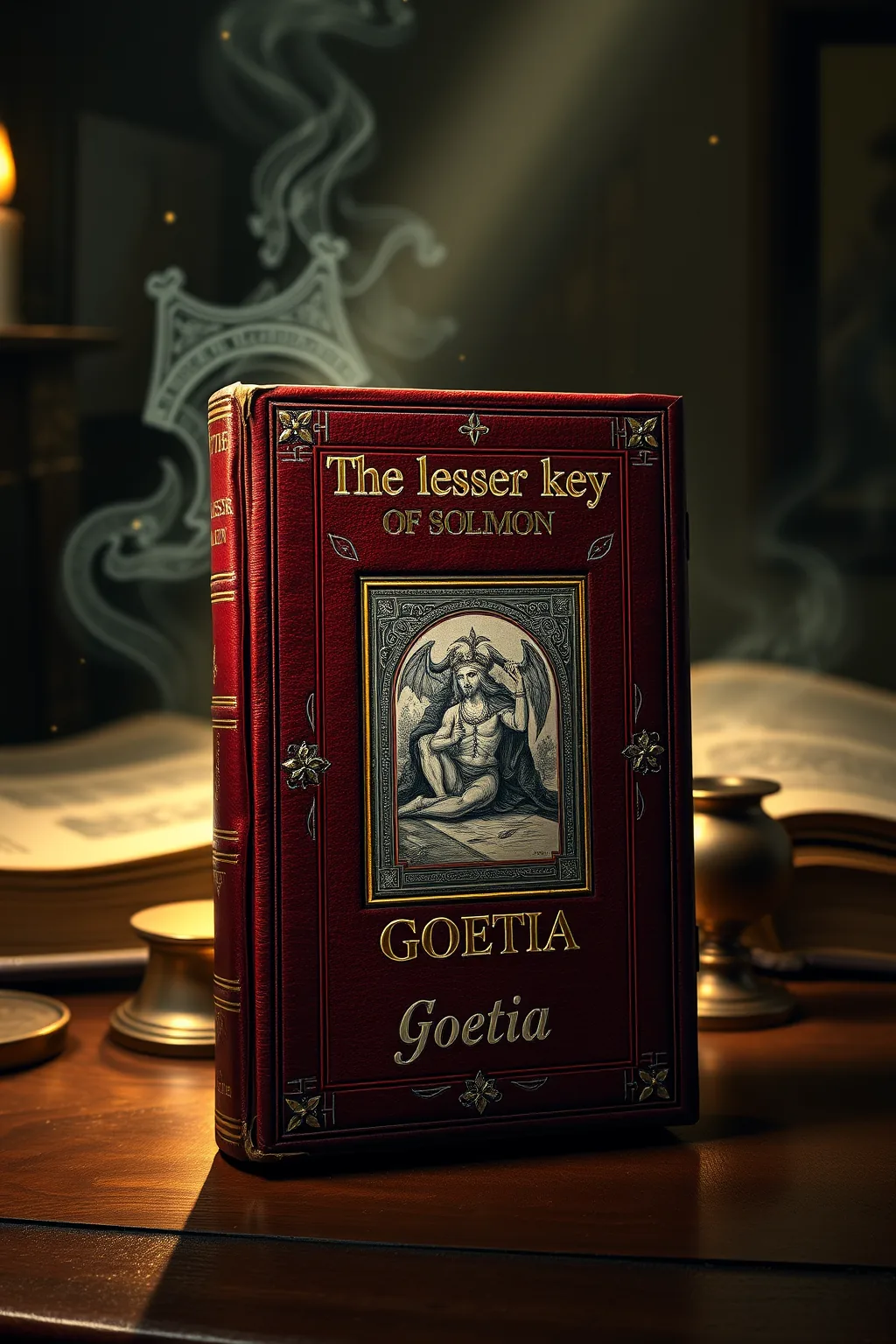
The Lesser Key of Solomon Goetia
 73
73

The Lesser Key of Solomon Goetia
The L. W. De Laurence edition of "The Lesser Key of Solomon Goetia" offers a direct encounter with the grim text of demonological evocation. Its strength lies in its unvarnished presentation of the rituals and the detailed descriptions of the 72 spirits, providing a stark look at the mechanics of ceremonial magic as conceived in certain historical occult traditions. The sheer cataloging of entities, each with its sigil and supposed dominion, is impressive in its systematic approach. However, the text's limitation is its dense, often archaic language and the inherent dangers implied by its subject matter, which demand significant prior knowledge and caution from the reader. A particularly striking section details the conjuration of King Paimon, emphasizing the precise ritualistic steps and the potential consequences of failure. For those seeking to understand the historical mechanics of Western ceremonial magic, this book serves as a crucial, albeit challenging, primary source.
📝 Description
73
L. W. De Laurence published this edition of The Lesser Key of Solomon Goetia in 2005.
This edition of The Lesser Key of Solomon Goetia compiles grimoires concerning ceremonial magic and spirit evocation. It draws on centuries of demonology and spirit conjuring traditions, detailing methods for summoning and commanding entities. Each spirit is described with specific attributes and powers.
This book is for serious students of Western esotericism interested in ceremonial magic's history and practice. Researchers of occult history and comparative religion scholars focusing on medieval and Renaissance magic will find it valuable. Individuals seeking to understand historical spirit evocation will also benefit. Its complex instructions and theoretical framework require a dedicated approach.
The original material likely originated in European occult circles during the late medieval and early Renaissance periods. While this edition is from 2005, it continues a lineage influential in 19th and 20th century occult orders and magical theories. The attribution to King Solomon was a common method to lend authority to magical works.
The Lesser Key of Solomon Goetia is part of the Solomonic grimoire tradition, a body of texts attributed to the biblical King Solomon. These works, which flourished from the late medieval period onward, claim to contain methods for commanding angels and demons. The Goetia specifically details the Lemegeton, a collection of 72 demons, their sigils, and hierarchical ranks. Such texts were central to the development of Western ceremonial magic, influencing occult orders and magical practices through the 19th and 20th centuries.
💡 Why Read This Book?
• Understand the historical methodology of Western ceremonial magic by studying the specific rituals and tools prescribed for spirit evocation, as detailed in the Goetia section of the Lemegeton. • Analyze the systematic cataloging of 72 distinct demonic entities, each with unique sigils and attributed powers, offering insight into the demonological frameworks prevalent in occult traditions. • Explore the practical application of esoteric principles through the detailed instructions for creating magical circles and performing conjurations, providing a concrete example of ritualistic practice.
⭐ Reader Reviews
Honest opinions from readers who have explored this book.
❓ Frequently Asked Questions
When was the original "Lesser Key of Solomon" likely compiled?
While the L. W. De Laurence edition is from 2005, the original manuscripts forming the "Lesser Key of Solomon" likely began circulating in the mid-17th century, drawing on older traditions.
What is the primary purpose of the "Lesser Key of Solomon Goetia"?
Its primary purpose is to provide instructions for the ceremonial evocation and control of 72 specific spirits or demons, as outlined in the Goetia section of the Lemegeton.
Who is L. W. De Laurence in the context of occult literature?
L. W. De Laurence was an American publisher and occult author active in the early 20th century, known for reprinting and popularizing many classic grimoires and esoteric texts.
Are the spirits described in the Goetia considered literal entities or symbolic representations?
Interpretations vary widely. Some practitioners view them as literal external beings, while others see them as psychological archetypes or symbolic representations of inner forces.
What is a 'sigil' as mentioned in the context of the Goetia?
A sigil is a unique symbolic representation or seal associated with each of the 72 spirits, believed to be crucial for their identification and invocation during rituals.
Does this book provide a complete system of magic?
The Goetia is one part of the larger Lemegeton. While it offers a specific system for spirit evocation, it is often studied alongside other grimoires for a broader magical practice.
🔮 Key Themes & Symbolism
Spirit Evocation and Control
The core of the Goetia lies in its detailed instructions for summoning and commanding 72 distinct spirits. It outlines specific incantations, rituals, and the use of sacred tools like circles and wands to establish a controlled environment for interaction. The text emphasizes the magician's authority and the need for precise execution to ensure safety and efficacy, treating these entities as forces to be harnessed for specific outcomes.
The Lemegeton Hierarchy
This work is a component of the larger Lemegeton, a compilation of five distinct grimoires. The Goetia itself presents a structured hierarchy of spirits, detailing their ranks (King, Duke, Marquis, etc.), their specific sigils (seals), and the domains over which they are said to preside. This systematic classification reflects a Renaissance-era attempt to codify and understand the spirit world.
Solomonic Magic Tradition
Attributing the text to King Solomon lends it immense historical and spiritual authority within esoteric traditions. While likely pseudepigraphic, this attribution connects the Goetia to a lineage of ancient wisdom and divine power. The book represents a continuation of the grimoire tradition that flourished in Europe, seeking to replicate or access the legendary magical abilities of biblical figures.
Ritualistic Practice and Symbolism
The text is fundamentally practical, detailing the precise steps, materials, and mindset required for ceremonial magic. It relies heavily on symbolic language and the power of consecrated objects and geometric figures, such as the magic circle, which serves as both a protective boundary and a focal point for the ritual. The efficacy is tied to the belief in the inherent power of these symbols and actions.
💬 Memorable Quotes
Direct passages from the work, attributed to the author.
“The 72 Spirits of Solomon.”
— This refers to the cataloged list of entities within the Goetia, each attributed specific powers and characteristics, forming the central focus of the grimoire's practical instructions.
“The Seal of King Paimon.”
— This highlights a specific sigil, a visual symbol believed to represent and hold the essence of a particular spirit, crucial for its evocation according to the text's methods.
“A Magic Circle for protection.”
— This points to a fundamental ritualistic tool described in the Goetia, designed to create a sacred and secure space for the magician during the potentially hazardous process of spirit invocation.
“Conjure and compel.”
— This succinctly captures the dual action central to the Goetia's purpose: to summon spirits and then exert one's will over them to perform tasks or provide information.
“The Lesser Key of Solomon.”
— This is the title itself, indicating a compendium of magical knowledge and practices, often considered a subset or companion to larger magical texts attributed to King Solomon.
🌙 Esoteric Significance
Tradition
The Goetia firmly belongs to the Western Esoteric Tradition, specifically within the lineage of ceremonial magic and Solomonic grimoires. It draws upon Kabbalistic concepts of hierarchy and divine names, though often in a syncretic manner rather than strict adherence. Its focus on the direct evocation and manipulation of spirits places it within a practical magical framework distinct from purely philosophical or meditative traditions, aiming for tangible results through ritualistic interaction.
Symbolism
Central symbols include the magic circle, serving as a protective and consecrated space, and the sigils, which are unique seals representing the essence and identity of each of the 72 demons. The pentagram and hexagram are also frequently employed within the rituals for invocation and banishing. These symbols function not merely as decorations but as active components believed to channel specific energies and enforce the magician's will upon the summoned entities.
Modern Relevance
Contemporary practitioners of Western ceremonial magic, particularly those within traditions like the Hermetic Order of the Golden Dawn or independent magical orders, continue to study and work with the Goetia. It remains a foundational text for understanding demonology and spirit evocation in practical occultism. Its influence can also be seen in modern paganism and Chaos magic, where practitioners adapt or reinterpret its principles and entities for their own magical systems.
👥 Who Should Read This Book
['• Students of Western Esotericism: Individuals seeking to understand the historical development and practical methodologies of ceremonial magic, particularly grimoire traditions.', '• Occult Historians: Researchers interested in the evolution of demonology, spirit summoning practices, and the influence of Renaissance magical texts on later occult movements.', '• Practitioners of Ceremonial Magic: Those engaged in the study and application of ritualistic magic who wish to engage with a primary source text on spirit evocation.']
📜 Historical Context
The material comprising "The Lesser Key of Solomon," and specifically its Goetia section, emerged from the rich milieu of late Renaissance occultism, likely coalescing into its current form around the mid-17th century. This era saw a fervent interest in ceremonial magic, grimoires, and the cataloging of supernatural entities, heavily influenced by earlier Kabbalistic and Hermetic traditions. The attribution to King Solomon was a common practice to imbue texts with ancient authority, a technique also seen in works like the "Greater Key of Solomon." The Goetia was part of a larger collection, the Lemegeton, which circulated in manuscript form. Its influence extended into the 19th century with figures like Éliphas Lévi referencing and reinterpreting its contents, and later into the Theosophical movement and various occult revival orders. The text competed with, yet also informed, diverse magical systems of the time, from folk magic to more structured Rosicrucian and Masonic rites.
📔 Journal Prompts
The 72 Spirits of Solomon: Which entity's described function most closely aligns with a challenge you currently face?
Analyze the purpose and construction of the magic circle as described in the text.
Consider the role of divine names and their invocation within the Goetia's ritual structure.
Reflect on the concept of commanding spirits versus seeking their cooperation.
How does the hierarchical structure of the spirits influence the ritualistic approach presented?
🗂️ Glossary
Grimoire
A textbook of magic, typically containing instructions for creating magical tools, performing rituals, and invoking spirits. The Goetia is a specific type of grimoire.
Lemegeton
A 17th-century compilation of five distinct grimoires, of which the Goetia is the first and most well-known part. It is also known as the 'Lesser Key of Solomon'.
Sigil
A symbolic representation or seal associated with a specific spirit or entity, used in magical rituals for identification and invocation. Each of the 72 spirits has a unique sigil.
Ceremonial Magic
A branch of magic involving elaborate rituals, specific tools, incantations, and often the evocation of spiritual or elemental beings, aiming to effect change.
Evocation
The act of calling forth or summoning a spirit or entity, typically from an external realm, often with the intention of commanding or communicating with it.
Conjuration
A magical rite or invocation, often involving commanding spirits to appear or perform specific actions, usually performed within a protective circle.
Solomonic Magic
A category of magical texts and practices attributed, often pseudepigraphically, to King Solomon of biblical fame, emphasizing control over spirits and demons.