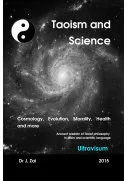
Taoism and Science
 82
82

Taoism and Science
Dr. J. Zai's Taoism and Science posits a radical equation: Taoism is Eastern science. This bold assertion forms the bedrock of a text that attempts to distill the entirety of Taoist cosmology for universal comprehension. The sheer breadth of topics covered, from the Zero/Tao as the cyclic universe to vegetarianism and environmentalism, is its most striking feature. The author's ambition to condense hundreds of books into one is evident in the dense presentation of information. However, this condensation, while efficient, sometimes sacrifices depth. For instance, the chapter on 'Hierarchies' could benefit from more detailed examples to illustrate its points beyond abstract principles. Despite this, the work's strength lies in its ambitious synthesis and its challenge to conventional disciplinary boundaries, inviting readers to reconsider the scientific underpinnings of ancient wisdom. It offers a unique perspective, though readers seeking nuanced, scholarly debates on specific Taoist schools might find it overly generalized. Ultimately, Taoism and Science serves as an ambitious, albeit dense, primer for those intrigued by the scientific underpinnings of Eastern philosophy.
📝 Description
82
Taoism and Science, published in June 2015, frames Taoist principles as a system of Eastern scientific inquiry.
This book examines Taoist principles, presenting them as a system of Eastern scientific inquiry. It aims to clarify Taoism for a wide readership, giving a condensed but thorough look at its cosmological foundations. The work consolidates extensive information often scattered across many texts into one volume. It is for anyone interested in the scientific aspects of Taoist philosophy, regardless of their background. Students of comparative religion, physics enthusiasts curious about historical cosmological models, and general readers exploring new ways to understand the universe will find it useful. Its clear language is suitable for those interested in the connection between spirituality and empirical observation.
The book's publication in 2015 occurred during a time of growing interest in integrating Eastern philosophies with Western scientific frameworks. It addresses a heightened curiosity about non-Western ways of knowing and their potential contributions to current scientific thinking. The author's approach implicitly questions the separation between spiritual study and empirical research. The work covers a range of Taoist ideas, such as the concept of Zero (Tao) as the origin of everything, the cyclical view of cosmic development, and the principle of Naturalness (Ziran). It also discusses hierarchies, wealth, and the role of language in Taoist thought, alongside its connections to Buddhism and Zen. Environmental concerns and the Taoist view on death are also included, giving a complete picture of its philosophical reach.
This book enters the conversation on how ancient Eastern philosophies can inform modern scientific understanding. It specifically looks at Taoism, a tradition with a long history of observing natural patterns and cosmic cycles. By connecting Taoist cosmology and principles like Ziran (naturalness) to scientific inquiry, it suggests a parallel or even complementary approach to understanding reality. This work positions Taoism not just as a spiritual path but as a distinct system of thought concerned with the fundamental workings of the universe, similar to how Western science approaches these questions.
💡 Why Read This Book?
• You will learn how the concept of Zero/Tao is presented as a fundamental principle of a cyclic universe, offering a novel cosmological framework beyond typical scientific models, as detailed in the 'Zero/Tao/Cyclic Universe' chapter. • You will gain an understanding of Naturalness (Ziran) as a core Taoist scientific principle, providing an alternative to anthropocentric approaches to environmentalism, as explored in the 'Naturalness' section. • You will discover the historical influence of Taoist thought on various global movements and philosophies, as outlined in the 'Historical Influence' chapter, revealing connections often overlooked in Western scholarship.
⭐ Reader Reviews
Honest opinions from readers who have explored this book.
❓ Frequently Asked Questions
What is the core argument presented about Taoism and science?
The book's central argument is that Taoism is fundamentally an Eastern form of science, particularly in its cosmological and philosophical principles. It suggests that Taoist concepts offer a scientific framework for understanding the universe and existence.
Who is the intended audience for Taoism and Science?
The book is written for everyone, aiming to be a world-class textbook of Taoist cosmology. It is accessible to beginners and those with prior knowledge, offering condensed information on a wide range of Taoist subjects.
What is the significance of the 'Zero/Tao/Cyclic Universe' concept?
This section explores the Tao as the origin of all things, conceptualized as Zero, and posits a cyclical model for the universe's creation and dissolution. It presents a non-linear, dynamic view of cosmic existence.
How does the book address the relationship between Taoism and Buddhism?
The chapter 'Buddhism and Zen' examines the historical and philosophical connections and divergences between Taoism and Buddhism. It highlights areas of overlap and distinct characteristics of each tradition.
What perspective does the book offer on environmentalism?
The 'Environmentalism' chapter likely discusses the Taoist principle of Naturalness (Ziran) as a foundation for ecological harmony, advocating for living in accordance with natural processes rather than imposing artificial structures.
What is the author's approach to presenting Taoist principles?
Dr. J. Zai employs a condensed, encyclopedic approach, aiming to provide a vast amount of information efficiently. The book is structured to cover a broad spectrum of Taoist thought, from cosmology to practical applications.
🔮 Key Themes & Symbolism
Zero as Cosmic Origin
The work foregrounds the concept of Zero not merely as an absence but as the primordial state from which the Tao, and consequently the universe, emerges. This perspective reframes the origin of existence as a point of potentiality and non-duality, challenging linear creation myths. The book explores how this concept underpins the cyclical nature of the cosmos, suggesting a continuous process of emanation and return, a core tenet of Taoist cosmology presented as a scientific model.
Naturalness and Environmentalism
A significant theme is Naturalness (Ziran), advocating for alignment with the inherent patterns and rhythms of the universe. This principle is directly applied to environmentalism, suggesting that true ecological balance arises from respecting natural processes rather than imposing human will. The book likely critiques anthropocentric views, promoting an ethos of co-existence and minimal interference, viewing this as a scientifically-grounded approach to planetary stewardship.
Taoist Epistemology and Language
The book examines how Taoism approaches knowledge and understanding, particularly through its unique use of language. It likely explores the limitations of conventional linguistic structures in conveying ultimate truths, contrasting this with the Taoist emphasis on direct experience and intuitive grasp. The section on 'Languages' probably explores the challenges of translating and comprehending Taoist texts, positioning these linguistic considerations as integral to its scientific methodology.
Cyclic Universe Theory
Central to the book's cosmological framework is the idea of a cyclic universe. This contrasts sharply with linear, eschatological models often found in Western thought. The work likely details how Taoist philosophy perceives the cosmos as undergoing perpetual cycles of formation, dissolution, and renewal, driven by the interplay of fundamental forces. This cyclic perspective is presented as a sophisticated cosmological theory with scientific implications.
💬 Memorable Quotes
Direct passages from the work, attributed to the author.
“Taoism is essentially an eastern word for science.”
— This statement serves as the foundational premise of the book, asserting that the core principles and observational methods of Taoism align with what is understood as scientific inquiry, particularly in its cosmological and philosophical dimensions.
“The information is very condensed.”
— This highlights the author's intent to pack a significant amount of knowledge into a compact format, suggesting that each section is dense with meaning and requires careful reading to fully absorb the intended information.
“Reading it equals to reading hundreds other books.”
— This hyperbolic claim emphasizes the book's encyclopedic scope and its ambition to serve as a comprehensive resource, consolidating a vast body of knowledge on Taoist cosmology and philosophy into a single accessible volume.
“Basic principles, Hierarchies, Wealth, Texts, Languages, Buddhism and Zen.”
— This list represents a fraction of the diverse topics covered, showcasing the book's broad sweep across philosophical, social, linguistic, and comparative religious domains within the context of Taoist thought.
“Zero/Tao/Cyclic Universe”
— This refers to a key conceptual nexus explored in the book, linking the idea of the Tao as the ultimate origin (Zero) with a dynamic, cyclical model of cosmic evolution and dissolution.
🌙 Esoteric Significance
Tradition
This work fits within the modern esoteric trend of synthesizing ancient philosophical systems with contemporary scientific understanding. While Taoism itself is a foundational tradition, this text approaches it through an explicitly 'scientific' lens, aligning with esoteric efforts to find universal laws and correspondences. It departs from purely mystical interpretations by grounding its exploration in cosmological and empirical frameworks, echoing theosophical and alchemical pursuits of underlying universal principles.
Symbolism
Key symbols likely explored include the Yin-Yang, representing duality and dynamic balance, and the concept of the Tao itself, often symbolized by emptiness or a flowing river, signifying the unmanifest source and the natural way of things. The circle, central to the concept of the cyclic universe and Zero, also functions as a potent symbol of wholeness, eternity, and the ultimate unity from which all phenomena arise and to which they return.
Modern Relevance
Contemporary thinkers and practitioners in fields like transpersonal psychology, integral theory, and eco-philosophy may find resonance with Zai's work. Its emphasis on naturalness and cyclic processes speaks to current concerns about sustainability and systemic thinking. The re-framing of ancient philosophy as a form of empirical science also appeals to those seeking to bridge the gap between spirituality and rational inquiry in the digital age.
👥 Who Should Read This Book
• Students of comparative cosmology and philosophy interested in non-Western models of the universe, particularly those seeking to understand the scientific underpinnings proposed within Taoist thought. • Individuals exploring concepts of Naturalness (Ziran) and the cyclical nature of existence, who wish to examine these ideas through a structured, textbook-like presentation. • General readers curious about the potential scientific interpretations of ancient Eastern philosophies, seeking a comprehensive yet condensed overview of Taoist cosmology.
📜 Historical Context
Published in June 2015, Taoism and Science emerged during a period of heightened global interest in cross-cultural philosophical exchange and the integration of Eastern wisdom traditions with Western scientific paradigms. The early 21st century saw numerous scholars and practitioners exploring concepts like quantum physics through the lens of Vedanta, Buddhism, and Taoism. This work participates in that intellectual current, challenging the perceived dichotomy between empirical science and spiritual philosophy. While specific contemporary reception details like reviews or citations are not readily available, the book addresses a growing academic and popular fascination with non-Western epistemologies. It implicitly engages with the legacy of figures like Fritjof Capra, whose 'The Tao of Physics' (1975) explored similar intersections, though Zai's work appears to offer a more direct equation of Taoism with scientific methodology itself.
📔 Journal Prompts
The concept of Zero/Tao as the origin of the cyclic universe.
Naturalness (Ziran) as a principle for environmental harmony.
The relationship between Taoist cosmology and modern scientific paradigms.
The implications of Taoist hierarchies for understanding social structures.
The role of language in conveying or obscuring Taoist wisdom.
🗂️ Glossary
Tao
The fundamental principle of the universe in Taoism, often translated as 'The Way.' It represents the ineffable, underlying reality and the natural order of all things, from which existence emanates.
Ziran
A core Taoist concept meaning 'Naturalness' or 'Spontaneity.' It signifies living in accordance with the inherent nature of things, without artificiality or forced action, aligning with the Tao.
Cyclic Universe
A cosmological model suggesting that the universe undergoes repeated cycles of creation, expansion, contraction, and rebirth, rather than having a singular beginning and end.
Zero
In this context, Zero refers to the primordial state of potentiality and non-duality from which the Tao and the manifest universe arise, representing the ultimate origin point.
Cosmology
The study of the origin, evolution, and structure of the universe. In Taoism, it involves understanding the fundamental principles governing existence and cosmic order.
Vegetarianism
The practice of abstaining from the consumption of meat. Within Taoism, it is often associated with principles of non-harming, purity, and aligning with natural cycles.
Equality
In a Taoist context, this likely refers to the inherent balance and interconnectedness of all things, challenging rigid social or hierarchical distinctions in favor of natural harmony.