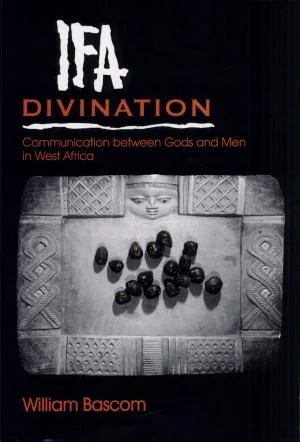
Ifa Divination
 76
76

Ifa Divination
Bascom’s "Ifa Divination" is an indispensable, albeit dense, academic treatment of a profound spiritual technology. It succeeds brilliantly in cataloging the architectural grandeur of the Ifa system, presenting its cosmology and symbolic language with scholarly rigor. The work’s strength lies in its exhaustive detail, offering a comprehensive overview that leaves little room for ambiguity regarding the structure of the divination itself. However, for those seeking a path to direct engagement or spiritual insight, the book's academic distance can feel like a barrier. The section detailing the eighteen principal `odù` and their associated verses, while informative, lacks the evocative power one might hope for in describing such potent narratives. It remains a vital scholarly resource, a foundational text for understanding Yoruba spirituality, but not a gateway for personal practice.
📝 Description
76
William Russell Bascom's "Ifa Divination" analyzes the Yoruba system Ifa, published in 1969.
Published in 1969, William Russell Bascom's "Ifa Divination" offers a detailed academic study of the Yoruba divination system. This is not a guide for practicing Ifa, but rather an examination of its structure, cosmology, and cultural importance. Bascom draws on oral traditions and scholarly research to clarify the complex knowledge system behind the divination process.
The book explains the connection between Ifa and the Yoruba worldview, showing its role in spiritual, social, and ethical life. It is considered a key text for understanding a significant African intellectual tradition. The work is recommended for scholars of African religions, anthropology, and comparative mythology, as well as students of Yoruba culture and indigenous knowledge systems. Researchers of divination practices globally and those interested in African philosophy will find its analysis valuable.
Ifa divination is a sophisticated system of knowledge originating with the Yoruba people of West Africa. It involves a complex corpus of verses, symbols, and rituals used to communicate with the divine. Traditionally interpreted by a diviner, or babalawo, through methods such as casting chains or nuts, Ifa serves as a means of guidance, healing, and maintaining social order. Bascom's study situates this practice within the broader Yoruba worldview, demonstrating its historical development and enduring cultural significance.
💡 Why Read This Book?
• Gain a scholarly understanding of the Ifa divination system, as meticulously documented by William Russell Bascom, offering insights into its structure and cosmology beyond mere ritual performance. • Explore the historical context of Ifa within Yoruba civilization, understanding its role in societal function and spiritual guidance, as presented in the 1991 publication. • Grasp the fundamental concepts of Ifa, including the significance of the `odù` and the role of Orunmila, providing a framework for appreciating its intricate philosophical underpinnings.
⭐ Reader Reviews
Honest opinions from readers who have explored this book.
❓ Frequently Asked Questions
What is the primary purpose of William Russell Bascom's book on Ifa Divination?
Bascom's "Ifa Divination" serves as a comprehensive academic study of the Yoruba divination system, detailing its structure, cosmology, and cultural significance rather than acting as a practical guide for practitioners.
Who is considered the principal deity associated with Ifa divination?
The principal deity associated with Ifa divination is Orunmila, who is believed to be the repository of divine wisdom and knowledge communicated through the system.
What are the 'odù' in the context of Ifa?
The 'odù' are the chapters or verses within the vast corpus of Ifa oral literature. Each 'odù' contains narratives, proverbs, and prescriptions interpreted by the diviner to provide guidance.
When was William Russell Bascom's "Ifa Divination" first published?
William Russell Bascom's "Ifa Divination" was first published on March 11, 1991.
Is this book a practical guide for learning to perform Ifa divination?
No, "Ifa Divination" by Bascom is an academic and anthropological study. It explains the system and its cultural context but does not provide instructions for performing divination rituals.
What is the significance of Ifa within Yoruba culture?
Ifa is a vital divination system integral to Yoruba culture, functioning as a means of spiritual communication, ethical guidance, healing, and maintaining social harmony for centuries.
🔮 Key Themes & Symbolism
Cosmology and the Divine Order
The work meticulously outlines how Ifa divination is intrinsically linked to the Yoruba understanding of the cosmos. It explores the relationships between the human realm, the spirit world, and the supreme creator, Olodumare. Central to this is the role of Orunmila as the mediator of divine will. The book explains how the patterns revealed through divination are seen as direct messages from the spiritual hierarchy, guiding individuals toward alignment with the cosmic order and their destined path, known as `ayanmo`.
The Structure of the Odù
A significant portion of Bascom's study is dedicated to the foundational elements of Ifa: the `odù`. The book details the existence of 256 principal `odù`, comprising 16 major ones and 240 minor variations. Each `odù` is a complex repository of myths, proverbs, ethical teachings, and practical advice drawn from the accumulated wisdom of generations. The interpretation of these `odù` by the babalawo forms the core of the divination process, offering context-specific solutions and insights.
Oral Literature and Knowledge Transmission
"Ifa Divination" underscores the critical role of oral literature in preserving and transmitting the vast knowledge of the Ifa system. The book highlights that Ifa is not merely a set of divinatory practices but a sophisticated literary tradition. The verses and stories associated with each `odù` are passed down through generations of babalawos, ensuring the continuity of Yoruba cultural heritage, philosophy, and spiritual understanding.
Social and Ethical Guidance
Beyond spiritual matters, Ifa serves as a crucial mechanism for social and ethical guidance within Yoruba society. The book illustrates how diviners interpret the `odù` to address concerns ranging from personal well-being and interpersonal conflicts to communal issues and agricultural success. The principles embedded within Ifa encourage individuals to live in accordance with moral codes, promoting harmony, justice, and responsible conduct.
💬 Memorable Quotes
Direct passages from the work, attributed to the author.
“Ifa is the most important and elaborate system of divination of the Yoruba people of Nigeria.”
— This statement highlights the preeminence and complexity of the Ifa system within its cultural context, signaling its depth and the extensive knowledge required to understand and practice it.
“Each odù contains a body of myth, legend, proverb, and ritual instruction.”
— This highlights the multi-faceted nature of the individual Ifa verses, or `odù`. They are not simple predictions but complex narratives and teachings that inform various aspects of life and spirituality.
“The babalawo interprets the patterns cast through the opele chain or the ikin nuts.”
— This describes the practical aspect of divination, identifying the diviner (babalawo) and the tools (opele chain, ikin nuts) used to generate the specific patterns that correspond to the `odù`.
“Ifa divination was a means of communication between the gods and men.”
— This conceptualizes Ifa's core function: bridging the gap between the human and divine realms, serving as a channel for divine wisdom and guidance to be imparted to individuals.
💡 Key Ideas
Editorial paraphrase of the work's core concepts — not direct quotes.
The sacred texts of Ifa... are an invaluable source not only for all students of African oral literature and Yoruba civilization, but also for future generations interested in the continuing vitality of Ifa divination and a Yoruba way of life and thought.
This quote from Henry Drewal emphasizes Ifa's broad significance, positioning it as a critical resource for understanding Yoruba culture, its literature, and the enduring relevance of its spiritual and philosophical traditions.
🌙 Esoteric Significance
Tradition
While Ifa is an indigenous West African tradition rather than fitting neatly into Western esoteric lineages like Hermeticism or Kabbalah, its sophisticated cosmology, symbolic language, and emphasis on divine communication share conceptual parallels. Like Gnosticism, it involves accessing hidden knowledge and understanding one's place within a divine order. Its intricate structure and the role of intermediaries can be compared to angelic hierarchies in Abrahamic traditions, offering a distinct yet conceptually related approach to gnosis and spiritual understanding.
Symbolism
Central to Ifa symbolism are the `odù`, the 256 'chapters' of Ifa, each a complex symbolic map of life's possibilities and challenges. The Opele divination chain, with its specific patterns formed by segments, represents the interface between the human and divine. The Ikin nuts, used in more elaborate divination, also carry profound symbolic weight, representing primordial elements and the connection to ancestral wisdom. The entire system functions as a symbolic language for understanding fate, ethics, and cosmic balance.
Modern Relevance
Contemporary practitioners of Ifa continue to rely on Bascom's work as a foundational reference. Beyond traditional Yoruba communities, thinkers and practitioners in diaspora communities and those interested in comparative divination systems draw upon its detailed scholarship. Scholars of African philosophy and religious studies utilize it to understand the intellectual depth of Yoruba thought. Its structured approach to cosmology and divination also finds echoes in modern New Age explorations of divination, albeit often stripped of its specific cultural context.
👥 Who Should Read This Book
• Anthropologists and religious studies scholars seeking in-depth analyses of African traditional religions and divination systems. • Students of Yoruba culture and civilization requiring a comprehensive academic resource on their spiritual and intellectual heritage. • Researchers in comparative mythology and oral literature interested in understanding the structure and transmission of complex knowledge systems.
📜 Historical Context
William Russell Bascom's "Ifa Divination" emerged in 1991, a period of increasing academic interest in African traditional religions and epistemologies, moving beyond colonial-era dismissals. The work built upon earlier ethnographic studies but aimed for a more systematic and comprehensive analysis of the Ifa system. It engaged with scholars like Pierre Verger and later, Henry Drewal, who provided an approving blurb. While not directly engaging in polemics with competing schools of thought like Western rationalism, Bascom's rigorous, evidence-based approach implicitly countered the marginalization of African spiritual systems. The book's publication solidified Ifa's place in scholarly discourse on religion, mythology, and African oral traditions, serving as a foundational text for subsequent research.
📔 Journal Prompts
The intricate relationship between the `odù` and Yoruba cosmology.
The function of Orunmila as a divine intermediary within the Ifa system.
Interpreting the symbolic meaning of the Opele divination chain.
Reflecting on the transmission of knowledge through Ifa's oral literature.
The ethical principles embedded within the verses of the `odù`.
🗂️ Glossary
Ifa
The complex system of divination, philosophy, and oral literature of the Yoruba people of West Africa.
Babalawo
A priest and diviner in the Ifa tradition, skilled in interpreting the system's verses and patterns.
Odù
One of the 256 chapters or verses in the Ifa corpus, each containing narratives, proverbs, and wisdom.
Orunmila
The Orisha (deity) of wisdom, knowledge, and divination, considered the primary intermediary in the Ifa system.
Opele
A divination chain used by babalawos, consisting of eight segments, which are cast to form patterns corresponding to the `odù`.
Ikin
Coconuts or kola nuts used in a more traditional and elaborate form of Ifa divination, often involving sixteen nuts.
Ayanmo
The Yoruba concept of destiny or fate, which Ifa divination often seeks to illuminate and help individuals navigate.
This book appears in 2 collections
🔮 Readers Also Liked
Browse all →









From the “Divination” Collection
View all →









More Free Occult Philosophy Books
View all →