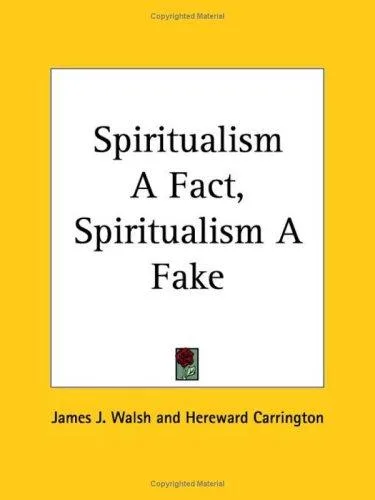
Spiritualism A Fact, Spiritualism A Fake
 72
72

Spiritualism A Fact, Spiritualism A Fake
James J. Walsh and Hereward Carrington’s "Spiritualism A Fact, Spiritualism A Fake" grapples with the volatile subject of spirit communication with a commendable, if sometimes uneven, rigor. Carrington, a noted investigator of the paranormal, lends his expertise to dissecting alleged phenomena, while Walsh offers a broader historical and medical perspective. The work’s strength lies in its detailed examination of specific cases and mediums, attempting to apply empirical scrutiny to claims that often defied it. A notable passage details the fraudulent methods employed by some mediums, effectively exposing trickery that preyed on the grieving and the credulous. However, the book occasionally struggles to maintain a consistent tone, sometimes appearing overly dismissive where nuanced observation might serve better, and at other times, perhaps too readily accepting of certain phenomena before definitive debunking. The initial publication date, while not specified in the provided data, likely situates its core arguments within early 20th-century debates. Despite its limitations, the book serves as a valuable historical document for understanding the critical discourse surrounding Spiritualism. It offers a sober assessment of a movement that profoundly impacted Victorian and Edwardian society.
📝 Description
72
In 1924, James J. Walsh and Hereward Carrington examined Spiritualism as both fact and fabrication.
This 1924 volume by James J. Walsh and Hereward Carrington scrutinizes Spiritualism, a movement that asserted spirit communication with the living. The authors dissect claims made during séances and by mediums, aiming to distinguish authentic spiritual phenomena from deliberate fraud. They analyze the societal impact of Spiritualism, a force in the late 19th and early 20th centuries, during a time of widespread interest in the occult and burgeoning psychical research.
The book appeals to scholars of parapsychology, historians of religion, and those interested in the critical investigation of supernatural claims. It is also for anyone curious about the history of Spiritualism, seeking to understand the roots of both belief and skepticism. Readers interested in how science, religion, and esoteric philosophies intersected during a period of intense spiritual inquiry will find its analysis valuable.
Published in 1924, this work engages with the intense spiritual and occult fervor of the late 19th and early 20th centuries. It situates Spiritualism within a broader context that included organizations like the Theosophical Society and the development of psychical research. The authors evaluate Spiritualist claims against emerging scientific thought and the era's fascination with esoteric philosophies, acknowledging the environment that fostered both sincere belief and widespread deception.
💡 Why Read This Book?
• Understand the historical methods used to investigate paranormal claims, specifically concerning Spiritualism and séances, by examining the techniques described by Hereward Carrington in the context of early 20th-century psychical research. • Differentiate between genuine anomalous phenomena and deliberate deception within the Spiritualist movement, learning to critically assess evidence presented by mediums and proponents of the era. • Gain insight into the cultural and scientific milieu of the late 19th and early 20th centuries that fueled widespread interest in Spiritualism, as explored through the societal context provided by James J. Walsh.
⭐ Reader Reviews
Honest opinions from readers who have explored this book.
❓ Frequently Asked Questions
What was the historical context of Spiritualism when this book was written?
The book addresses Spiritualism during its peak popularity in the mid-19th century through the early 20th century, a period marked by widespread interest in the occult, psychical research, and theosophy.
Who were the main authors and what were their perspectives?
James J. Walsh, a medical doctor, and Hereward Carrington, a prominent investigator of the paranormal, contributed to this work, offering both historical and empirical analyses of Spiritualism's claims.
Does the book definitively prove or disprove Spiritualism?
The work attempts to distinguish between fraudulent practices ('fake') and potentially genuine phenomena ('fact'), offering a critical examination rather than a simple yes/no answer to Spiritualism's validity.
What specific phenomena does the book analyze?
It scrutinizes alleged mediumistic abilities, séances, spirit photography, ectoplasm, and telekinesis, dissecting the evidence and methods presented by Spiritualists.
Is this book a primary source for understanding Spiritualism?
As a critical analysis published after the initial wave of Spiritualism, it serves as a secondary source that engages with primary accounts and phenomena of the movement.
What is the significance of the title 'Spiritualism A Fact, Spiritualism A Fake'?
The title highlights the book's central aim: to investigate the claims of Spiritualism and differentiate between what the authors consider verifiable ('fact') and fraudulent ('fake') manifestations.
🔮 Key Themes & Symbolism
The Art of Mediumship
The work dissects the role of mediums within the Spiritualist movement, analyzing their purported abilities to channel spirits. It examines techniques, common manifestations like table-tipping and materializations, and the psychological susceptibility of sitters. The authors explore how mediums operated, the societal pressures and financial incentives involved, and the methods used by both genuine (or believed genuine) practitioners and outright charlatans to create the illusion of spirit contact.
Evidence and Deception
A core theme is the rigorous examination of evidence presented for Spiritualist phenomena. This includes analyzing photographic anomalies, alleged spirit voices, and physical manifestations like ectoplasm. The book contrasts the standards of proof accepted by believers with scientific and logical scrutiny, often revealing elaborate hoaxes and psychological misinterpretations. It highlights the challenges in verifying subjective experiences against objective reality.
Spiritualism's Societal Impact
The text situates Spiritualism within its broader social and cultural context, particularly during the 19th century. It touches upon the movement's appeal to those grieving lost loved ones, its intersection with religious questioning, and its influence on public discourse. The authors consider why Spiritualism gained such traction and the societal implications of widespread belief in spirit communication, including its reception by scientific and religious establishments.
Rationality vs. Belief
This theme explores the tension between rational, scientific inquiry and the fervent belief characteristic of Spiritualism. The authors, particularly Carrington, advocate for critical thinking and empirical investigation when confronting claims of the supernatural. They address the psychological underpinnings of belief, the desire for comfort or validation, and how these factors can override critical judgment, leading individuals to accept phenomena as 'fact' without sufficient evidence.
💬 Memorable Quotes
Direct passages from the work, attributed to the author.
“The history of Spiritualism is replete with instances of both the genuine and the fraudulent.”
— This statement expresses the book's dualistic approach, acknowledging the complexity of the Spiritualist movement and the authors' intent to discern authentic phenomena from deception.
“Many alleged manifestations could be explained by trickery or psychological suggestion.”
— This highlights the critical stance taken, suggesting that a significant portion of Spiritualist claims can be attributed to naturalistic explanations, including deliberate deception and the power of suggestion on the part of the observers.
“The desire for contact with departed loved ones fueled much of the belief.”
— This interpretation points to the emotional and psychological drivers behind Spiritualism's appeal, emphasizing the role of grief and longing in fostering belief in spirit communication.
“Scientific investigation often struggled to keep pace with the claims of mediums.”
— This suggests a historical dynamic where the rapid emergence of new Spiritualist phenomena often outstripped the capacity for rigorous, timely scientific analysis, creating a fertile ground for both genuine inquiry and exploitation.
“Discernment was crucial for separating true spiritual phenomena from mere illusion.”
— This emphasizes the importance of critical thinking and careful observation for anyone engaging with Spiritualist claims, underscoring the authors' role as guides in this process of discernment.
🌙 Esoteric Significance
Tradition
While not strictly adhering to a single esoteric lineage, this work engages with the broader Western Esoteric Tradition's interest in phenomena beyond the material. It bridges the gap between folk beliefs and more formalized occult systems by critically examining claims of spirit communication, a theme present in Hermeticism and later Theosophy's exploration of the spirit world. Its analytical approach, however, diverges from purely devotional or initiatory traditions, prioritizing empirical critique.
Symbolism
The book implicitly deals with symbols of communication and presence. The 'spirit' itself is a symbol of the departed, the afterlife, and consciousness beyond the physical. Phenomena like 'ectoplasm' served as tangible, albeit often illusory, symbols of the spirit world's ability to manifest physically. Table-tipping and raps functioned as rudimentary symbolic languages for conveying messages from beyond the veil.
Modern Relevance
Contemporary investigations into consciousness, near-death experiences, and mediumistic abilities by researchers like Stanislav Grof or the work of organizations such as the Rhine Research Center echo the critical spirit of this book. Modern parapsychology continues to grapple with the challenges of empirical validation for anomalous phenomena, a debate directly informed by historical texts like this one.
👥 Who Should Read This Book
• Researchers of late 19th and early 20th-century religious and social movements, seeking primary critical analyses of the Spiritualist phenomenon. • Students of parapsychology and psychical research, interested in historical methodologies for investigating claims of the supernatural and mediumship. • Skeptics and critical thinkers exploring the history of belief, fraud, and the psychology of deception within the context of esoteric movements.
📜 Historical Context
Published in the early 20th century, "Spiritualism A Fact, Spiritualism A Fake" emerged during a period of intense fascination with the paranormal and occult. The mid-to-late 19th century had seen Spiritualism explode into public consciousness, fueled by the Fox sisters' rappings in 1848 and spreading rapidly across North America and Europe. This era was also marked by the founding of the Theosophical Society by Helena Blavatsky in 1875 and the nascent field of psychical research, spearheaded by figures like William James and F.W.H. Myers. Walsh and Carrington’s work directly engages with this climate, seeking to apply critical scrutiny to a movement that had captured the imagination of millions, including many intellectuals. It implicitly debates against less critical proponents and sensationalist reporting, standing in contrast to the more credulous accounts found in some contemporary spiritualist literature.
📔 Journal Prompts
The concept of 'discernment' in evaluating spiritual claims.
Carrington's methods for detecting fraudulent mediums.
The appeal of Spiritualism during the era of its prominence.
Defining 'fact' versus 'fake' in paranormal investigation.
Psychological factors contributing to belief in spirit communication.
🗂️ Glossary
Spiritualism
A religious movement that asserted the possibility of communication between the living and the spirits of the dead, prominent in the mid-19th to early 20th centuries.
Medium
An individual believed to be capable of acting as an intermediary between the living and spirits, facilitating communication.
Séance
A gathering where individuals attempt to make contact with spirits, often involving rituals, chanting, and specific conditions designed to facilitate spiritual manifestation.
Ectoplasm
A supposed physical substance or emanation from a spiritualist medium, often described as a vaporous or viscous material believed to be used for spirit manifestations.
Psychical Research
The scientific investigation into alleged psychic phenomena, such as telepathy, clairvoyance, precognition, and psychokinesis.
Fraudulent Mediumship
The practice of deception by individuals claiming to be mediums, employing trickery and illusion to simulate spirit communication for personal gain or attention.
Telekinesis
The purported ability to move or influence objects by mental power alone, often claimed by mediums or associated with paranormal phenomena.
🔮 Readers Also Liked
Browse all →








More Free Occult Philosophy Books
View all →