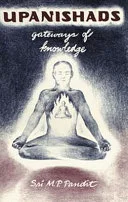
Upanishads
 73
73

Upanishads
M. P. Pandit's commentary on the Upanishads, a significant entry in the Esoteric Library's catalog, offers a focused lens on these ancient Indian scriptures. Panditji’s strength lies in his adherence to the interpretive framework established by Sri Aurobindo and T.V. Kapaly Sastry, providing a consistent, albeit specialized, approach. He effectively unpacks the dense philosophical arguments, particularly in his detailed examinations of the Isha and Brihadaranyaka Upanishads. A potential limitation for newcomers is the assumed familiarity with the Aurobindonian philosophy, which underpins many of his interpretations. For instance, the explanation of 'tamas' in relation to consciousness and liberation, while insightful within his framework, might require prior study for full comprehension. The work serves as a valuable, if specialized, introduction for those already oriented towards this particular stream of Upanishadic scholarship.
📝 Description
73
M. P. Pandit's 1988 edition of the Upanishads provides access to ancient Indian philosophical texts.
The Upanishads are a collection of Sanskrit writings central to the Vedanta school of Hinduism. They examine concepts of reality, consciousness, and the self. These dialogues and discourses investigate the connection between the individual soul, Atman, and the universal spirit, Brahman.
M. P. Pandit's commentary guides serious students of comparative philosophy and Eastern mysticism. This edition appeals to those interested in the introspective and metaphysical aspects of Vedic thought, particularly within the lineage of Sri Aurobindo and T.V. Kapaly Sastry. It is not intended for casual readers seeking simple spiritual advice.
Composed over centuries, with the earliest parts dating to the 8th century BCE, the Upanishads represent a shift from ritual to philosophical thought in ancient India. Pandit's work, published in 1988, connects with a modern resurgence of interest in these texts, building on 20th-century scholarly interpretations.
The Upanishads form the culmination of the Vedas, moving from ritualistic concerns to deep philosophical inquiry. They articulate the core principles of Vedanta, emphasizing the non-dual nature of existence where the individual self is identical with the ultimate reality. Pandit's commentary aims to reveal the hidden meanings within these verses, aligning with traditions that seek direct realization of these truths rather than mere intellectual understanding. This approach connects with gnostic traditions that value inner knowledge and direct experience of the divine.
💡 Why Read This Book?
• Gain direct access to the metaphysical inquiries of the Isha Upanishad, understanding its concept of 'Ishavasyam idam sarvam' (all this is for the dwelling of the Lord) as interpreted by M. P. Pandit, offering a unique perspective on divine immanence. • Explore the esoteric implications of the Brihadaranyaka Upanishad's teachings on the nature of the Self (Atman) and its relationship with the Absolute (Brahman), as detailed in Pandit's commentaries, providing a path for inner realization. • Understand the philosophical lineage of Sri Aurobindo and T.V. Kapaly Sastry, as their interpretive methods are central to Pandit's analysis, allowing for a deeper appreciation of modern Vedantic thought.
⭐ Reader Reviews
Honest opinions from readers who have explored this book.
❓ Frequently Asked Questions
What is the primary philosophical school of thought associated with the Upanishads?
The Upanishads are primarily associated with the Vedanta school of Hindu philosophy. This school focuses on the philosophical interpretations of the Vedas, particularly the Upanishads themselves, exploring concepts like Brahman and Atman.
Who were Sri Aurobindo and T.V. Kapaly Sastry in relation to Upanishadic studies?
Sri Aurobindo was a philosopher, yogi, and poet who provided extensive commentaries on the Upanishads. T.V. Kapaly Sastry was a scholar and disciple of Sri Aurobindo, known for his own insightful works on Vedic literature and philosophy.
What is the significance of M. P. Pandit's edition of the Upanishads?
M. P. Pandit's edition is significant for its detailed commentaries on major Upanishads, following the specific interpretive tradition of Sri Aurobindo and T.V. Kapaly Sastry, offering a focused approach to these ancient texts.
When were the Upanishads originally composed?
The composition of the Upanishads spans a considerable period, with the earliest texts dating back to approximately the 8th century BCE, making them some of the oldest philosophical works in existence.
What does the term 'Atman' refer to in the Upanishads?
In the Upanishads, 'Atman' refers to the individual soul or self, the innermost essence of a being. A central tenet is the exploration of Atman's identity and its relationship with Brahman.
What is the concept of 'Brahman' in Upanishadic philosophy?
Brahman represents the ultimate reality, the supreme cosmic spirit, or the absolute existence underlying all phenomena. The Upanishads explore the nature of Brahman and its connection to Atman.
🔮 Key Themes & Symbolism
The Unity of Atman and Brahman
The core of Upanishadic thought, as presented by Pandit, is the profound realization of the identity between the individual self (Atman) and the universal consciousness (Brahman). This edition meticulously unpacks passages from texts like the Mandukya Upanishad, illustrating how the mundane world and individual experiences are ultimately manifestations of this singular, supreme reality. The commentaries guide the reader toward recognizing this unity not merely as an intellectual concept but as a lived truth, achievable through inner contemplation and yogic discipline.
The Nature of Consciousness
Pandit's work studies the complex layers of consciousness described in the Upanishads. It moves beyond the ordinary waking state to explore dream states and deep sleep, referencing the Mandukya Upanishad's four states of consciousness. The esoteric significance lies in understanding these states not as mere psychological phenomena but as pointers to the different modes of Brahman's manifestation and the progressive stages of spiritual awareness. The commentaries highlight how transcending ordinary consciousness is key to realizing the ultimate reality.
Path to Liberation (Moksha)
The Upanishads, through Pandit's exposition, offer a roadmap to liberation from the cycle of birth and death (samsara). This is achieved not through ritual alone, but through Jnana Yoga, the path of knowledge. The commentaries emphasize the Upanishadic understanding of karma and its intricate workings, showing how true freedom comes from understanding the illusory nature of the ego and the material world. The goal is self-realization, a state of profound peace and oneness with the Absolute.
Esoteric Interpretation of Vedic Mantras
This edition is particularly valuable for its approach to interpreting the symbolic language and hidden meanings within the Upanishadic verses. Following the tradition of Sri Aurobindo, Pandit reveals the deeper, psychological, and spiritual significance behind seemingly simple statements. For example, the concept of 'prana' (life force) is explored not just as biological energy but as a cosmic force connecting all beings and a vehicle for spiritual ascent, as elucidated in the commentaries on texts like the Kena Upanishad.
💬 Memorable Quotes
Direct passages from the work, attributed to the author.
“That from which these beings are born, that by which they are sustained, that into which they enter when they die. That is Brahman.”
— This is a classic Upanishadic definition of Brahman, emphasizing its role as the origin, sustainer, and ultimate destination of all existence. It points to the all-encompassing nature of the Absolute Reality.
“The knower of Brahman attains the Supreme.”
— This statement captures the core promise of Upanishadic philosophy: that direct knowledge and realization of Brahman lead to the highest spiritual attainment, often understood as liberation or enlightenment.
“For the Self is the Lord of all beings, the king of all beings.”
— This interpretation emphasizes the inherent sovereignty and ultimate authority of the Atman. It suggests that understanding oneself as the Self is realizing one's true dominion over all aspects of existence.
💡 Key Ideas
Editorial paraphrase of the work's core concepts — not direct quotes.
The Self is the one that is to be heard of, reflected on, and meditated upon.
This paraphrased concept highlights the Upanishadic emphasis on actively seeking knowledge of the Atman. It suggests a threefold process: first, hearing the teachings (shravana), then contemplating their meaning (manana), and finally internalizing them through meditation (nididhyasana).
He who knows Me [the Self] in this manner, with the Self in the Self, the imperishable Being.
This paraphrased concept refers to the profound realization of the Atman, achieved through introspective awareness. It signifies an internal, direct apprehension of the true, unchanging nature of the Self.
🌙 Esoteric Significance
Tradition
The Upanishads are foundational to the Vedanta tradition within Hinduism, which itself has deeply influenced various esoteric movements globally. While not strictly Hermetic or Kabbalistic, their exploration of ultimate reality, the inner self (Atman), and the cosmic principle (Brahman) aligns with the universal quest for gnosis found in many esoteric lineages. This work fits within the modern esoteric revival that seeks to integrate Eastern wisdom with Western metaphysical thought, particularly through the lens of Sri Aurobindo's integral yoga.
Symbolism
Key symbols include 'Om,' representing the primordial sound and the totality of existence, encompassing past, present, and future. Another is the 'cave of the heart,' symbolizing the inner sanctuary where the Atman resides and can be realized. The commentaries often interpret natural phenomena and cosmic processes described in the texts as symbolic representations of spiritual states and the journey towards enlightenment.
Modern Relevance
Contemporary spiritual seekers, particularly those engaged with integral psychology, consciousness studies, and non-dual philosophies, draw heavily from Upanishadic concepts. Thinkers and practitioners in fields influenced by Sri Aurobindo's philosophy continue to find profound relevance in these texts for understanding the evolution of consciousness and the path to spiritual realization in the modern world.
👥 Who Should Read This Book
['• Students of comparative philosophy and religion: Those seeking to understand the core texts of Hindu philosophy and their influence on global spiritual thought will find this edition informative.', "• Practitioners of yoga and meditation: Individuals interested in the philosophical underpinnings of yogic practices and the deeper meaning of consciousness exploration will benefit from the text's insights.", "• Scholars of Sri Aurobindo's philosophy: Readers familiar with or interested in the works of Sri Aurobindo and T.V. Kapaly Sastry will appreciate Pandit's commentary for its adherence to their interpretive lineage."]
📜 Historical Context
The Upanishads emerged in ancient India during the Vedic period, roughly between the 8th and 5th centuries BCE, a time when Brahmanical thought was evolving significantly. This era saw a transition from the ritualistic focus of the earlier Vedas towards more philosophical and introspective inquiries into the nature of reality and the self. The Upanishads represent the culmination of this intellectual shift, forming the basis of the Vedanta philosophical system. This particular edition, published in 1988, comes at a time of renewed global interest in Eastern spiritual traditions, building on extensive 20th-century scholarship. It engages with interpretations established by prominent figures like Sri Aurobindo, whose philosophical system profoundly influenced modern Vedantic studies. Unlike earlier, purely scholastic approaches, this commentary aligns with a more esoteric and psychological understanding of these ancient texts, offering a distinct perspective compared to the more orthodox Mimamsa school which prioritized Vedic ritual.
📔 Journal Prompts
The concept of Brahman as the sole reality behind all phenomena.
The relationship between Atman and Brahman as explored in the Brihadaranyaka Upanishad.
The significance of the mantra 'Om' as presented in the Mandukya Upanishad.
The different states of consciousness described in the Upanishads.
The path to liberation (moksha) through knowledge, as elucidated in the texts.
🗂️ Glossary
Brahman
The ultimate reality, the supreme cosmic spirit, the absolute existence that is the source and sustainer of all creation. It is the fundamental ground of all being.
Atman
The individual self or soul, the innermost essence of a living being. Upanishadic philosophy often posits the identity of Atman with Brahman.
Vedanta
A school of Hindu philosophy literally meaning 'end of the Vedas.' It is based on the Upanishads and focuses on metaphysical and spiritual inquiry.
Moksha
Liberation or release from the cycle of birth, death, and rebirth (samsara). It is the ultimate spiritual goal in Hinduism.
Jnana Yoga
The spiritual path of knowledge and wisdom, emphasizing intellectual understanding and direct realization of the truth, as opposed to devotion or action.
Samsara
The continuous cycle of birth, death, and reincarnation that sentient beings are believed to undergo, driven by karma.
Prana
The vital life force or energy that sustains all living beings. It is often associated with breath and considered a cosmic principle.