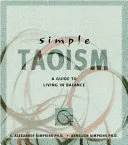
Simple Taoism
 72
72

Simple Taoism
The Simpkins’ "Simple Taoism" offers a commendably clear entry point into a philosophy often shrouded in metaphor. Its strength lies in its structured approach, moving from abstract principles to concrete practices, a method that genuinely aids comprehension. The section on wu-wei, for instance, effectively reframes "non-action" from mere idleness to a dynamic alignment with natural processes, a crucial distinction often missed. However, the book’s "simplicity" occasionally borders on oversimplification, particularly when discussing the nuanced interplay of yin and yang, which can feel somewhat reduced to binary oppositions. Despite this limitation, its practical guidance on exercises like chi kung and meditation makes it a useful handbook for those seeking to incorporate Taoist tenets into their daily routines. It is a functional primer, best suited for the absolute beginner.
📝 Description
72
Published in 1999, Simple Taoism by C. Alexander Simpkins and Annellen M. Simpkins offers a clear path into Taoist philosophy.
This book aims to make Taoist philosophy and practices understandable for a general audience. It is organized into three sections that first explain basic Taoist ideas, then offer practical exercises, and finally examine key concepts more closely. The authors intend to remove the perceived complexity from Taoism, allowing readers to apply its principles to their daily lives.
The Simpkins guide is for anyone wanting a direct approach to Taoist thought and its integration into everyday living. It is particularly useful for those interested in self-improvement through methods such as meditation, controlled breathing, and gentle physical disciplines like Tai Chi. The book explains concepts like wu-wei and yin and yang without resorting to overly academic language, promoting personal development and a sense of well-being.
Simple Taoism emerged in 1999 amidst growing Western interest in Eastern spiritual traditions. It follows a lineage of Western authors who sought to translate Taoist texts and ideas for a broader audience, building on interpretations of works like the Tao Te Ching. While distinct from purely academic studies, the book's focus on practical application positions it within the popular dissemination of Taoist thought, aiming to bridge ancient philosophy with contemporary life.
💡 Why Read This Book?
• Learn the practical application of wu-wei (non-action) from Chapter 9, enabling you to approach daily tasks with greater ease and effectiveness by understanding its alignment with natural flow. • Understand the foundational principles of yin and yang as explained in Chapter 12, allowing you to recognize and balance opposing forces in your life for greater harmony. • Gain simple, actionable instructions for exercises like meditation and chi kung, as detailed in Part Two, to cultivate personal energy and well-being rooted in Taoist practices.
⭐ Reader Reviews
Honest opinions from readers who have explored this book.
❓ Frequently Asked Questions
What is the primary goal of the book 'Simple Taoism'?
The primary goal of 'Simple Taoism' by C. Alexander Simpkins and Annellen M. Simpkins is to make the core principles of Taoism understandable and applicable to everyday life, offering practical exercises for personal enrichment.
When was 'Simple Taoism' first published?
'Simple Taoism' was first published on May 15, 1999, making it a relatively contemporary introduction to classical Taoist philosophy.
What are some of the key Taoist concepts discussed in the book?
The book discusses key Taoist concepts such as wu-wei (non-action), yin and yang (complementary forces), and Te (virtue or power), explaining their relevance to modern living.
Does 'Simple Taoism' include practical exercises?
Yes, the book includes simple instructions for various practices aimed at leading a fuller life, such as meditation, breathing exercises, chi kung, and Tai Chi Chuan.
Who are the authors of 'Simple Taoism'?
The authors are C. Alexander Simpkins and Annellen M. Simpkins, who collaborated to present Taoist philosophy in an accessible manner.
What is the structure of 'Simple Taoism'?
The book is divided into three parts: an explanation of Taoism and its application, instructions for exercises, and a discussion of key Taoist concepts.
🔮 Key Themes & Symbolism
Living in Accordance with the Tao
The central theme is understanding and aligning one's life with the Tao, the fundamental principle of the universe. This involves recognizing the natural flow of existence and acting in harmony with it, rather than against it. The book emphasizes that this alignment isn't about passivity but about 'effortless action' or wu-wei, a core concept that permeates daily decisions and interactions. It suggests that by observing and yielding to natural patterns, individuals can achieve a state of balance and reduce unnecessary struggle.
The Balance of Yin and Yang
Simple Taoism explores the ubiquitous concept of yin and yang, presenting them not as opposing forces but as complementary, interdependent energies that shape all phenomena. The book illustrates how these dualities manifest in nature, human relationships, and personal experiences. Understanding yin and yang, as presented in the text, allows readers to recognize the dynamic interplay of seemingly opposite qualities and to cultivate a more balanced perspective, appreciating the necessity of both light and shadow, activity and rest.
Cultivating Inner Power (Te)
The book addresses Te, often translated as virtue, power, or integrity, as the manifestation of the Tao within an individual. It posits that true power arises not from force or dominance, but from cultivating one's innate nature and acting in accordance with Taoist principles. This concept encourages self-awareness and the development of character through consistent practice of wu-wei and understanding of yin and yang. The Simpkins' explanation guides readers on how to embody their inherent Te, leading to a more authentic and effective life.
Practical Application of Taoist Principles
A significant theme is the translation of abstract Taoist philosophy into tangible practices for daily living. The book provides concrete instructions for exercises such as meditation, breathing techniques, chi kung, and Tai Chi Chuan. These practices are presented as direct methods for cultivating internal harmony, physical vitality, and mental clarity, thereby embodying Taoist wisdom. The emphasis is on making these ancient teachings accessible and beneficial for contemporary individuals seeking a more balanced and fulfilling existence.
💬 Memorable Quotes
Direct passages from the work, attributed to the author.
“wu-wei (non-action)”
— This central concept is interpreted not as doing nothing, but as acting in accordance with the natural flow of things, achieving results with minimal effort and resistance. It's about aligning with the Tao rather than imposing one's will against it.
“yin and yang”
— These represent the fundamental, complementary forces that govern the universe. The work explains their interconnectedness and interdependence, illustrating how they are not in opposition but are essential parts of a whole.
“Te (power virtue, life)”
— This refers to the power or virtue that arises from living in accordance with the Tao. It is the manifestation of one's true nature and the natural efficacy that comes from inner balance and alignment.
“simple instructions for exercises to lead a fuller life”
— This highlights the book's practical orientation, offering accessible methods like meditation, breathing, chi kung, and Tai Chi Chuan to enhance well-being and integrate Taoist principles.
💡 Key Ideas
Editorial paraphrase of the work's core concepts — not direct quotes.
clear explanation of Taoism and how to apply its best aspects to your daily life
This summarizes the book's primary aim: to clarify Taoist philosophy and provide actionable insights that readers can readily incorporate into their everyday routines and decision-making.
🌙 Esoteric Significance
Tradition
While Taoism itself is a profound philosophical and religious tradition, 'Simple Taoism' by the Simpkins functions as an introductory bridge. It aligns with the broader esoteric interest in understanding universal principles of harmony and natural law, often explored in Hermetic and Neoplatonic thought. However, its direct lineage is distinctly Taoist, focusing on concepts like the Tao, Yin/Yang, and Te, which are foundational to Chinese indigenous spiritual practices and cosmology. It departs from more complex, ritualistic or alchemical interpretations often found in Western esotericism, opting for a focus on personal cultivation and psychological balance.
Symbolism
Key symbols explored include the Yin and Yang, depicted as a circle divided by a S-shaped line, representing the dynamic interplay of complementary forces. The concept of the Tao itself, often symbolized by water (yielding, persistent, life-giving) or an uncarved block (simplicity, potential), is central. The book likely touches on the 'empty bowl' or 'uncarved block' as metaphors for receptivity and natural state, encouraging a return to simplicity and authenticity, core motifs in Taoist iconography.
Modern Relevance
The principles outlined in 'Simple Taoism' continue to resonate strongly in contemporary wellness and self-help movements. Concepts like mindfulness, stress reduction, and finding balance are cornerstones of modern psychology and personal development. Practices such as Tai Chi Chuan and Qigong, discussed in the book, are widely recognized and practiced globally for their health benefits. Thinkers and practitioners in fields ranging from mindfulness-based stress reduction (MBSR) to ecological philosophy find value in Taoism's emphasis on natural cycles, non-interference, and living in harmony with one's environment.
👥 Who Should Read This Book
• Beginners to Eastern philosophy seeking a clear, practical introduction to Taoist concepts like wu-wei and yin/yang, presented without dense academic jargon. • Individuals interested in incorporating mind-body practices into their lives, such as meditation, breathing exercises, chi kung, or Tai Chi Chuan, guided by accessible instruction. • Readers exploring comparative religion or personal growth who want to understand how ancient philosophies can inform contemporary well-being and daily living.
📜 Historical Context
Published in 1999, 'Simple Taoism' by C. Alexander Simpkins and Annellen M. Simpkins emerged at a time when Western interest in Eastern philosophies, particularly those offering practical paths to well-being, was significant. It arrived in a landscape populated by earlier, influential interpreters like Alan Watts, who had already introduced Taoist concepts to a broad English-speaking audience. The Simpkins' work aimed for a more direct, instructional approach, building on this groundwork. While not engaging directly with academic debates or facing censorship, its publication reflected a broader cultural trend towards mindfulness and holistic living, often drawing from traditions like Buddhism and yoga, but presenting Taoism’s unique emphasis on natural flow and effortless action. The book’s accessibility positioned it as a contemporary guide for those seeking personal growth through ancient wisdom, distinct from more scholarly or esoteric treatments of the subject.
📔 Journal Prompts
Reflect on a situation where applying wu-wei could bring effortless resolution.
Identify the dominant yin and yang energies in your current daily routine.
How does the concept of Te relate to your personal definition of strength?
Consider one Taoist exercise mentioned and how you might integrate it.
Describe the 'natural flow' you observe in a specific aspect of your life.
🗂️ Glossary
Tao (or Dao)
The fundamental, ineffable principle of the universe in Taoism. It represents the natural order, the source of all things, and the way of existence that one should follow.
Wu-wei
Literally 'non-action' or 'effortless action.' It signifies acting in accordance with the natural flow of the Tao, achieving goals with minimal resistance and without forced effort.
Yin
The feminine, passive, dark, and receptive principle in Taoist cosmology, representing qualities like intuition, coolness, and stillness.
Yang
The masculine, active, light, and assertive principle in Taoist cosmology, representing qualities like logic, warmth, and movement.
Te (or De)
Often translated as virtue, power, or integrity. It is the manifestation of the Tao within an individual or thing, representing one's inherent nature and natural efficacy.
Chi (or Qi)
The vital life force or energy that flows through all things. Practices like Qigong aim to cultivate and balance this energy.
Chi Kung (Qigong)
A system of coordinated body postures, movement, breathing, and meditation used for health, spirituality, and martial arts training, aimed at cultivating chi.