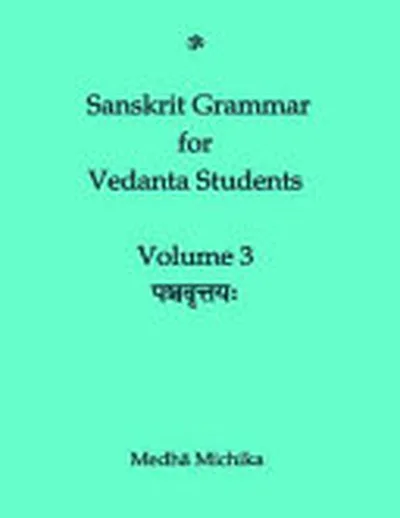
Sanskrit Grammar for Vedanta Student Volume 3
 82
82

Sanskrit Grammar for Vedanta Student Volume 3
Medha Michika's approach in Sanskrit Grammar for Vedanta Student Volume 3 is commendable for its direct engagement with Vedantic scriptural examples. The systematic explanation of the *Pancavrtti*, the five types of derived words, offers a clear pathway into understanding Sanskrit word formation, which is indeed a complex area. A particular strength is the series' commitment to visual and logical presentation, a welcome change from dense, traditional grammars. However, the book's utility is somewhat constrained by its exclusive focus on Vedanta; students interested in broader Sanskrit literature might find its scope limited. A passage detailing the derivation of *karma* (action) from the root *kṛ* (to do), and its subsequent modification through suffixes to denote intention or consequence, exemplifies the book's practical, scripturally-grounded method. While effective for its target audience, a broader range of examples from classical Sanskrit literature could have enhanced its overall applicability. This volume serves as a specialized, effective tool for Vedanta scholars.
📝 Description
82
Published in 2015, Sanskrit Grammar for Vedanta Student Volume 3 focuses on word derivation in Sanskrit.
This volume, the third in Medha Michika's series, presents a structured method for understanding Sanskrit grammar, with a specific focus on how words are derived. It departs from traditional, dense Sanskrit grammars by prioritizing clear, logical, and visual explanations. The series aims to make Sanskrit's complex linguistic structures accessible, especially for those interested in the philosophical and spiritual texts of Vedanta. The book is designed for students of Vedanta who want a deeper grasp of its scriptural language. It serves both newcomers to Sanskrit grammar and those with some background needing a precise reference. By using examples drawn directly from Vedanta scriptures, it is particularly useful for scholars and practitioners of Advaita Vedanta, Vishishtadvaita, and Dvaita traditions. Its modern teaching style also benefits students of linguistics interested in Indo-Aryan languages or comparative grammar.
The series acknowledges a growing global interest in Eastern philosophies and languages. While earlier scholars like Sir William Jones established comparative linguistics and Sir Edwin Arnold translated Sanskrit epics, Michika's work addresses a modern need for Sanskrit learning tied to scriptures. The series distinguishes itself by directly connecting grammar study to Vedanta texts, offering a more focused approach than general Sanskrit grammars or purely academic linguistic studies.
This grammar series is situated within the study of Vedanta, a major school of Hindu philosophy. Vedanta texts, which form the basis for the book's examples, are concerned with the nature of reality, the self, and liberation. Understanding Sanskrit, the classical language of these texts, is therefore crucial for serious students. This volume specifically addresses the grammatical structures that allow for a deeper comprehension of the philosophical concepts and spiritual insights embedded within Vedanta scriptures, facilitating a more direct engagement with the tradition's core teachings.
💡 Why Read This Book?
• Gain a precise understanding of the *Pancavrtti* (five types of derived words), a concept essential for dissecting the semantic layers within Vedanta scriptures, as systematically explained in this volume. • Master Sanskrit grammar through examples drawn exclusively from Vedanta texts, enhancing your ability to interpret specific philosophical arguments and spiritual concepts presented by figures like Adi Shankaracharya. • Benefit from a modern, visual, and logical pedagogical method applied to Sanskrit grammar, making the study of complex derivations more accessible than traditional approaches first published in the 19th century.
⭐ Reader Reviews
Honest opinions from readers who have explored this book.
❓ Frequently Asked Questions
What is the primary focus of Sanskrit Grammar for Vedanta Student Volume 3?
Volume 3 specifically explains the *Pancavrtti*, the five types of derived words in Sanskrit. It uses examples exclusively from Vedanta scriptures to illustrate these grammatical rules.
Who is the intended audience for this Sanskrit grammar book?
The book is designed for students of Vedanta, including beginners and those with prior Sanskrit grammar knowledge, who need a systematic and visual approach to the language.
When was the first edition of this Sanskrit grammar series published?
The first edition of the Sanskrit Grammar for Vedanta Student series was published on October 22, 2015, by Medha Michika.
How does this book differ from traditional Sanskrit grammars?
It employs a modern, systematic, logical, and visual presentation of grammar rules, unlike many older, more dense traditional grammars.
Are the examples in Volume 3 taken from general Sanskrit literature?
No, all examples in Volume 3 are sourced directly from Vedanta scriptures, making it highly relevant for students of this specific philosophical tradition.
What specific grammatical concept is detailed in Volume 3?
Volume 3 details the *Pancavrtti*, which refers to the five distinct methods of word derivation in Sanskrit, crucial for understanding scriptural nuances.
🔮 Key Themes & Symbolism
Pancavrtti Explained
The core of Volume 3 lies in its systematic exposition of the *Pancavrtti*, the five categories of Sanskrit word derivation. This framework is essential for understanding how complex philosophical terms and concepts are built from basic roots. Michika breaks down these derivations, allowing students to see how meaning is modulated through prefixes, suffixes, and internal changes, directly linking grammatical structure to Vedantic thought. The emphasis is on practical application within the scriptural context, moving beyond abstract linguistic rules to elucidate the precise language of spiritual texts.
Vedanta Scriptural Focus
This volume's unique selling proposition is its exclusive use of Vedanta scriptures for all grammatical examples. This deliberate choice ensures that learners are not just studying Sanskrit but are actively engaging with the language of the Upanishads, Bhagavad Gita, and commentaries by figures like Adi Shankaracharya. By grounding grammar in these sacred texts, the book aims to facilitate a deeper, more intuitive grasp of their profound philosophical and spiritual messages, making the learning process intrinsically connected to the subject matter.
Modern Pedagogical Approach
Sanskrit Grammar for Vedanta Student Volume 3 represents a departure from outdated, dense grammatical treatises. Medha Michika employs a modern pedagogical strategy emphasizing systematic, logical, and visual presentations. This approach is designed to accommodate the cognitive styles of contemporary learners who may find traditional methods intimidating. The clarity and structure aim to explain Sanskrit grammar, making it an accessible and engaging subject for serious students of Vedanta.
Grammar as Interpretation Tool
The book positions Sanskrit grammar not merely as a set of rules, but as a vital tool for scriptural interpretation. By understanding how words are derived and their subtle semantic shifts, students can engage more critically with Vedantic texts. This volume empowers readers to move beyond superficial readings, enabling them to appreciate the intricate linguistic architecture that underpins complex philosophical arguments and spiritual insights found in the tradition.
💬 Memorable Quotes
Direct passages from the work, attributed to the author.
“The Pancavrtti, five types of derived words in Sanskrit, are systematically explained.”
— This statement from the original blurb highlights the central focus of Volume 3. It signifies that the book offers a structured method for understanding how Sanskrit words are formed and modified, which is crucial for deciphering the nuanced language of Vedanta philosophy.
“All examples are sourced from Vedanta scriptures.”
— This emphasizes the specialized nature of the series. Unlike general Sanskrit grammars, this volume directly connects linguistic principles to the specific texts studied within Vedanta, enhancing relevance for its target audience.
“Suitable for the modern mind which needs a systematic, logical, and visual presentation of grammar rules.”
— This points to the pedagogical innovation of the series. It acknowledges that contemporary learners often benefit from structured, visually organized content, contrasting with potentially less accessible traditional grammatical texts.
“The series is not only suitable for beginners, but it can also serve as a good reference book for those who have studied Sanskrit grammar before.”
— This indicates the dual utility of the work. It aims to provide foundational knowledge for novices while also serving as a practical, accessible reference for more experienced students needing to review or clarify specific grammatical points.
“Volume 3: In this book the Pancavrtti, five types of derived words in Sanskrit, are systematically explained.”
— This is a direct statement of the content covered in the specific volume. It clearly defines the scope and primary subject matter, setting expectations for the reader regarding the grammatical concepts to be explored.
🌙 Esoteric Significance
Tradition
This work aligns with the modern esoteric tradition's emphasis on accessing primary spiritual texts in their original languages. While not strictly Hermetic or Kabbalistic, it serves a similar purpose for Vedanta practitioners as esoteric texts do for Western mystics: providing the tools for direct scriptural engagement. It supports the goal of understanding universal spiritual truths through the lens of a specific, ancient wisdom lineage, facilitating a more direct connection to the teachings of the Rishis.
Symbolism
While Volume 3 focuses on grammatical structures rather than overt symbolism, the concept of *Pancavrtti* itself can be seen metaphorically. The fivefold derivation of words reflects the Vedantic understanding of reality manifesting through multiple layers or *koshas* (sheaths). Each derived word represents a further specification or manifestation of a root concept, mirroring the cosmic unfolding from the unmanifest Brahman to the diverse phenomenal world.
Modern Relevance
Contemporary Vedanta scholars, practitioners of yoga and meditation seeking deeper textual understanding, and students of comparative religion are the primary beneficiaries. Thinkers and organizations promoting non-dual philosophies, such as those influenced by Ramana Maharshi or modern Advaita Vedanta teachers, find this resource important for accurate scriptural interpretation. It supports the modern esoteric quest for embodied wisdom through intellectual rigor.
👥 Who Should Read This Book
• Students of Advaita Vedanta: Those seeking to rigorously study the Upanishads, Bhagavad Gita, and commentaries by Adi Shankaracharya will gain the linguistic tools necessary for precise interpretation. • Comparative Religion Scholars: Researchers interested in the philosophical nuances of Hindu traditions will benefit from understanding the grammatical underpinnings of key Vedantic concepts. • Sanskrit Language Enthusiasts: Individuals drawn to Indo-Aryan languages who wish to focus specifically on the classical language of Vedanta scriptures will find a systematic and accessible entry point.
📜 Historical Context
Medha Michika's Sanskrit Grammar for Vedanta Student series, with Volume 3 published in 2015, arrives in an era marked by a resurgence of interest in Indic philosophies and languages, particularly within Western esoteric and academic circles. This follows a trajectory initiated in the late 18th century with scholars like Sir William Jones exploring Sanskrit’s linguistic connections and continued through the 19th and 20th centuries with figures like Swami Vivekananda introducing Vedanta to Western audiences. While general Sanskrit grammars have existed for centuries, and specialized linguistic studies continued apace, Michika's work distinguishes itself by its explicit focus on Vedanta scriptures and its modern pedagogical approach. Unlike the comprehensive, often daunting, grammars developed by colonial administrators or earlier orientalists, this series aims for accessibility for spiritual seekers. Its reception is part of a broader movement seeking authentic engagement with Eastern traditions, moving beyond mere translation to understanding the source languages, potentially engaging with comparative philosophy movements that gained traction in the early 20th century.
📔 Journal Prompts
The Pancavrtti's role in shaping Vedantic terminology requires careful examination.
How does the systematic explanation of derived words clarify scriptural meaning?
Reflect on a specific Vedantic concept and how its derived forms contribute to its many-sided understanding.
Consider the visual and logical presentation of grammar rules in relation to scriptural study.
Analyze how understanding word derivation enhances one's interpretive capacity for Vedanta texts.
🗂️ Glossary
Pancavrtti
Literally 'fivefold modification' or 'fivefold derivation'. In Sanskrit grammar, this refers to the five principal ways in which words are derived or formed from root syllables, leading to different meanings or grammatical functions.
Vedanta
A school of Hindu philosophy based on the Upanishads, literally meaning 'the end of the Vedas'. It focuses on the nature of ultimate reality (Brahman) and the self (Atman).
Sanskrit
An ancient Indo-Aryan language in which the Vedas, Upanishads, Bhagavad Gita, and many other foundational texts of Hinduism, Buddhism, and Jainism are written.
Vrtti
In Sanskrit, 'vrtti' can mean modification, modification, explanation, or a particular way of functioning. In grammar, it often relates to how a root word is modified or explained.
Root Syllable (Dhatu)
The basic, irreducible element of a Sanskrit word, typically a verb root, from which other words are derived through various grammatical processes.
Derived Words (Pratyaya)
Words formed from a root syllable by adding prefixes, suffixes, or undergoing internal changes. The study of these derivations is key to understanding Sanskrit vocabulary.
Grammar Rules (Vyakarana)
The systematic study and description of the structure of a language, including its phonology, morphology, and syntax. Sanskrit grammar is highly systematized.