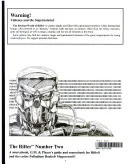
Rifter Number Two
 83
83

Rifter Number Two
Rifter Number Two, from April 1998, continues the Palladium Books tradition of dense, detail-oriented world-building for its flagship Rifts RPG. The collaborative effort between Kevin Siembieda and Kent Burles delivers a substantial addition, particularly strong in its introduction of specialized character classes and distinct geographical regions. One passage detailing the specific tribal customs of the indigenous inhabitants of the 'Dying Earth' continent provides a vivid example of the granular detail present, offering immediate role-playing hooks. However, the presentation can sometimes feel overwhelming; the sheer volume of stats and lore, while appreciated by dedicated fans, might present a steep learning curve for newcomers. The value lies in its focused expansion of established lore rather than broad thematic exploration. It serves its purpose for the existing player base effectively.
📝 Description
83
Rifter Number Two, released in April 1998, adds new game material to the Palladium Books Megaverse.
This 1998 supplement for the Rifts role-playing game introduces fresh content for players and Game Masters. Edited by Kevin Siembieda with contributions from Kent Burles, it expands the existing lore of the Megaverse, a post-apocalyptic science-fantasy setting that blends magic, technology, and psionics. The book focuses on specific regions, creatures, and technologies, aiming to enrich ongoing campaigns or spark new ones.
It is intended for dedicated Rifts players and Game Masters seeking to deepen their understanding of the game's universe. Enthusiasts of detailed world-building and imaginative combat scenarios will find ample material. The Rifter series, in general, served as a consistent outlet for new game development and fan contributions, acting as a bridge for the evolving Rifts player base during a period of significant growth for Palladium Books.
While not strictly 'esoteric' in a philosophical or occult sense, Rifter Number Two contributes to a specific genre tradition. The Rifts Megaverse itself is a blend of high-tech science fiction and high-magic fantasy, a common trope in modern speculative fiction that explores the intersection of disparate belief systems and technological paradigms. This supplement adds to that established framework by introducing new elements, akin to expanding upon established mythologies or cosmologies within a fictional universe. It builds on the game's established lore, which itself draws from various speculative fiction subgenres.
💡 Why Read This Book?
• Gain specific insights into unique character classes and their combat/social mechanics, directly applicable to campaign integration, as presented in Rifter Number Two. • Discover detailed lore regarding specific geographical locations and their inhabitants, offering fresh plot hooks and world-building elements beyond the core Rifts rulebook. • Acquire concrete game mechanics and statistics for new creatures and technologies, enhancing tactical encounters and providing immediate usability for Game Masters.
⭐ Reader Reviews
Honest opinions from readers who have explored this book.
❓ Frequently Asked Questions
What is the primary focus of Rifter Number Two for the Rifts RPG?
Rifter Number Two primarily focuses on expanding the Rifts Megaverse with new character classes, specific geographical regions, and detailed lore, offering direct gameplay material for Game Masters and players.
Who are the main contributors to Rifter Number Two?
The main contributors listed for Rifter Number Two are Kevin Siembieda, who also serves as editor, and Kent Burles, highlighting a collaborative effort in developing its content.
When was Rifter Number Two originally published?
Rifter Number Two was originally published in April 1998, contributing to the ongoing development and expansion of the Rifts role-playing game universe.
Does Rifter Number Two introduce new playable species or monsters?
Yes, Rifter Number Two typically introduces new playable character classes, often alongside new monsters and alien species, providing fresh challenges and options for the Rifts setting.
Is Rifter Number Two essential for playing Rifts?
While not strictly essential for basic play, Rifter Number Two is highly valuable for players and GMs seeking to deepen their experience with the Rifts RPG by adding diverse content and expanding the established lore.
What kind of world-building elements can be found in Rifter Number Two?
The book offers specific world-building elements such as detailed descriptions of continents, unique cultures, and technological advancements within the Rifts universe, enriching campaign settings.
🔮 Key Themes & Symbolism
Character Class Expansion
This installment significantly expands the roster of playable character classes within the Rifts universe. It details unique archetypes, often with specialized skills, backgrounds, and equipment, reflecting the diverse post-apocalyptic landscape. These classes are designed to offer players distinct role-playing experiences and tactical advantages, moving beyond the core archetypes to explore more niche or specialized roles within the Megaverse, providing fresh avenues for player agency.
Regional Lore Deepening
Rifter Number Two dedicates substantial content to exploring specific geographical regions within the Rifts setting. This includes detailed descriptions of continents, unique ecosystems, native inhabitants, and the socio-political landscapes. The aim is to flesh out the world, providing GMs with concrete details for their campaigns and players with a richer understanding of the diverse environments they might encounter, moving beyond generalized descriptions to specific, localized lore.
Technological and Magical Integration
The series consistently explores the fusion of advanced technology and potent magic that defines the Rifts setting. This volume continues that exploration, introducing new technological marvels, magical artifacts, and the ways they interact within the game world. It provides game mechanics for these elements, allowing players and GMs to integrate them seamlessly into their adventures, reinforcing the core science-fantasy premise of the Rifts universe.
Creature and Adversary Design
Introducing new threats and allies is a central to supplementary material, and Rifter Number Two is no exception. It presents a variety of new creatures, alien species, and potential antagonists, complete with statistics and background information. These additions serve to challenge players, expand the bestiary of the Rifts world, and provide GMs with a wider array of adversaries to populate their campaigns, ensuring dynamic encounters.
💬 Memorable Quotes
Direct passages from the work, attributed to the author.
“Specific continents are detailed with unique dangers and opportunities.”
— This concept highlights the book's focus on expanding the geography of the Rifts setting, detailing specific landmasses with their own distinct challenges and potential rewards for explorers.
“Alien species with distinct physiology and societal structures are introduced.”
— This concept points to the book's expansion of the Rifts' alien population, detailing new extraterrestrial races with unique biological traits and organized societies for players to interact with or confront.
“The Megaverse grows with fresh narrative possibilities.”
— This interpretation suggests that the content within Rifter Number Two serves to broaden the scope and potential storylines within the larger Rifts continuity, offering new directions for campaigns.
💡 Key Ideas
Editorial paraphrase of the work's core concepts — not direct quotes.
New archetypes of adventurers emerge from the ashes.
This paraphrase captures the essence of introducing novel character classes, suggesting that the book provides fresh concepts for player characters who are shaped by the Rifts' post-apocalyptic environment.
Advanced weaponry and arcane devices are presented for game use.
This paraphrase refers to the inclusion of new game mechanics for both high-tech gear and magical items, emphasizing their integration into the Rifts system for players and GMs.
🌙 Esoteric Significance
Tradition
While not explicitly adhering to a single esoteric tradition like Hermeticism or Gnosticism, the Rifts Megaverse, as expanded by Rifter Number Two, draws heavily from a syncretic blend of occult, science fiction, and apocalyptic themes. It incorporates elements reminiscent of post-apocalyptic fiction, New Age concepts of spiritual evolution, and traditional fantasy tropes, creating a unique, albeit loosely defined, esoteric landscape. The series' emphasis on powerful individuals wielding both advanced technology and supernatural abilities echoes certain archetypes found in esoteric thought, though filtered through a distinct pulp fiction lens.
Symbolism
Key symbols in Rifter Number Two often revolve around the fusion of the technological and the mystical. Advanced cybernetics and power armor can be seen as externalized manifestations of the will or 'magical' intent, while dimensional rifts themselves symbolize thresholds between states of being or reality. Creatures and alien species often embody primal forces or distorted archetypes, serving as symbolic representations of the chaos and transformation inherent in the Rifts setting. The overarching visual and conceptual themes blend futurism with a certain 'cosmic horror' sensibility.
Modern Relevance
The Rifts setting, including material like Rifter Number Two, continues to influence creators in tabletop role-playing and speculative fiction. Its bold fusion of genres and detailed world-building provides a rich source of inspiration for those interested in creating complex fictional universes. Contemporary game designers and authors exploring themes of post-apocalyptic futures, interdimensional travel, or the intersection of magic and technology may find conceptual footholds within the lore established by Palladium Books, appreciating its ambitious scope and imaginative scope.
👥 Who Should Read This Book
• Dedicated Rifts RPG Game Masters seeking to expand their campaign with new creature statistics, regional details, and unique character options presented in Rifter Number Two. • Players of the Rifts RPG eager to explore advanced character classes and specialized roles not covered in the core rulebooks, enhancing their personal play experience. • Collectors and enthusiasts of Palladium Books' extensive Megaverse who wish to acquire comprehensive material for the Rifts game line, appreciating the detailed lore and gameplay additions.
📜 Historical Context
Published in April 1998, Rifter Number Two arrived during a vibrant period for Palladium Books and its Rifts franchise, which had debuted in 1990. The late 1990s saw the RPG market actively exploring detailed world-building and expansive campaign settings. Rifts, with its combination of post-apocalyptic survival, high technology, magic, and psionics, appealed to a growing contingent of players looking for rich, imaginative universes. Supplements like the Rifter series were crucial for sustaining interest and providing a steady stream of new material, acting as a curated outlet for game development and fan contributions. This era was marked by a strong emphasis on providing GMs with tools to customize and expand their games, a philosophy clearly embodied by the Rifter line. The work engaged with the burgeoning trend of 'kitchen sink' settings, where disparate genres could coexist, setting it apart from more focused fantasy or sci-fi RPGs of the time, and its reception was primarily within the dedicated player base of the Rifts RPG.
📔 Journal Prompts
The specific tribal customs of the 'Dying Earth' inhabitants, as detailed in the text, and their implications for survival.
Reflecting on the fusion of technology and magic presented through new character classes.
Consider the symbolic meaning of dimensional rifts within the Rifts Megaverse.
Analyze the unique challenges posed by the newly introduced creatures in Rifter Number Two.
How might the advanced weaponry described alter the power dynamics of a Rifts campaign?
🗂️ Glossary
Megaverse
The overarching term used by Palladium Books to describe the vast, multi-dimensional cosmology encompassing all their game settings, including Rifts.
Rifts
The primary setting for the role-playing game, characterized by a post-apocalyptic Earth where dimensional rifts spew forth monsters, magic, and advanced technology.
Character Classes
Specific archetypes or professions available to players in the Rifts RPG, each with unique skills, abilities, and backgrounds.
Game Master (GM)
The player responsible for running the Rifts role-playing game, describing the world, controlling non-player characters, and adjudicating rules.
Palladium Books
The publisher of the Rifts RPG and its numerous supplements, known for its distinctive art style and detailed world-building.
Supplement
An additional book or material designed to expand upon the core rules and setting of a role-playing game, like Rifter Number Two.
Lore
The background information, history, mythology, and established narrative details of a fictional setting, such as the Rifts Megaverse.
This book appears in 2 collections
🔮 Readers Also Liked
Browse all →







From the “Ley Lines” Collection
View all →









More Free Occult Philosophy Books
View all →