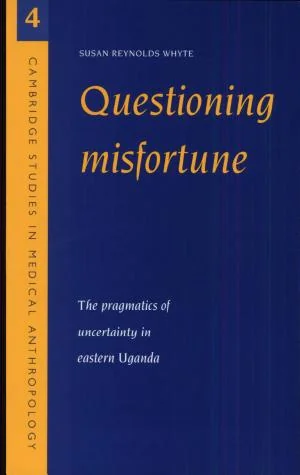
Questioning Misfortune
 80
80

Questioning Misfortune
Susan Reynolds Whyte’s *Questioning Misfortune* offers a starkly unromanticized view of how people in Bunyole, Uganda, grapple with life's vicissitudes. Rather than seeking grand pronouncements, the book meticulously details the local logic and social dynamics that frame sickness, failure, and death as phenomena requiring explanation. Its strength lies in its grounded, anthropological approach, avoiding sensationalism and instead presenting a clear-eyed account of divination and its social functions. The book's limitation, however, is its dense academic prose, which occasionally obscures the human drama at its core. A particularly striking aspect is the exploration of how accusations of sorcery can become a social mechanism for diagnosing and addressing underlying community tensions, demonstrating that misfortune is rarely a purely individual burden. This is a significant, if challenging, contribution to the ethnography of experience.
📝 Description
80
Susan Reynolds Whyte's 1997 ethnography examines how people in Bunyole, Uganda, understand and respond to misfortune.
Questioning Misfortune offers an ethnographic account of how individuals in Bunyole, eastern Uganda, deal with life's unpredictable events. Susan Reynolds Whyte's 1997 book examines the social contexts of adversity, specifically looking at responses to sickness, marital problems, failure, and death. It highlights the role divination plays in identifying perceived causes for these events. These causes can include the displeasure of ancestors, spiritual interference, or malevolent sorcery. The book connects these cultural practices to the actual lives of the people studied.
The work is important for anthropologists and sociologists who study lived religion and the ethnography of experience. It will also interest scholars of African studies and those who look at how culture, belief, and material well-being connect in non-Western societies. Readers interested in how societies create meaning around misfortune, going beyond purely material explanations, will find this book valuable. It addresses how people construct meaning around adversity.
Published in 1997, Questioning Misfortune engages with anthropological traditions that focus on the indeterminate nature of existence. Whyte's work analyzes local interpretations of misfortune, including divination and sorcery, aligning with a turn towards practice theory and the anthropology of everyday life. It examines how societies construct meaning around adversity, incorporating spiritual and ancestral explanations that go beyond purely materialist viewpoints. The book explores how individuals and communities manage uncertainty through these belief systems.
💡 Why Read This Book?
• Gain insight into the social causation of misfortune by examining the specific practices of divination and attribution prevalent in Bunyole, as detailed in the book's ethnographic accounts. • Understand how uncertainties like sickness and marital problems are socially managed through local belief systems, moving beyond abstract concepts to concrete examples from eastern Uganda. • Appreciate the anthropological significance of Susan Reynolds Whyte's 1997 study in understanding how diverse cultures interpret and respond to adversity, as presented in its detailed ethnography.
⭐ Reader Reviews
Honest opinions from readers who have explored this book.
❓ Frequently Asked Questions
What is the primary geographical focus of Questioning Misfortune?
The book centers on Bunyole, a region in eastern Uganda. Susan Reynolds Whyte conducted her long-term study here, examining how its inhabitants perceive and respond to various forms of adversity and uncertainty.
When was Questioning Misfortune first published?
The original publication date for Questioning Misfortune by Susan Reynolds Whyte is 1997. This places the research within a specific period of anthropological and sociological inquiry.
What role does divination play in the book's analysis?
Divination is presented as a key social mechanism in Bunyole for identifying the causes of misfortune. The book details how diviners attribute problems like sickness or marital issues to various sources, including ancestors, spirits, or sorcery.
What types of adversity does the book explore?
Questioning Misfortune examines a range of life uncertainties, including sickness, suffering, marital problems, personal failures, and death. It focuses on the social causes and interpretations of these experiences within the Bunyole community.
What is the ethnographic tradition Questioning Misfortune belongs to?
The book is situated within the ethnographic tradition that highlights the indeterminate nature of life. It focuses on lived experience and how people make sense of uncertainty, drawing on long-term fieldwork.
Who is the author of Questioning Misfortune?
The author is Susan Reynolds Whyte. She is known for her work in medical anthropology and the ethnography of experience, with a particular focus on African societies.
🔮 Key Themes & Symbolism
Social Construction of Adversity
The work argues that misfortune is not merely an objective event but is actively constructed through social processes and cultural interpretations. In Bunyole, explanations for sickness, failure, or death are embedded within social relationships and beliefs about spiritual forces. Whyte illustrates how attributing misfortune to specific causes, such as ancestral anger or sorcery, serves social functions within the community, shaping how individuals and groups respond to hardship and uncertainty.
Divination as Social Diagnosis
Divination occupies a central role as a mechanism for understanding and addressing misfortune. The book details how diviners in Bunyole interpret signs to identify the perceived sources of problems, ranging from spiritual entities to human malevolence. This practice is not simply about finding a cause but is integral to social diagnostics, offering explanations that can guide actions, resolve disputes, or reinforce social norms. Whyte examines the social implications of these divinatory findings.
Managing Life's Uncertainties
Fundamentally, Questioning Misfortune investigates the human capacity to manage the inherent uncertainties of life. Whyte focuses on how people in eastern Uganda cope with unpredictable events like illness, marital breakdown, and death. The book explores the practical and symbolic strategies employed, including reliance on divination, appeals to ancestors, and the social negotiation of blame, demonstrating how cultural frameworks provide tools for navigating existential insecurity.
Spirits, Ancestors, and Sorcery
The book explores the cosmological framework that explains misfortune in Bunyole. It details the perceived influences of ancestral spirits, various spiritual beings, and the practice of sorcery as direct causes of suffering. Whyte's ethnography provides a nuanced view of these beliefs, showing how they are integrated into daily life and influence social interactions, conflict resolution, and the understanding of well-being and ill-health.
💬 Memorable Quotes
Direct passages from the work, attributed to the author.
“Divination may identify causes of misfortune, ranging from ancestors and spirits to sorcerers.”
— This concise statement captures the book's exploration of how misfortune is attributed to a spectrum of spiritual and human agents within the Bunyole culture, highlighting the social and cosmological framework.
“The work explores the way in which people deal with uncertainties of life, such as sickness, suffering, marital problems, failure, and death.”
— This highlights the ethnographic focus on practical responses to existential challenges, emphasizing that the book is concerned with lived experience and the social strategies employed to navigate life's unpredictable aspects.
“Some of the most interesting ethnographies of experience are concerned to highlight the indeterminate nature of life.”
— This sets the theoretical stage for Whyte's work, positioning it within a tradition of anthropological inquiry that prioritizes the subjective, uncertain, and fluid aspects of human existence over rigid structures.
“Questioning Misfortune is very much within this tradition.”
— This direct assertion places the book firmly within the described ethnographic approach, signaling its commitment to exploring the lived realities and subjective interpretations of misfortune.
“Based on a long-term study of adversity and its social causes in Bunyole, eastern Uganda...”
— This factual anchor grounds the entire analysis in specific empirical research, indicating the book's methodological foundation in sustained fieldwork and its geographical and thematic focus.
🌙 Esoteric Significance
Tradition
While not explicitly aligned with a single Western esoteric lineage like Hermeticism or Kabbalah, *Questioning Misfortune* shares thematic overlaps with animistic and shamanistic traditions found globally. Its exploration of unseen forces—ancestors, spirits, and sorcery—as direct causal agents in human affairs aligns with worldviews that posit a dynamic interplay between the material and spiritual realms. The book serves as an ethnographic evidence of the pervasiveness of such cosmologies, offering insights that can inform comparative studies of esoteric thought and practice.
Symbolism
The book implicitly deals with potent symbols of misfortune and its redress. Ancestors function as powerful symbolic figures, representing lineage, authority, and the bridge between the living and the spiritual world; their displeasure is a potent symbol of imbalance. Sorcery, too, is a symbolic representation of malevolence, social envy, and hidden conflict within the community. Divination itself acts as a symbolic practice, translating the unseen causes of suffering into a language comprehensible and actionable within the social order.
Modern Relevance
Contemporary thinkers in fields like medical anthropology, global health, and the sociology of religion continue to draw on the foundational work of ethnographies like *Questioning Misfortune*. Its emphasis on local explanatory models for health and well-being remains crucial for culturally sensitive interventions. Moreover, the book's exploration of how communities interpret and manage uncertainty through belief systems offers valuable perspectives for understanding resilience and social cohesion in diverse global contexts, informing discussions on indigenous knowledge and holistic approaches.
👥 Who Should Read This Book
• Anthropologists and sociologists studying belief systems, misfortune, and social causation in non-Western contexts, seeking detailed ethnographic data. • Scholars of African studies interested in the cultural interpretations of health, illness, and adversity in Uganda. • Researchers and practitioners in comparative religion or esoteric studies looking to understand diverse cosmologies and the role of spiritual agents in daily life.
📜 Historical Context
Published in 1997, Susan Reynolds Whyte's *Questioning Misfortune* emerged during a vibrant period of anthropological discourse, particularly concerning the ethnography of experience and the social construction of illness. The late 20th century saw a move away from purely structuralist explanations towards understanding lived realities and subjective interpretations. Whyte's work resonated with this shift, offering a detailed look at how individuals in Bunyole, Uganda, grappled with adversity. Her approach, emphasizing the indeterminate nature of life and the social dimensions of suffering, contrasted with earlier functionalist or materialist analyses. Key contemporaries like Arthur Kleinman were also exploring the cultural meanings of illness. The book’s focus on divination, spiritual causes, and social causation provided a rich counterpoint to Western biomedical models and gained traction among scholars of medical anthropology and African studies, contributing to ongoing debates about cultural relativism and the interpretation of non-Western belief systems.
📔 Journal Prompts
The attribution of misfortune to ancestors and spirits: what social functions does this serve?
How does the practice of divination in Bunyole act as a form of social diagnosis?
Reflect on the concept of life's indeterminate nature as presented in the book.
Consider the specific uncertainties—sickness, marital problems, death—and their social causes.
Analyze the role of sorcery as a symbolic representation of community conflict.
🗂️ Glossary
Bunyole
The specific region in eastern Uganda where Susan Reynolds Whyte conducted her ethnographic research for Questioning Misfortune, focusing on the social dynamics surrounding adversity.
Ethnography of Experience
A subfield of anthropology that focuses on understanding and representing the subjective, lived experiences of individuals within their cultural context, emphasizing how people make sense of their world.
Divination
The practice of seeking knowledge of the future or the unknown by supernatural means. In Questioning Misfortune, it is presented as a key method for identifying the causes of misfortune in Bunyole.
Social Causes of Misfortune
Refers to the explanations within a culture that attribute hardship (like illness or death) not just to natural events, but to social dynamics, relationships, or actions, including spiritual or supernatural interventions.
Ancestors
In the context of Bunyole as described in the book, ancestors are spiritual entities believed to influence the lives of the living, and their displeasure is often cited as a cause of misfortune.
Sorcery
The practice of using alleged supernatural powers or magic for evil purposes. In the book, sorcery is presented as one of the potential causes of misfortune identified through divination.
Indeterminate Nature of Life
A philosophical and anthropological concept highlighting the inherent unpredictability, uncertainty, and lack of fixed outcomes in human existence, which cultures develop frameworks to address.
This book appears in 1 collection
🔮 Readers Also Liked
Browse all →









From the “Divination” Collection
View all →









More Free Occult Philosophy Books
View all →