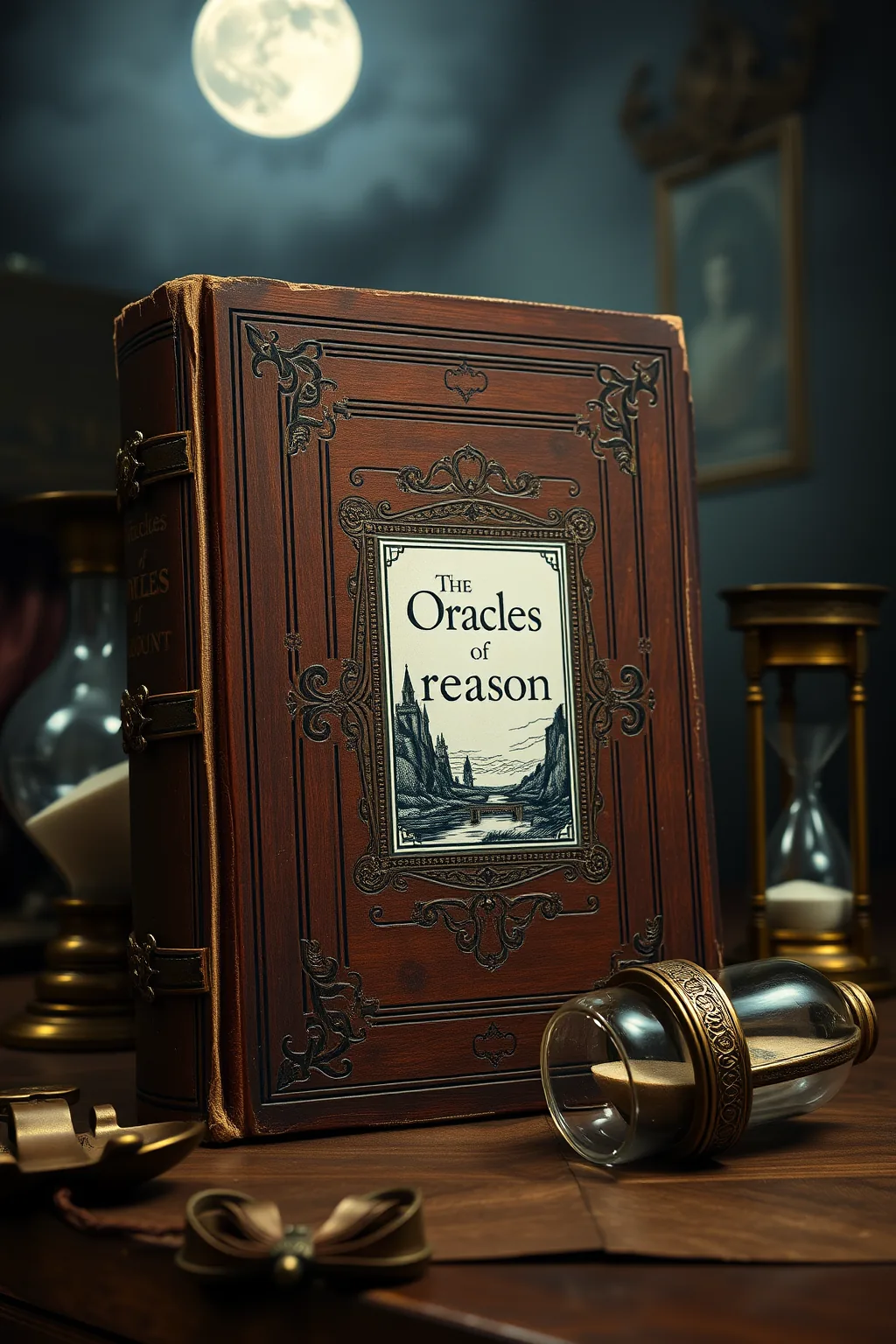
The oracles of reason
 62
62

The oracles of reason



Ophelia Vance, Mystical Literature Reviewer: Charles Blount's "The Oracles of Reason" is a beacon of intellectual light, illuminating the path from blind faith to profound insight. This work stands as a testament to the power of rational inquiry in unlocking esoteric truths. Blount masterfully dissects theological dogma, revealing the underlying currents of natural law and the inherent wisdom accessible through empirical observation and logical deduction. It is a vital read for scholars of Enlightenment philosophy and seekers of deistic wisdom, offering a compelling argument for the divine presence within the natural order. Its strength lies in its unwavering commitment to reason as the ultimate oracle, guiding us towards a more authentic spiritual understanding.
📝 Description
62
Charles Blount's 1693 work, 'The Oracles of Reason,' challenges religious dogma with rational inquiry.
Published in 1693, Charles Blount's 'The Oracles of Reason' directly confronts established religious beliefs by advocating for intellectual clarity. Blount argues that true understanding of the divine and the universe arises from human reason, not from inherited dogma or scripture. He invites readers to examine the natural world as a manifestation of rational principles, suggesting that divinity is observable and discernible through careful thought. The book positions itself against blind faith, promoting a path to knowledge through rigorous analysis and personal introspection.
This work is for those who seek to question received truths and find meaning through a more empirical and logical approach to existence. Blount's arguments aim to free the mind from the constraints of unexamined doctrines, encouraging a personal discovery of cosmic order. It is a call to intellectual self-reliance, proposing that the universe is a system of interconnected laws accessible to the thinking individual.
Published in the late 17th century, 'The Oracles of Reason' emerged during a period of significant intellectual ferment in England. While not strictly an esoteric text in the vein of Hermeticism or Kabbalah, it participated in a broader shift towards rationalism and natural philosophy that influenced many esoteric traditions. Blount's emphasis on reason as a path to understanding the divine resonated with certain currents of deism and freethought, which sought to find God through the observation of nature rather than through miraculous revelation. This approach positioned him alongside thinkers who, while often operating outside orthodox religious structures, still sought a rational framework for spiritual or philosophical understanding.
💡 Why Read This Book?
Uncover the roots of rational mysticism and deistic thought. "The Oracles of Reason" offers a rare opportunity to engage with a foundational text that bridges philosophical inquiry and spiritual seeking. Ideal for scholars of early modern thought, practitioners of natural magic, and any individual drawn to the concept of a divinely ordered universe accessible through intellect. Discover how reason itself can become a sacred oracle, revealing profound truths about existence.
⭐ Reader Reviews
Honest opinions from readers who have explored this book.
❓ Frequently Asked Questions
What is the primary focus of "The Oracles of Reason"?
The book primarily focuses on advocating for reason and natural philosophy as the most reliable means of understanding the divine and the universe, challenging traditional religious dogma through logical argument.
Who was Charles Blount?
Charles Blount (1654–1693) was an English deist and freethinker, known for his controversial writings that questioned religious authority and promoted rationalism.
What is Deism?
Deism is a philosophical belief that posits the existence of a creator deity, but who does not intervene in the universe, allowing it to operate according to natural laws.
Is this book suitable for beginners in philosophy?
While Blount's arguments are rigorous, the book's historical context and language may present a challenge for absolute beginners. However, for those with a budding interest in rational thought and philosophy, it offers a rewarding, albeit demanding, entry point.
What esoteric traditions does this book touch upon?
It touches upon the esoteric tradition of seeking divine knowledge through natural observation and rational inquiry, a cornerstone of early Deism and certain Hermetic philosophies that emphasize the 'book of nature'.
🔮 Key Themes & Symbolism
The Oracle of Reason
This theme explores Blount's central thesis: that human reason, guided by observation of the natural world, serves as a superior and more authentic 'oracle' than revealed scripture or ecclesiastical authority. It posits that the universe itself is a text imbued with divine logic, accessible through critical thought and empirical evidence. This perspective challenges the notion of divine intervention and supernatural revelation, instead championing an immanent divinity discoverable through intellectual pursuit and a deep understanding of natural laws.
Critique of Religious Dogma
Blount systematically deconstructs the tenets of established religions, particularly Christianity, highlighting perceived contradictions, historical inaccuracies, and the use of dogma to suppress intellectual freedom. He argues that blind adherence to doctrine obscures the true, rational nature of the divine. This critical examination aims to liberate individuals from the constraints of blind faith, encouraging them to seek truth independently rather than accepting pronouncements from religious institutions without question.
The Book of Nature
Central to Blount's philosophy is the concept of the 'Book of Nature' – the observable universe as a source of divine truth. He advocates for studying the cosmos, its inhabitants, and its laws as the primary means of discerning God's will and nature. This theme emphasizes a pantheistic or panentheistic leaning, where the divine is not separate from creation but is intrinsically woven into its very fabric, waiting to be understood through rational observation and scientific inquiry.
💬 Memorable Quotes
Direct passages from the work, attributed to the author.
“Reason is the light by which we see.”
— Here, reason is elevated to a divine illumination, the essential tool for discerning truth and understanding the world, replacing or augmenting traditional sources of spiritual guidance.
“Where reason fails, faith begins, and so does error.”
— This powerful statement directly critiques blind faith, suggesting that it arises from a deficit of reason and is therefore a pathway to falsehood and misunderstanding.
“The universe speaks to us in the language of laws.”
— This highlights the order and predictability inherent in the cosmos, suggesting that understanding these natural laws is akin to understanding divine intent and communication.
“To know God is to know His works.”
— This aphorism underscores the Deist principle that understanding the creator is achieved through diligent study and appreciation of the creation, rather than through mystical revelation or dogma.
💡 Key Ideas
Editorial paraphrase of the work's core concepts — not direct quotes.
The Book of Nature is written by the finger of God.
This quote signifies that the universe, observable through our senses and intellect, is a direct revelation from the divine, containing divine truth accessible to all.
🌙 Esoteric Significance
Tradition
This work is deeply rooted in the esoteric tradition of Hermeticism and natural philosophy, which seeks to understand the divine through the study of the cosmos and its inherent laws. Blount draws upon the principle of 'as above, so below,' interpreting the rational order of the universe as a reflection of divine intelligence. It aligns with Neoplatonic ideas of emanation and the search for ultimate truth through intellectual ascent, positioning reason as the key to unlocking these hidden divine principles.
Symbolism
While not overtly symbolic in the manner of alchemical texts, Blount's work uses the 'Book of Nature' as its primary symbolic metaphor. The natural world—stars, planets, flora, fauna—becomes a divine text, its intricate workings and predictable laws representing the divine will and intelligence. Reason, in turn, is symbolized as a pure, unadulterated light, capable of useful the hidden meanings within this natural text, stripping away the obscuring shadows of dogma and superstition.
Modern Relevance
In an age still grappling with the tension between faith and reason, Blount's "The Oracles of Reason" offers a compelling perspective on finding spiritual meaning through intellectual exploration and the observation of the natural world. Its emphasis on critical thinking and the inherent order of the universe appeals to modern scientific and philosophical discourse, providing a historical lens through which to view contemporary debates on cosmology, consciousness, and the nature of reality. It encourages a holistic view of divinity, integrated within the fabric of existence.
👥 Who Should Read This Book
This profound text is essential for scholars of the Enlightenment, particularly those interested in the development of Deism and rational theology. Seekers of spiritual wisdom who believe in a divinely ordered universe but question traditional religious dogma will find Blount's arguments compelling. Practitioners of nature-based spiritualities and those who resonate with the 'Book of Nature' philosophy will appreciate its foundational arguments. For the intellectually curious, "The Oracles of Reason" offers a rigorous yet rewarding journey into the heart of reasoned spirituality, challenging preconceived notions and inspiring a deeper connection with the cosmos.
📜 Historical Context
Penned during the tumultuous intellectual range of the late 17th century, "The Oracles of Reason" emerged from the burgeoning Enlightenment, a period marked by a profound shift towards empiricism, rationalism, and skepticism towards traditional religious authority. Charles Blount, a key figure in early English Deism, penned this work as a direct challenge to the prevailing theological orthodoxies, particularly those of the Church of England. The era was characterized by intense philosophical debate, the rise of scientific inquiry, and a growing desire for intellectual autonomy. Blount's arguments, though controversial and leading to his persecution, resonated with a growing movement seeking a more natural, reasoned, and less dogmatic approach to spirituality, laying groundwork for future philosophical and religious reform movements.
📔 Journal Prompts
Reflect on a time when reason led you to a profound personal truth that differed from societal or religious expectations.
Consider the 'Book of Nature' around you. What 'divine laws' or patterns can you discern in its workings today?
How might Charles Blount define 'faith' in the context of modern scientific discovery?
If reason is the light, what are the 'shadows' that obscure your understanding of the world or the divine?
Write a letter to Charles Blount, sharing your thoughts on the enduring relevance of his 'Oracles of Reason' in the 21st century.
🗂️ Glossary
Deism
A philosophical belief in a creator deity who does not intervene in the universe, allowing it to operate according to natural laws discoverable by reason.
Rationalism
A philosophical approach that emphasizes reason as the primary source of knowledge and justification, often contrasted with empiricism or faith.
Dogma
A set of principles or tenets laid down by an authority as incontrovertibly true, often associated with religious or political doctrines.
Natural Philosophy
An archaic term for the study of nature and the physical universe, often encompassing what we now consider physics, astronomy, and biology.
Empiricism
The theory that all knowledge is derived from sense experience, observation, and experimentation, often a complement to rationalist inquiry.
This book appears in 1 collection
🔮 Readers Also Liked
Browse all →








From the “Divination” Collection
View all →









More Free Divination & Tarot Books
View all →