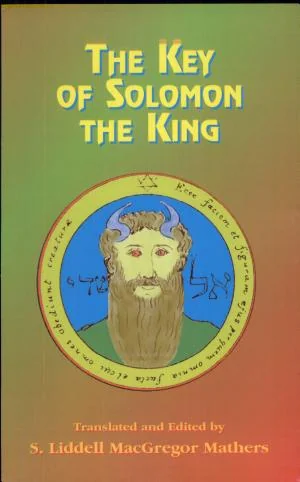
The Key of Solomon the King
 71
71

The Key of Solomon the King
Mathers' translation of *The Key of Solomon* remains a pivotal text for understanding the mechanics of grimoire magic, offering a structured approach to what can otherwise seem chaotic. The meticulous detail concerning the preparation of tools, the astrological considerations for timing rituals, and the specific conjurations are its undeniable strengths. For instance, the detailed instructions for creating the 'wand of art' or the 'pentacle' provide tangible steps for the practitioner. However, the work's inherent challenge lies in its dense, archaic language and the sheer complexity of its procedures, which can be daunting for newcomers. A passage detailing the preparation for the 'Grand Conjuration' requires significant commitment and understanding of esoteric principles. While invaluable for its historical and practical content, it demands a dedicated reader willing to grapple with its historical context and intricate demands. It serves as a crucial, if demanding, gateway to classical ceremonial magic.
📝 Description
71
S. Liddell MacGregor Mathers published his translation of The Key of Solomon the King in 1889.
The Key of Solomon the King, or Clavicula Salomonis, is a significant grimoire detailing ceremonial magic. Mathers' 1889 edition compiles ancient manuscripts from the British Museum, purporting to contain King Solomon's instructions for spirit invocation, celestial influence understanding, and magical operations. The book systematically outlines sympathetic magic principles, stressing astrological timing, ritual purity, and specific implements. It instructs on creating magical tools, reciting conjurations and prayers, and the necessary magician's attire and fasting. The text also covers constructing talismans and summoning various spirit classes for different aims.
This work is directed toward serious practitioners of Western esotericism, especially those involved with ceremonial magic, Kabbalah, and Renaissance occultism. Scholars of comparative religion and magical history will find it valuable for understanding grimoire tradition development. Adepts seeking direct engagement with classical texts on spirit invocation and planetary magic will discover detailed procedures within its pages.
Compiled in the late 19th century during a surge of occult interest, this grimoire links modern practitioners to older magical traditions. Mathers, a key figure in the Hermetic Order of the Golden Dawn, translated and published these 15th and 16th century manuscripts. The Golden Dawn itself incorporated principles from such texts into its own magical system. This publication provided access to esoteric knowledge previously confined to obscure handwritten documents, making classical ceremonial magic more accessible.
💡 Why Read This Book?
• Learn the specific correspondences and astrological timings Mathers outlines for invoking planetary intelligences, offering a structured approach to celestial magic beyond general astrological principles. • Understand the detailed methodology for creating magical implements, such as the 'wand of art' or the 'pentacle', providing practical insight into the construction of sacred tools. • Engage directly with classical conjurations and orations attributed to King Solomon, allowing for a historical perspective on the language and intent behind ancient spirit invocation.
⭐ Reader Reviews
Honest opinions from readers who have explored this book.
❓ Frequently Asked Questions
When was the original *Key of Solomon* believed to have been written?
While S. Liddell MacGregor Mathers published his translation in 1889, the manuscripts that form the basis of *The Key of Solomon* date primarily from the 15th and 16th centuries, reflecting Renaissance-era occultism.
What is the significance of S. Liddell MacGregor Mathers?
Mathers was a prominent 19th-century occultist and a co-founder of the Hermetic Order of the Golden Dawn. His translation and editing of *The Key of Solomon* made this influential grimoire accessible to a wider audience interested in ceremonial magic.
Does this book provide a step-by-step guide for beginners?
While it contains detailed instructions, the book is highly complex and assumes a degree of prior knowledge in magical theory, ritual practice, and symbolism. It is best approached by those with some background in esotericism.
What kind of spirits are discussed in *The Key of Solomon*?
The text details methods for conjuring various spiritual entities, including angels, planetary intelligences, and other classes of spirits, often categorized by their function or dominion.
What role do astrological timings play in the rituals?
Astrology is central. The book specifies precise days, hours, and planetary alignments considered necessary for the success of particular conjurations and operations, linking celestial events to earthly magical work.
Are the rituals described in the book safe to perform?
The book describes powerful magical operations. Practitioners should exercise extreme caution, thorough research, and understand the ethical and energetic implications before attempting any rituals, as they involve confronting potentially challenging spiritual forces.
🔮 Key Themes & Symbolism
Spirit Invocation and Control
The core of *The Key of Solomon* lies in its detailed instructions for summoning and commanding spiritual entities. It outlines specific conjurations, prayers, and the use of divine names to compel spirits to appear and obey the magician's will. The text categorizes these entities, specifying their purported domains and the methods for their manifestation, emphasizing the magician's authority derived from divine sanction.
Astrological Timing and Planetary Magic
Celestial mechanics are paramount. The book meticulously details the importance of selecting specific astrological hours, days, and planetary configurations for each magical operation. This emphasizes a worldview where the microcosm (human ritual) is intrinsically linked to the macrocosm (planetary forces), requiring precise alignment for efficacy.
Ritual Purity and Preparation
Success in the operations described hinges on the magician's state of being. Extensive purification rituals, including fasting, bathing, and the wearing of specific robes, are mandated. The preparation and consecration of magical tools, such as wands, pentacles, and the sword, are also crucial steps, imbuing them with the necessary spiritual potency.
Divine Authority and Names
The text frequently invokes the power of God and divine names (e.g., Tetragrammaton) as the ultimate source of authority for the magician. The efficacy of the conjurations relies on the belief that the magician acts as an intermediary, wielding divine power to influence the spiritual and material realms.
💬 Memorable Quotes
Direct passages from the work, attributed to the author.
“The Book of the most Ancient and Learned King Solomon, concerning the wonderful and secret arts, by the practice whereof Men may attain to the highest Wisdom and perfect knowledge of all things.”
— This opening statement frames the grimoire not merely as a collection of spells, but as a path to profound wisdom and gnosis, attributed to King Solomon, positioning it as a source of ultimate understanding.
“Concerning the preparation of the Magical Instruments.”
— This signifies the book's practical, operative nature. It stresses that the tools of magic are not symbolic but require specific crafting and consecration to function effectively in ritual.
“The choice of the time is of great importance.”
— A core tenet of the work, this highlights the necessity of astrological timing. The book guides the practitioner to align their operations with favorable celestial influences for maximum potency and desired outcome.
“Thou shalt make a new coat, of fine linen, and pure white.”
— This instruction regarding the magician's attire underscores the theme of purity and separation from the mundane. The robe is a consecrated garment, marking the practitioner's transition into the sacred space of ritual.
“When thou shalt begin to work, thou shalt first pray unto God.”
— This emphasizes the spiritual foundation of the magic. The text directs the practitioner to seek divine assistance and legitimacy before engaging in the more complex operations of conjuration.
🌙 Esoteric Significance
Tradition
This work is a central to Western Ceremonial Magic, deeply rooted in the Hermetic and Kabbalistic traditions prevalent during the Renaissance. It represents a significant transmission of operative magic, aiming not just for theoretical understanding but for practical results through structured ritual and invocation, fitting within the lineage of grimoires.
Symbolism
Key symbols include the Pentacle, used for protection and invocation, often inscribed with divine names and sigils; the Wand of Art, symbolizing the magician's will and authority; and the Circle, representing a consecrated space of safety and power where the magician stands protected while interacting with spirits.
Modern Relevance
Contemporary practitioners of Western Esotericism, particularly those within Golden Dawn-derived traditions or independent ceremonial magicians, continue to study and utilize *The Key of Solomon*. Its structured approach to planetary magic and spirit work informs modern magical systems and theoretical discussions on the nature of ritual efficacy.
👥 Who Should Read This Book
• Students of Renaissance occultism seeking primary source material on magical theory and practice from the period. • Aspiring ceremonial magicians interested in the historical foundations of Western ritual magic and spirit invocation. • Scholars of comparative religion and esoteric history looking to understand the transmission and evolution of grimoire traditions.
📜 Historical Context
The late 19th century saw a surge in occultism, with figures like S. Liddell MacGregor Mathers playing an important role. Mathers' 1889 translation of *The Key of Solomon the King* tapped into this renewed interest, offering a version of a text whose manuscripts predominantly date to the 15th and 16th centuries. This period, the Renaissance, was a fertile ground for Hermeticism, Kabbalah, and Neoplatonism, all of which inform the grimoire's structure and content. Mathers himself was instrumental in the Hermetic Order of the Golden Dawn, an organization that heavily utilized and adapted material from such grimoires, integrating them into its own system. While earlier translations existed, Mathers' edition, drawing from British Museum manuscripts, became particularly influential, contrasting with the more purely scholarly, less 'operative' approaches to ancient texts emerging at the time.
📔 Journal Prompts
The specific conjurations detailed for the spirits of Jupiter.
The preparation procedures for the 'wand of art'.
The symbolic significance of the Pentacle in planetary operations.
The required fasting and purification rituals before a Grand Conjuration.
The attribution of specific divine names to different spiritual entities.
🗂️ Glossary
Grimoire
A textbook of magic, typically containing instructions on how to create magical tools, perform rituals, and summon spirits. *The Key of Solomon* is a famous example.
Conjuration
A formal invocation or summoning, often through prayer or incantation, directed at a spiritual entity. The book contains numerous specific conjurations.
Pentacle
A magical disc, often inscribed with symbols, names, or sigils, used for protection, invocation, or as a focus in ritual magic. Specific pentacles are detailed in the text.
Tetragrammaton
The four-letter Hebrew name of God (YHWH), frequently used in magical texts, including this one, as a powerful divine name for invocation and protection.
Planetary Magic
A branch of magic that works with the energies and correspondences associated with the seven classical planets (Sun, Moon, Mercury, Venus, Mars, Jupiter, Saturn).
Sigil
A symbol or magical sign, often created through a specific process, believed to hold or channel spiritual power or intent. The book describes the creation of various sigils.
Fasting
Abstaining from food and drink for a period, undertaken as a ritual purification to prepare the body and mind for magical work.
This book appears in 1 collection
🔮 Readers Also Liked
Browse all →









From the “Occultism” Collection
View all →



More Free Occult Philosophy Books
View all →